

University College, Oxford (must see)
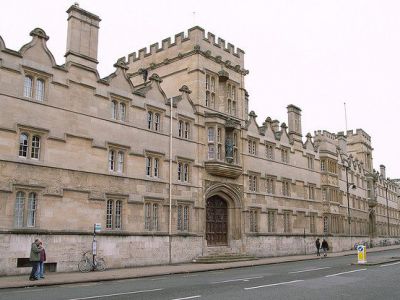
University College, usually known simply as “Univ,” stands on Oxford’s High Street and is often regarded as Oxford’s oldest college. A long-standing legend claimed that it was founded by King Alfred in 872, but its real origins lie in a bequest made in 1249 by William of Durham, who left money to support masters of arts studying theology at Oxford.
Very little survives from the medieval college. Much of what visitors see today belongs to later phases of rebuilding, and inside, the college offers an evocative collection of architectural styles. The Main Quad, begun in 1634 and completed in 1676, forms the historic core, while the Radcliffe Quad followed in 1719, the New Building in 1842, and the Library in 1861.
The central entrance area is located within the main gatehouse on High Street, which marks the transition from the busy city into a quieter academic setting. To find the first highlight, stand directly under the tower at the main entrance and look up to see the 17th-century fan vaulting. Once you find yourself beneath the stone canopy, look for the intricate “ribs” of the masonry that meet at a central point, showcasing the late Gothic style that persisted in Oxford long after it had faded elsewhere.
Visitors can then pass into enclosed spaces that feel quieter and more private than the street outside. One distinctive feature is Logic Lane, a cobbled passage that divides the college and is crossed by a short covered bridge. The lane is believed to have been associated with schools or teaching rooms where logic was studied, one of the core subjects in the medieval university curriculum. Earlier, however, it had a more practical name. In the 13th and 14th centuries, it was known as Horseman Lane or Horsemull Lane, probably because a horse-powered mill once stood nearby.
Further into the grounds, a dedicated shrine reflects a curious piece of the college’s literary history. The college is known for the Shelley Memorial, housed in a small domed room built in 1892. To reach this highlight, walk toward the corner of the Front Quad near the High Street; once you find yourself inside the dim, atmospheric chamber, look for Edward Onslow Ford’s white marble sculpture of writer and poet Percy Bysshe Shelley. Notice the realistic details of the poet lying on an Italian shore, which contrast sharply with the dark bronze base.
Shelley studied at Univ but was expelled in 1811 after publishing The Necessity of Atheism. Over time, however, the solemn memorial became the target of student humour; at one point, the room was reportedly filled with water and goldfish.
University College has strong connections with notable figures, including British prime ministers Clement Attlee and Harold Wilson, U.S. President Bill Clinton, physicist Stephen Hawking, and C. S. Lewis.
Very little survives from the medieval college. Much of what visitors see today belongs to later phases of rebuilding, and inside, the college offers an evocative collection of architectural styles. The Main Quad, begun in 1634 and completed in 1676, forms the historic core, while the Radcliffe Quad followed in 1719, the New Building in 1842, and the Library in 1861.
The central entrance area is located within the main gatehouse on High Street, which marks the transition from the busy city into a quieter academic setting. To find the first highlight, stand directly under the tower at the main entrance and look up to see the 17th-century fan vaulting. Once you find yourself beneath the stone canopy, look for the intricate “ribs” of the masonry that meet at a central point, showcasing the late Gothic style that persisted in Oxford long after it had faded elsewhere.
Visitors can then pass into enclosed spaces that feel quieter and more private than the street outside. One distinctive feature is Logic Lane, a cobbled passage that divides the college and is crossed by a short covered bridge. The lane is believed to have been associated with schools or teaching rooms where logic was studied, one of the core subjects in the medieval university curriculum. Earlier, however, it had a more practical name. In the 13th and 14th centuries, it was known as Horseman Lane or Horsemull Lane, probably because a horse-powered mill once stood nearby.
Further into the grounds, a dedicated shrine reflects a curious piece of the college’s literary history. The college is known for the Shelley Memorial, housed in a small domed room built in 1892. To reach this highlight, walk toward the corner of the Front Quad near the High Street; once you find yourself inside the dim, atmospheric chamber, look for Edward Onslow Ford’s white marble sculpture of writer and poet Percy Bysshe Shelley. Notice the realistic details of the poet lying on an Italian shore, which contrast sharply with the dark bronze base.
Shelley studied at Univ but was expelled in 1811 after publishing The Necessity of Atheism. Over time, however, the solemn memorial became the target of student humour; at one point, the room was reportedly filled with water and goldfish.
University College has strong connections with notable figures, including British prime ministers Clement Attlee and Harold Wilson, U.S. President Bill Clinton, physicist Stephen Hawking, and C. S. Lewis.
Want to visit this sight? Check out these Self-Guided Walking Tours in Oxford. Alternatively, you can download the mobile app "GPSmyCity: Walks in 1K+ Cities" from Apple App Store or Google Play Store. The app turns your mobile device to a personal tour guide and it works offline, so no data plan is needed when traveling abroad.
Download The GPSmyCity App



University College on Map
Sight Name: University College
Sight Location: Oxford, England (See walking tours in Oxford)
Sight Type: Attraction/Landmark
Guide(s) Containing This Sight:
Sight Location: Oxford, England (See walking tours in Oxford)
Sight Type: Attraction/Landmark
Guide(s) Containing This Sight:
Nearby Sights

Walking Tours in Oxford, England

Create Your Own Walk in Oxford
Creating your own self-guided walk in Oxford is easy and fun. Choose the city attractions that you want to see and a walk route map will be created just for you. You can even set your hotel as the start point of the walk.

Harry Potter Walk in Oxford
Oxford’s connection with Harry Potter rests on a simple fact: the city already looked like Hogwarts before the cameras arrived. Long before it became associated with wands, robes, and moving staircases, Oxford was known for its medieval colleges, vaulted halls, cloisters, libraries, and enclosed quadrangles. For the filmmakers, it offered a real academic setting that needed little alteration to... view more
Tour Duration: 1 Hour(s)
Travel Distance: 1.0 Km or 0.6 Miles
Tour Duration: 1 Hour(s)
Travel Distance: 1.0 Km or 0.6 Miles
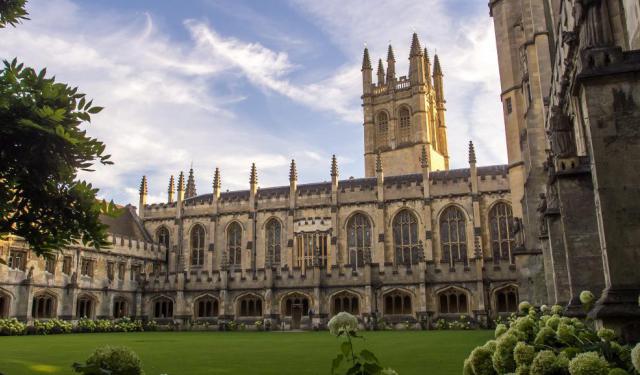
Colleges of Oxford University
During an 1862 summer boat ride along the River Thames, Oxford writer Lewis Carroll invented a fantastical story for Alice, the daughter of the dean of Christ Church, Oxford. That tale would later become Alice's Adventures in Wonderland.
Oxford’s colleges are the heart of the city’s identity, forming one of the oldest and most influential university communities in the world. Their... view more
Tour Duration: 1 Hour(s)
Travel Distance: 1.5 Km or 0.9 Miles
Oxford’s colleges are the heart of the city’s identity, forming one of the oldest and most influential university communities in the world. Their... view more
Tour Duration: 1 Hour(s)
Travel Distance: 1.5 Km or 0.9 Miles
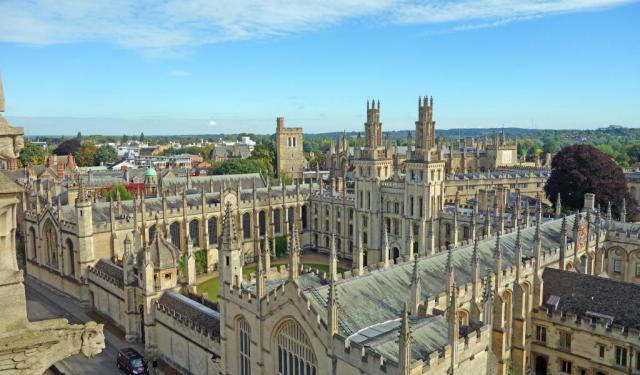
Oxford Introduction Walking Tour
Writer Oscar Wilde, who studied at Magdalen College, Oxford, once remarked that Oxford gave him “the most wonderful years” of his youth.
The city of Oxford has one of the longest and most layered histories in England. Its name comes from the Old English Oxenaforda, meaning “ford of the oxen,” referring to a shallow river crossing where cattle could pass through the water. This crossing... view more
Tour Duration: 2 Hour(s)
Travel Distance: 3.5 Km or 2.2 Miles
The city of Oxford has one of the longest and most layered histories in England. Its name comes from the Old English Oxenaforda, meaning “ford of the oxen,” referring to a shallow river crossing where cattle could pass through the water. This crossing... view more
Tour Duration: 2 Hour(s)
Travel Distance: 3.5 Km or 2.2 Miles