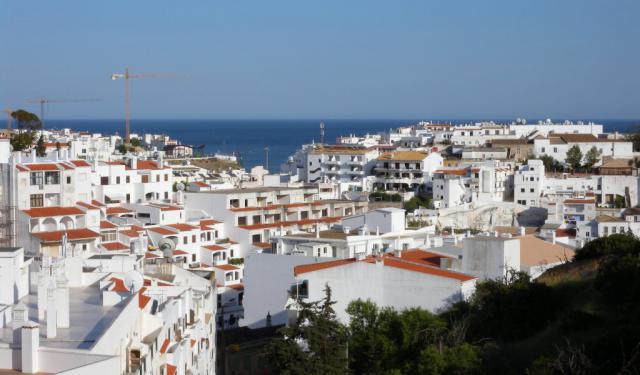


Albufeira Introduction Walking Tour (Self Guided), Albufeira
Albufeira is one of the Algarve’s oldest settlements, its history closely tied to the coast, fishing, and successive waves of conquest. The town’s name derives from the Arabic al-Buḥayra, meaning “the lagoon” or “the small sea,” a reference to the sheltered waters and coastal inlets that once defined the area.
Long before the arrival of the Moors, the region was inhabited by prehistoric communities and later influenced by Phoenician traders navigating the Atlantic coast. Under Roman rule, nearby coastal settlements supported fishing, agriculture, and maritime trade, though Albufeira itself remained a modest outpost rather than a major port. Archaeological traces suggest Roman villas and fish-processing activities in the surrounding area.
From the 8th century onward, Albufeira became part of al-Andalus, developing into a fortified hilltop town overlooking the sea. Agriculture, fishing, and coastal trade sustained the town, while its natural harbour provided shelter for small vessels.
In 1249, Albufeira was taken by Portuguese forces during the Christian Reconquest under King Afonso III. Unlike some Algarve towns that rapidly expanded afterward, Albufeira remained relatively small and economically modest. Its population continued to rely mainly on fishing, salt production, and small-scale agriculture, while the old Moorish layout still defined daily life.
The town suffered repeated hardships in the early modern period. Pirate raids along the Algarve coast posed constant threats, and in 1755 the catastrophic earthquake and tsunami devastated Albufeira almost entirely, killing much of the population and destroying large sections of the town. Reconstruction was slow, and for centuries Albufeira remained a quiet community with limited regional influence.
Only in the second half of the 20th century did Albufeira undergo dramatic change. Tourism altered the town’s fate, transforming its whitewashed houses, beaches, and cliffs into one of Portugal’s most visited destinations. Despite this transformation, the historic centre still preserves traces of its layered past, from Moorish street patterns to post-earthquake rebuilding.
Walking through Albufeira’s old town leads you along narrow, sloping streets shaped by Moorish planning, opening onto small squares such as Old Town Square and lined with whitewashed houses trimmed with stone and tile. The route passes the Clock Tower, traditional churches, and viewpoints above Fishermen’s Beach. Cafés, local shops, and terraces line the way, while frequent glimpses of cliffs, sand, and Atlantic water anchor the town firmly to its coastal setting.
After centuries of survival and reinvention, Albufeira stands ready to be explored-not as a polished façade, but as a town shaped by resilience, memory, and the sea.
Long before the arrival of the Moors, the region was inhabited by prehistoric communities and later influenced by Phoenician traders navigating the Atlantic coast. Under Roman rule, nearby coastal settlements supported fishing, agriculture, and maritime trade, though Albufeira itself remained a modest outpost rather than a major port. Archaeological traces suggest Roman villas and fish-processing activities in the surrounding area.
From the 8th century onward, Albufeira became part of al-Andalus, developing into a fortified hilltop town overlooking the sea. Agriculture, fishing, and coastal trade sustained the town, while its natural harbour provided shelter for small vessels.
In 1249, Albufeira was taken by Portuguese forces during the Christian Reconquest under King Afonso III. Unlike some Algarve towns that rapidly expanded afterward, Albufeira remained relatively small and economically modest. Its population continued to rely mainly on fishing, salt production, and small-scale agriculture, while the old Moorish layout still defined daily life.
The town suffered repeated hardships in the early modern period. Pirate raids along the Algarve coast posed constant threats, and in 1755 the catastrophic earthquake and tsunami devastated Albufeira almost entirely, killing much of the population and destroying large sections of the town. Reconstruction was slow, and for centuries Albufeira remained a quiet community with limited regional influence.
Only in the second half of the 20th century did Albufeira undergo dramatic change. Tourism altered the town’s fate, transforming its whitewashed houses, beaches, and cliffs into one of Portugal’s most visited destinations. Despite this transformation, the historic centre still preserves traces of its layered past, from Moorish street patterns to post-earthquake rebuilding.
Walking through Albufeira’s old town leads you along narrow, sloping streets shaped by Moorish planning, opening onto small squares such as Old Town Square and lined with whitewashed houses trimmed with stone and tile. The route passes the Clock Tower, traditional churches, and viewpoints above Fishermen’s Beach. Cafés, local shops, and terraces line the way, while frequent glimpses of cliffs, sand, and Atlantic water anchor the town firmly to its coastal setting.
After centuries of survival and reinvention, Albufeira stands ready to be explored-not as a polished façade, but as a town shaped by resilience, memory, and the sea.
How it works: Download the app "GPSmyCity: Walks in 1K+ Cities" from Apple App Store or Google Play Store to your mobile phone or tablet. The app turns your mobile device into a personal tour guide and its built-in GPS navigation functions guide you from one tour stop to next. The app works offline, so no data plan is needed when traveling abroad.
Albufeira Introduction Walking Tour Map
Guide Name: Albufeira Introduction Walking Tour
Guide Location: Portugal » Albufeira (See other walking tours in Albufeira)
Guide Type: Self-guided Walking Tour (Sightseeing)
# of Attractions: 9
Tour Duration: 2 Hour(s)
Travel Distance: 2.5 Km or 1.6 Miles
Author: hollyg
Sight(s) Featured in This Guide:
Guide Location: Portugal » Albufeira (See other walking tours in Albufeira)
Guide Type: Self-guided Walking Tour (Sightseeing)
# of Attractions: 9
Tour Duration: 2 Hour(s)
Travel Distance: 2.5 Km or 1.6 Miles
Author: hollyg
Sight(s) Featured in This Guide:
- Old Town Square
- Cândido dos Reis Street
- Praia dos Pescadores (Fishermen's Beach)
- Archaeological Museum
- Clock Tower
- Igreja Matriz (Parish Church)
- Saint Anne Church
- San Vicente de Albufeira Statue
- Albufeira Marina
1) Old Town Square (must see)
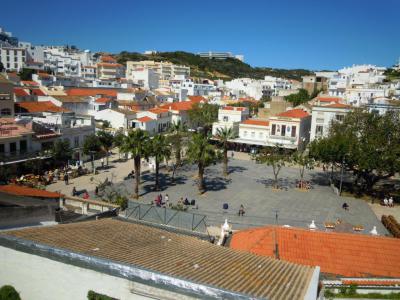
Old Town Square is the social and symbolic heart of Albufeira’s historic centre. It developed organically from the medieval fabric of the town, shaped by Moorish urban planning that favoured compact streets opening into small communal spaces rather than grand plazas. Although its present form is relatively open, the square still sits within a dense web of sloping lanes that reflect the town’s earlier defensive and residential layout.
Following the devastating earthquake and tsunami of 1755, much of Albufeira had to be rebuilt almost from scratch. Old Town Square emerged as a focal point during this reconstruction, framed by whitewashed buildings, modest civic structures, and nearby churches. Many of the surrounding façades feature traditional tile wall designs and iron balconies often laden with flowers, lending the square a distinctly Algarvian character. Over time, it became a natural gathering place for markets, celebrations, and everyday social life, gradually replacing earlier informal meeting spots lost to destruction.
Today, Old Town Square functions as the town’s main open-air living room. Its broad paved surface allows space for public events, performances, and seasonal festivals, while cafés and restaurants around the perimeter remain active from morning through late evening. Shops lining the square offer a mix of goods, including beach toys, T-shirts, wines, and Portuguese liqueurs. One notable cultural stop is the free Art Gallery housed in a former power station, which mainly features works by Albufeira-born artist José Barros.
As night falls, the atmosphere shifts. The square becomes a starting point for bar-hopping among nearby pubs and music venues, a favourite pastime for many visitors. Despite this lively edge, Old Town Square retains its role as a central crossroads, offering clear views toward the Clock Tower and the streets leading down to Fishermen’s Beach, and anchoring daily life in Albufeira’s old town.
Old Town Square is an ideal place to pause and absorb Albufeira’s atmosphere. Street musicians, small craft stalls, and changing light on the surrounding façades create a lively yet relaxed setting.
Following the devastating earthquake and tsunami of 1755, much of Albufeira had to be rebuilt almost from scratch. Old Town Square emerged as a focal point during this reconstruction, framed by whitewashed buildings, modest civic structures, and nearby churches. Many of the surrounding façades feature traditional tile wall designs and iron balconies often laden with flowers, lending the square a distinctly Algarvian character. Over time, it became a natural gathering place for markets, celebrations, and everyday social life, gradually replacing earlier informal meeting spots lost to destruction.
Today, Old Town Square functions as the town’s main open-air living room. Its broad paved surface allows space for public events, performances, and seasonal festivals, while cafés and restaurants around the perimeter remain active from morning through late evening. Shops lining the square offer a mix of goods, including beach toys, T-shirts, wines, and Portuguese liqueurs. One notable cultural stop is the free Art Gallery housed in a former power station, which mainly features works by Albufeira-born artist José Barros.
As night falls, the atmosphere shifts. The square becomes a starting point for bar-hopping among nearby pubs and music venues, a favourite pastime for many visitors. Despite this lively edge, Old Town Square retains its role as a central crossroads, offering clear views toward the Clock Tower and the streets leading down to Fishermen’s Beach, and anchoring daily life in Albufeira’s old town.
Old Town Square is an ideal place to pause and absorb Albufeira’s atmosphere. Street musicians, small craft stalls, and changing light on the surrounding façades create a lively yet relaxed setting.
2) Cândido dos Reis Street
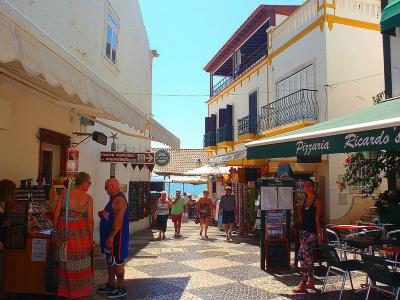
Cândido dos Reis Street is one of the main pedestrian arteries of Albufeira’s historic centre, linking the upper parts of the old town with Fisherman’s Beach below. Its sloping course follows the natural contours of the hillside, reflecting the medieval layout of the town, when streets were shaped more by topography and defence than by formal planning. In earlier centuries, this route connected residential areas with the shore and was used daily by fishermen, traders, and townspeople moving between the harbour and the town above.
The street takes its name from Admiral Cândido dos Reis, a key figure in the Revolution of 1910 that overthrew the Portuguese monarchy and established the Republic. On the night of 3 October 1910, he famously declared, “If there is one who fulfils his duty, this one will be me.” It is easy to imagine that he would be amused to see the lively shopping street that now bears his name.
Known locally as “Bar Street,” it is one of the liveliest stretches in the old town. During the day, it functions as a colourful shopping corridor, with exotic clothing and leather boutiques, original gift shops, and kiosks selling odds and ends not easily found elsewhere, creating something of a mini shopping safari. Many houses still display traditional tiled façades, while palm trees and festive, brightly coloured canopies provide welcome shade. As evening falls, cafés, restaurants, and bars take over, and the street becomes part of Albufeira’s nightlife circuit.
The street takes its name from Admiral Cândido dos Reis, a key figure in the Revolution of 1910 that overthrew the Portuguese monarchy and established the Republic. On the night of 3 October 1910, he famously declared, “If there is one who fulfils his duty, this one will be me.” It is easy to imagine that he would be amused to see the lively shopping street that now bears his name.
Known locally as “Bar Street,” it is one of the liveliest stretches in the old town. During the day, it functions as a colourful shopping corridor, with exotic clothing and leather boutiques, original gift shops, and kiosks selling odds and ends not easily found elsewhere, creating something of a mini shopping safari. Many houses still display traditional tiled façades, while palm trees and festive, brightly coloured canopies provide welcome shade. As evening falls, cafés, restaurants, and bars take over, and the street becomes part of Albufeira’s nightlife circuit.
3) Praia dos Pescadores (Fishermen's Beach)
Fishermen’s Beach lies at the foot of Albufeira’s old town and has long been central to the town’s identity. For centuries, this sheltered stretch of sand functioned as a working beach rather than a place of leisure. Small fishing boats were pulled directly onto the shore, and nets were mended on the sand.
The character of the beach began to change after the catastrophic earthquake and tsunami of 1755, which reshaped the coastline and destroyed much of the town above. Even so, fishing activity continued here for generations. Only in the second half of the 20th century, with the rise of tourism, did Fishermen’s Beach gradually transition into a recreational setting, becoming one of Albufeira’s most recognisable landmarks.
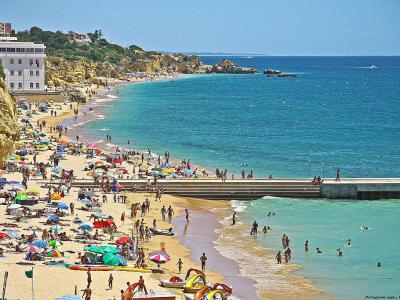
Today, Fishermen’s Beach is framed by an amphitheatre of multi-coloured houses to the west and a pier to the east. It is a large urban beach, stretching over 700 feet along the shoreline and expanding by roughly another 300 feet at low tide. Access is possible via several flights of steps from the old town, or more easily from the wide, paved 25th of April Square on the western edge of the beach. Bordering the sand is a lively tourist zone filled with shops, bars, and restaurants. Calm waters make the beach suitable for swimming, but as a city beach it is frequently crowded, especially in summer, while quieter beaches lie farther along the coast.
The character of the beach began to change after the catastrophic earthquake and tsunami of 1755, which reshaped the coastline and destroyed much of the town above. Even so, fishing activity continued here for generations. Only in the second half of the 20th century, with the rise of tourism, did Fishermen’s Beach gradually transition into a recreational setting, becoming one of Albufeira’s most recognisable landmarks.
Today, Fishermen’s Beach is framed by an amphitheatre of multi-coloured houses to the west and a pier to the east. It is a large urban beach, stretching over 700 feet along the shoreline and expanding by roughly another 300 feet at low tide. Access is possible via several flights of steps from the old town, or more easily from the wide, paved 25th of April Square on the western edge of the beach. Bordering the sand is a lively tourist zone filled with shops, bars, and restaurants. Calm waters make the beach suitable for swimming, but as a city beach it is frequently crowded, especially in summer, while quieter beaches lie farther along the coast.
4) Archaeological Museum
The Archaeological Museum offers a compact but revealing overview of the town’s long and layered past. It is housed in a former 19th-century municipal building near the historic centre which, while modest in appearance from the outside, is unexpectedly spacious once inside. The museum traces continuous human presence in the area from prehistory through the Roman and Islamic periods and into the early modern era.
Most of the exhibits were excavated by Father José Azevedo, an enthusiastic-though amateur-archaeologist who played a central role in preserving Albufeira’s material heritage. Azevedo collected artefacts from sites close to home, including the Castle of Paderne, a Roman villa at Retorta, the necropolis of Morgado da Lameira, and the Old Parish Church. Among the most notable pieces are an intact Roman mosaic and a Neolithic vase dated to around 5000 BCE.
The exhibition moves through prehistoric tools and early ceramics, followed by Roman-period amphorae and domestic objects linked to fishing and food production. Material from the Islamic period includes pottery and architectural fragments that help explain the Moorish layout of Albufeira’s old town. Artefacts from the Christian period after the Reconquest complete the historical sequence.
Spread across two floors overlooking the sea, the museum also includes areas dedicated to study, conservation, restoration, and storage, as well as a small library. Information sheets accompany each exhibit, printed in Portuguese, English, French, German, and Spanish, making the museum accessible to a wide range of visitors.
Most of the exhibits were excavated by Father José Azevedo, an enthusiastic-though amateur-archaeologist who played a central role in preserving Albufeira’s material heritage. Azevedo collected artefacts from sites close to home, including the Castle of Paderne, a Roman villa at Retorta, the necropolis of Morgado da Lameira, and the Old Parish Church. Among the most notable pieces are an intact Roman mosaic and a Neolithic vase dated to around 5000 BCE.
The exhibition moves through prehistoric tools and early ceramics, followed by Roman-period amphorae and domestic objects linked to fishing and food production. Material from the Islamic period includes pottery and architectural fragments that help explain the Moorish layout of Albufeira’s old town. Artefacts from the Christian period after the Reconquest complete the historical sequence.
Spread across two floors overlooking the sea, the museum also includes areas dedicated to study, conservation, restoration, and storage, as well as a small library. Information sheets accompany each exhibit, printed in Portuguese, English, French, German, and Spanish, making the museum accessible to a wide range of visitors.
5) Clock Tower (must see)
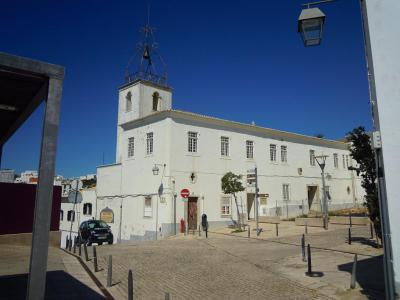
The Clock Tower of Albufeira is one of the most recognisable landmarks in the town’s historic centre and is often considered the town’s unofficial logo by local residents. Rising above the whitewashed houses near Old Town Square, it occupies a strategic high point that has been important since medieval times. The site itself was already significant during the Islamic period, when this elevated area formed part of the town’s defensive system, close to the Moorish walls.
The tower visible today dates mainly from the 18th century and was once part of a fortified hospital complex rebuilt after the catastrophic earthquake of 1755. Square in plan, the tower features a clock face and arched portals on each side. In the 19th century, the installation of the clock transformed it into a public timekeeper for the town, helping to regulate daily life.
The bell, which strikes every hour, sits within a wrought-iron framework crowning the tower. At night, this framework is outlined with lights, creating an especially striking sight against the dark sky. By walking around the base of the tower and looking south, you will be rewarded with an unobstructed view of Peneco Beach and the vast Atlantic Ocean. It is widely considered one of the best spots in the city for photography, especially during "golden hour" just before sunset.
Nearby, traces of earlier history remain visible. Close to the former hospital complex, a fenced-off area encloses the remains of two 12th-century Islamic houses, offering a glimpse into domestic life in Albufeira during its time as part of al-Andalus. More specifically, the remains are placed in the square between the Clock Tower and the Archeological Museum. The low, white fence surrounding the site is distinctive and somewhat unusual in appearance.
The Clock Tower and its bell can be seen from almost anywhere in the old town, making it both a natural landmark and a practical meeting point. “Meet me under the Tower with the Bell,” locals still say.
The tower visible today dates mainly from the 18th century and was once part of a fortified hospital complex rebuilt after the catastrophic earthquake of 1755. Square in plan, the tower features a clock face and arched portals on each side. In the 19th century, the installation of the clock transformed it into a public timekeeper for the town, helping to regulate daily life.
The bell, which strikes every hour, sits within a wrought-iron framework crowning the tower. At night, this framework is outlined with lights, creating an especially striking sight against the dark sky. By walking around the base of the tower and looking south, you will be rewarded with an unobstructed view of Peneco Beach and the vast Atlantic Ocean. It is widely considered one of the best spots in the city for photography, especially during "golden hour" just before sunset.
Nearby, traces of earlier history remain visible. Close to the former hospital complex, a fenced-off area encloses the remains of two 12th-century Islamic houses, offering a glimpse into domestic life in Albufeira during its time as part of al-Andalus. More specifically, the remains are placed in the square between the Clock Tower and the Archeological Museum. The low, white fence surrounding the site is distinctive and somewhat unusual in appearance.
The Clock Tower and its bell can be seen from almost anywhere in the old town, making it both a natural landmark and a practical meeting point. “Meet me under the Tower with the Bell,” locals still say.
6) Igreja Matriz (Parish Church)
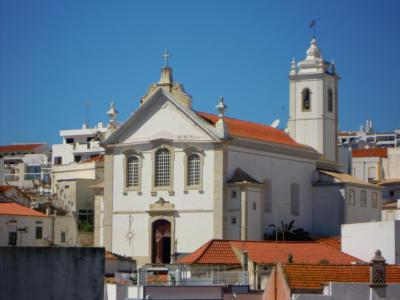
The Parish Church of Albufeira, also known as the Church of Our Lady of the Conception, is one of the town’s most significant religious landmarks, standing on elevated ground within the historic centre. An earlier church occupied this site during Moorish rule, and after the Christian Reconquest in 1249 it was adapted for Christian worship, becoming Albufeira’s principal parish church.
Severely damaged by the catastrophic earthquake and tsunami of 1755, the church was largely rebuilt in the late 18th and early 19th centuries. The result is a restrained Neoclassical structure with a simple whitewashed façade that conceals a richer interior. The church consists of a single nave, four side chapels, a choir, a baptistry, two pulpits, and side halls, reflecting a carefully ordered post-earthquake design. The bell tower dates from 1869 and rises to about 92 feet, housing a carillon of eight bells tuned to F major. A spiral staircase leads to the top.
Inside, gilded woodcarving and azulejo tile panels frame a space centred on the main altar, which was gilded in 1868 and crowned with a statue of the Immaculate Conception. The side chapels are dedicated to Saints Peter and Louis, Our Lady of Fátima, and the Sacred Heart of Jesus. In a niche, a Rococo painting by Albufeira artist Samora Barros depicts Our Lady of the Conception, while the presbytery contains two paintings by Álvaro Mota and Sousa illustrating scenes from the life and martyrdom of Saint Vincent.
Severely damaged by the catastrophic earthquake and tsunami of 1755, the church was largely rebuilt in the late 18th and early 19th centuries. The result is a restrained Neoclassical structure with a simple whitewashed façade that conceals a richer interior. The church consists of a single nave, four side chapels, a choir, a baptistry, two pulpits, and side halls, reflecting a carefully ordered post-earthquake design. The bell tower dates from 1869 and rises to about 92 feet, housing a carillon of eight bells tuned to F major. A spiral staircase leads to the top.
Inside, gilded woodcarving and azulejo tile panels frame a space centred on the main altar, which was gilded in 1868 and crowned with a statue of the Immaculate Conception. The side chapels are dedicated to Saints Peter and Louis, Our Lady of Fátima, and the Sacred Heart of Jesus. In a niche, a Rococo painting by Albufeira artist Samora Barros depicts Our Lady of the Conception, while the presbytery contains two paintings by Álvaro Mota and Sousa illustrating scenes from the life and martyrdom of Saint Vincent.
7) Saint Anne Church (must see)
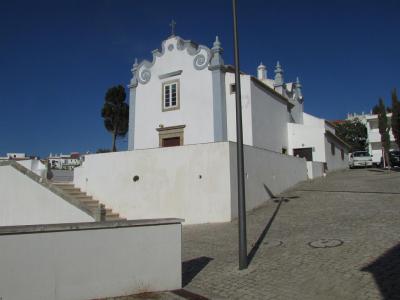
Saint Anne Church is one of Albufeira’s oldest surviving religious buildings and offers a quieter, more intimate counterpoint to the town’s main parish church. It stands slightly apart from the busiest areas of the old town.
The church was founded in the 13th century, shortly after the Christian Reconquest of the Algarve, making it one of the earliest Christian places of worship established in the town. Dedicated to Saint Anne, traditionally regarded as the protector of families and childbirth, it served a local devotional role rather than a grand civic one. Over the centuries, the building underwent several alterations, particularly following damage caused by earthquakes, including the catastrophic events of 1755.
Architecturally, Saint Anne Church is modest and restrained. The whitewashed exterior follows traditional Algarve religious forms, with clean lines and little ornamentation. Inside, it is a single-nave church with three chapels, creating a calm and almost village-like atmosphere. The main artistic focus is the Baroque altarpiece, painted blue with gilded details. You can find it by walking straight ahead from the entrance of the church. At the altarpiece's centre stands a statue of Saint Anne, flanked on the right by Saint Joseph and the Child Jesus, and on the left by Saint Joachim, Anne’s husband. This ensemble is thought to be the work of sculptors Francisco Xavier Guedelha and João Baptista. On your way to the altar look to your left and you'll see the late Baroque ornate pulpit. It is an elevated, carved wooden structure that is intricately "pointed in gold”.
Saint Anne Church is also closely linked to local tradition. Each year on 14 August, images of Mary and the Child Jesus from the church are carried in a boat procession, connecting the building’s quiet interior life with Albufeira’s long relationship with the sea.
The church was founded in the 13th century, shortly after the Christian Reconquest of the Algarve, making it one of the earliest Christian places of worship established in the town. Dedicated to Saint Anne, traditionally regarded as the protector of families and childbirth, it served a local devotional role rather than a grand civic one. Over the centuries, the building underwent several alterations, particularly following damage caused by earthquakes, including the catastrophic events of 1755.
Architecturally, Saint Anne Church is modest and restrained. The whitewashed exterior follows traditional Algarve religious forms, with clean lines and little ornamentation. Inside, it is a single-nave church with three chapels, creating a calm and almost village-like atmosphere. The main artistic focus is the Baroque altarpiece, painted blue with gilded details. You can find it by walking straight ahead from the entrance of the church. At the altarpiece's centre stands a statue of Saint Anne, flanked on the right by Saint Joseph and the Child Jesus, and on the left by Saint Joachim, Anne’s husband. This ensemble is thought to be the work of sculptors Francisco Xavier Guedelha and João Baptista. On your way to the altar look to your left and you'll see the late Baroque ornate pulpit. It is an elevated, carved wooden structure that is intricately "pointed in gold”.
Saint Anne Church is also closely linked to local tradition. Each year on 14 August, images of Mary and the Child Jesus from the church are carried in a boat procession, connecting the building’s quiet interior life with Albufeira’s long relationship with the sea.
8) San Vicente de Albufeira Statue
The Saint Vincent of Albufeira Statue stands as a quiet but meaningful landmark overlooking the town and the Atlantic beyond. The monument is dedicated to Saint Vincent of Albufeira, a local figure whose life connects the town to a far wider world.
Vincent was born in Albufeira in 1590, when the settlement was little more than a small village clustered around a castle. He later became an Augustinian missionary and travelled extensively, visiting Spain, Mexico, the Philippines, and eventually Japan. His mission was to convert souls to Christianity at a time when Japanese authorities were deeply suspicious of foreign religious influence. He was ultimately martyred by fire in the 17th century, a fate that cemented his status as a symbol of faith and sacrifice. In Albufeira, his memory is honoured each year on September 3.
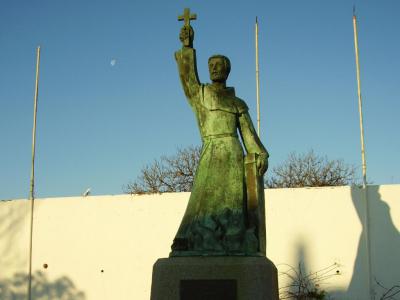
The statue itself is bronze, set on a stone pedestal, and depicts Vincent dressed in priestly garments, holding a crucifix aloft in his right hand. At certain times of day, depending on the season and the viewer’s position, sunlight passes directly through the crucifix, creating an optical effect in which the saint appears to raise a beam of pure white light.
Placed on elevated ground, the statue also functions as a viewpoint, offering broad views across Albufeira’s rooftops, beaches, and open sea.
Vincent was born in Albufeira in 1590, when the settlement was little more than a small village clustered around a castle. He later became an Augustinian missionary and travelled extensively, visiting Spain, Mexico, the Philippines, and eventually Japan. His mission was to convert souls to Christianity at a time when Japanese authorities were deeply suspicious of foreign religious influence. He was ultimately martyred by fire in the 17th century, a fate that cemented his status as a symbol of faith and sacrifice. In Albufeira, his memory is honoured each year on September 3.
The statue itself is bronze, set on a stone pedestal, and depicts Vincent dressed in priestly garments, holding a crucifix aloft in his right hand. At certain times of day, depending on the season and the viewer’s position, sunlight passes directly through the crucifix, creating an optical effect in which the saint appears to raise a beam of pure white light.
Placed on elevated ground, the statue also functions as a viewpoint, offering broad views across Albufeira’s rooftops, beaches, and open sea.
9) Albufeira Marina (must see)
The Albufeira Marina is a relatively recent addition to the town, marking a decisive shift from Albufeira’s traditional fishing-based coastline to a leisure-oriented maritime identity. Opened in the early 2000s, it was developed west of the old town near the mouth of the Albufeira River. Today, it is widely regarded as one of the safest and best-sheltered marinas in Portugal, protected from Atlantic swells and designed specifically for recreational boating.
The marina is far more than a yacht harbour. While it offers around 475 moorings for pleasure craft, it also functions as a high-end tourist complex. The surrounding development includes hotels, restaurants, bars, a marina nautical club, and a recreation and leisure centre. In total, the area incorporates roughly 590 hotel rooms across three hotels, including 75 apartments in a four-star apart-hotel, alongside a 220-unit tourist complex, 133 family residences, and three tourist villages providing a further 389 apartments. Upscale shops and a Naval Club complete the setting.
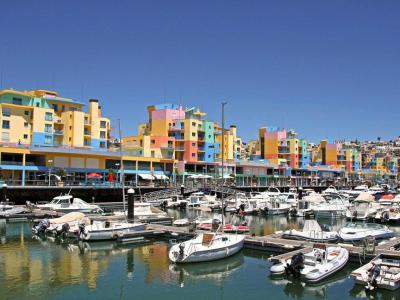
Architecturally, the marina is instantly recognisable for its cluster of brightly coloured buildings around the basin. Painted in bold tones, they form a deliberate contrast to the whitewashed houses of Albufeira’s historic centre and have become one of the marina’s defining visual features. Wide quays, pedestrian promenades, and open sightlines create a spacious, contemporary atmosphere well suited to strolling and lingering by the water.
Adventure seekers have plenty to choose from. Beyond fishing and dolphin-watching trips, Albufeira Marina offers jet skis, rocket boats, parasailing, yacht charters, sunset cruises, and a wide range of water sports.
The candy-coloured houses and busy activity will likely make you hungry. One of the best authentic restaurants in the marina is Tasca Portuguesa. For an affordable meal, look for the handwritten chalkboards placed around the restaurant. Finding it is straightforward, as the name is highlighted in dark blue lettering, with brown canopies below providing shade.
Gaining access to the marina itself can be a little trickier. As you reach the end of your walk, you will notice the street-facing façades of the vividly coloured buildings. Look for gaps between them, where staircases lead down to the lower level-the marina promenade.
The marina is far more than a yacht harbour. While it offers around 475 moorings for pleasure craft, it also functions as a high-end tourist complex. The surrounding development includes hotels, restaurants, bars, a marina nautical club, and a recreation and leisure centre. In total, the area incorporates roughly 590 hotel rooms across three hotels, including 75 apartments in a four-star apart-hotel, alongside a 220-unit tourist complex, 133 family residences, and three tourist villages providing a further 389 apartments. Upscale shops and a Naval Club complete the setting.
Architecturally, the marina is instantly recognisable for its cluster of brightly coloured buildings around the basin. Painted in bold tones, they form a deliberate contrast to the whitewashed houses of Albufeira’s historic centre and have become one of the marina’s defining visual features. Wide quays, pedestrian promenades, and open sightlines create a spacious, contemporary atmosphere well suited to strolling and lingering by the water.
Adventure seekers have plenty to choose from. Beyond fishing and dolphin-watching trips, Albufeira Marina offers jet skis, rocket boats, parasailing, yacht charters, sunset cruises, and a wide range of water sports.
The candy-coloured houses and busy activity will likely make you hungry. One of the best authentic restaurants in the marina is Tasca Portuguesa. For an affordable meal, look for the handwritten chalkboards placed around the restaurant. Finding it is straightforward, as the name is highlighted in dark blue lettering, with brown canopies below providing shade.
Gaining access to the marina itself can be a little trickier. As you reach the end of your walk, you will notice the street-facing façades of the vividly coloured buildings. Look for gaps between them, where staircases lead down to the lower level-the marina promenade.
The Most Popular Cities
/ view all