

Auckland houses a vast array of religious buildings and places of worship. Some of them date back to the 19th century and are considered to be landmarks and fine examples of beautiful architecture. Take the following tour to see Auckland’s most important religious buildings.
1) Saint Patrick's Cathedral
From modest beginnings in 1841 to the grand building you see before you today, St. Patrick’s Cathedral in Auckland has always been the centre of Catholicism in the city. The land that the cathedral is built on was granted by the crown to the city’s first bishop Jean Baptiste Pompallier on June 1st, 1841. A simple wooden structure was first built to serve the 300 odd strong congregation that was mainly made up of Irish immigrants. It was clear that a more substantial building would be required and in 1845 an architect was commissioned to design a stone church. When Auckland was made a diocese in 1848, it was clear that a grander building would be required.
In 1884 the foundation stone was laid for extensive expansions to be made to the church and the old stone church became the transept. A new nave was added that included a bell tower and bells were imported directly from Rome. The new cathedral was officially opened on March 15, 1885 – just before St. Patrick’s Day. Further expansions were carried out to make more space for the growing city’s congregation at the turn of the 20th century and the church that was completed in 1907 is the very same that you gaze upon today.
Image Courtesy of Wikimedia and Szczepan1990
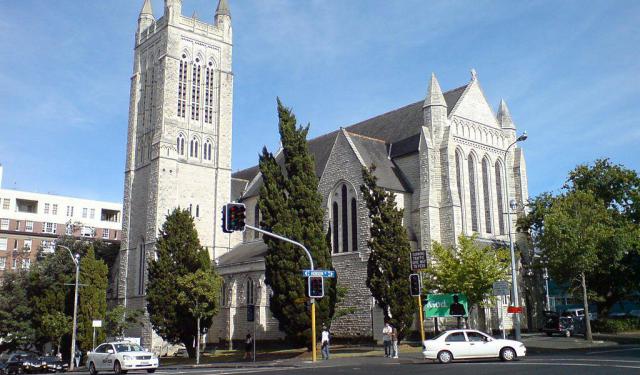
2) St Matthew's Church
St Matthew’s Church is one of Auckland’s historical religious buildings to be found in the city centre. The church is located to the west of Queen Street and the congregation began to meet there in a simple wooden structure from 1843 onwards, soon after the founding of the city in 1840. The congregation has traditionally been made up of merchants and retailers, which set the church’s coffers in good stead. As the 19th century was drawing to a close in 1896, the parish decided that a grand stone church was needed to reflect the status of the location and congregation and as the city built up in the west. Well known architect John Loughborough Pearson was engaged to design the church, but he was succeeded by his son Frank who completed the design.
In 1902 the foundation stone was laid by the Governor Lord Ranfurly and the neo-Gothic style church was officially opened in 1905. Within the building there is also an ancient stone taken from St Augustine’s Abbey in England. The central location of the church makes it ideal for community involvement with the city’s residents – and the church now holds many civic services as well as developing a strong tradition of community support.
Image Courtesy of Wikimedia and Ingolfson
3) Saint Paul's Church
Saint Paul’s Church in Auckland is one of the city’s Historic Place Trust buildings, which demonstrates the importance of the church in the development of the city. The church is a stunning example of the blending of the best elements of 19th century Gothic Revival designs with the natural resources of the New Zealand colony – intelligent use of native timber has been used throughout the cathedral. The building that you see today is the third built for the congregation of Saint Paul’s – the grand design was done by William Skinner and the foundation stone was laid in 1894. Due to the economic dire straits of the late 19th century, the grand plans for a bell tower and spire were deserted and have never been revisited at a later date.
Inside the church there are some unique features that make it an interesting place to visit. There is a chalice that was presented to the church by Queen Victoria and carved stones that come from Westminster Abbey, Canterbury Cathedral, St. Paul’s Cathedral in England and Yorkminster. Sections of the church, especially around the bishop’s throne are highly decorated. Saint Paul’s Church is often referred to as the “Mother Church” since it was the first to be built in the city.
Image Courtesy of Wikimedia and Jean Fouquet
4) Auckland Baptist Tabernacle
The story of the Auckland Baptist Tabernacle begins in 1881 when Thomas Spurgeon, son of the famous C H Spurgeon, arrived to begin work as a pastor in the colonial town. Thomas’s father C H Spurgeon was a well known Baptist preacher, who to this day is highly considered within the church. With his reputation preceding him, the congregation of the church built steadily and it quickly became apparent that larger premises would be needed to conduct church services. After steadfast fundraising, the foundation stone for the new tabernacle was laid on Easter Monday, 1884 on the central Queen Street site.
The tabernacle has a very different design to that which you see in most other religious buildings in Auckland. The building’s facade features six giant Corinthian columns on a large portico. One of the great supporters of the construction of the tabernacle was Charles Blomfield, who was a sign writer by trade. Mr. Blomfield produced much of the ornate stencilling in the interior of the church on the ceiling of the main auditorium. The Auckland Baptist Tabernacle seems to go from strength to strength and today provides a lot of community support for those of the inner city.
Image Courtesy of Wikimedia and National Library of New Zealand
5) Pitt Street Methodist Church
The very first gatherings of the Methodist church began soon after the city was founded – the first services were conducted wherever space could be found. The congregation began to swell and it was deemed essential to find a more permanent home for the church – it seems that the straightforward, everyday language favoured by the Methodist church struck a chord with hardworking and unpretentious settlers. The Methodist Church purchased land in 1864 in Pitt Street with the express purpose of building a church. The foundation stone of the Gothic Revival style design was laid in 1865 and it was officially inaugurated on October 14th, 1866.
The Pitt Street Methodist Church took over the role of the City of Auckland’s leading Methodist church, when the earlier High Street Church was closed in 1877. Following the increase in the Pitt Street church’s role, the buildings on the grounds were extended to include a sizeable hall for church events and the Sunday School. In 1887 classrooms and a lecture hall were also added. The most recent modifications to the complex were made in 1962 with the addition of a vestibule and the removal of internal flanking galleries. Women in the congregation were integral in helping New Zealand women to win the right to vote.
Image Courtesy of Wikimedia and Uploader.
6) Auckland Unitarian Church
Built in 1901, this church has been built in the 19th century wooden Gothic style. Inside the Auckland Unitarian Church you will find a beautifully carved wooden pulpit and fine paintings by Marge Barley. Very active socially, this church welcomes a great number of people who have questions and doubts and want to find a new meaning to their lives.
Image Courtesy of Wikimedia and N.N.