


Historical Churches Walking Tour (Self Guided), Boston
Boston's great churches are among the most precious of the city's numerous architectural jewels. What makes them special are their unique styles, elegant facades and long history.
Starting with the Old North Church, which towers in the city’s North End, this journey surely feels like taking a step back in time. Legend was made there, in the very place that Paul Revere waited for the famous signal; "One if by land, and two if by sea." Located in a setting filled with magnificent trees and plants, the building has been very well preserved over the years.
Next up, the King’s Chapel was the first Anglican Church in America (1686), and the construction alone – replacing the original wooden building – is worth a visit. Inside, there are plenty of design features, art, and specific adornments that make it unique.
The Tiffany art glass windows in the Church of the Covenant are another special find. For a nominal fee, you’ll receive an excellent tour of the building's numerous Tiffany stained-glass windows, and will be allowed to linger to your heart's content in the light of their majesty.
It’s really worth walking until the very end, to Copley Square, where the iconic Trinity Church immediately catches the eye. Its 19-century exterior in Romanesque style sure looks like a fairy-tale castle in the forest of high-rise modern buildings!
Take this self-guided walking tour to witness 7 wonders of Boston’s religious life. You you'll come away much richer from the experience – richer in many ways!
Starting with the Old North Church, which towers in the city’s North End, this journey surely feels like taking a step back in time. Legend was made there, in the very place that Paul Revere waited for the famous signal; "One if by land, and two if by sea." Located in a setting filled with magnificent trees and plants, the building has been very well preserved over the years.
Next up, the King’s Chapel was the first Anglican Church in America (1686), and the construction alone – replacing the original wooden building – is worth a visit. Inside, there are plenty of design features, art, and specific adornments that make it unique.
The Tiffany art glass windows in the Church of the Covenant are another special find. For a nominal fee, you’ll receive an excellent tour of the building's numerous Tiffany stained-glass windows, and will be allowed to linger to your heart's content in the light of their majesty.
It’s really worth walking until the very end, to Copley Square, where the iconic Trinity Church immediately catches the eye. Its 19-century exterior in Romanesque style sure looks like a fairy-tale castle in the forest of high-rise modern buildings!
Take this self-guided walking tour to witness 7 wonders of Boston’s religious life. You you'll come away much richer from the experience – richer in many ways!
How it works: Download the app "GPSmyCity: Walks in 1K+ Cities" from Apple App Store or Google Play Store to your mobile phone or tablet. The app turns your mobile device into a personal tour guide and its built-in GPS navigation functions guide you from one tour stop to next. The app works offline, so no data plan is needed when traveling abroad.
Download The GPSmyCity App



Historical Churches Walking Tour Map
Guide Name: Historical Churches Walking Tour
Guide Location: USA » Boston (See other walking tours in Boston)
Guide Type: Self-guided Walking Tour (Sightseeing)
Tour Duration: 2 Hour(s)
Travel Distance: 3.6 Km or 2.2 Miles
Guide Location: USA » Boston (See other walking tours in Boston)
Guide Type: Self-guided Walking Tour (Sightseeing)
Tour Duration: 2 Hour(s)
Travel Distance: 3.6 Km or 2.2 Miles
Sights Featured in This Walk
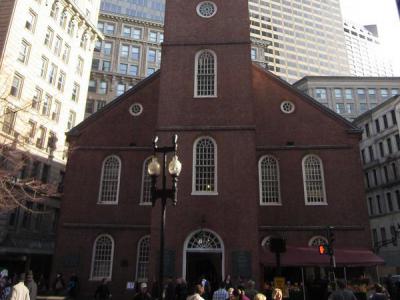
1) Old North Church (must see)


Walking Tours in Boston, Massachusetts

Create Your Own Walk in Boston
Creating your own self-guided walk in Boston is easy and fun. Choose the city attractions that you want to see and a walk route map will be created just for you. You can even set your hotel as the start point of the walk.

Bunker Hill Walking Tour
Bunker Hill rises above the banks of the Charles River like a chapter of American history carved in stone. At the heart of it all stands the towering Bunker Hill Monument, a granite obelisk that marks one of the earliest and most defining clashes of the American Revolution. Indeed, it is really hard to miss, both physically and historically...
The battle fought here on June 17, 1775, was... view more
Tour Duration: 1 Hour(s)
Travel Distance: 1.5 Km or 0.9 Miles
The battle fought here on June 17, 1775, was... view more
Tour Duration: 1 Hour(s)
Travel Distance: 1.5 Km or 0.9 Miles
North End Walking Tour
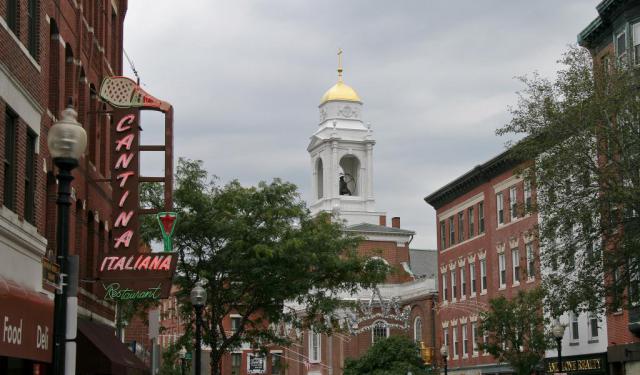
The North End is Boston’s oldest neighborhood, and for centuries it has played an outsized role in the city’s story. By the 1750s, this compact waterfront district had become a busy center of commercial, social, and intellectual life, filled with merchants, artisans, ship captains, printers, taverns, meeting places, and restless political energy.
Later, it came to be known as Boston’s... view more
Tour Duration: 1 Hour(s)
Travel Distance: 1.0 Km or 0.6 Miles
Later, it came to be known as Boston’s... view more
Tour Duration: 1 Hour(s)
Travel Distance: 1.0 Km or 0.6 Miles

Historical Cambridge MA Walking Tour
Once a quiet New England farming village that briefly served as the capital of the Massachusetts Bay Colony, today’s Cambridge, Massachusetts, is a university town that dazzles visitors as the home of renowned Harvard University – alma mater to intellectuals, literary giants, Nobel Prize winners, celebrities, and political leaders. Many of America’s elite have spent time within Harvard’s... view more
Tour Duration: 2 Hour(s)
Travel Distance: 3.5 Km or 2.2 Miles
Tour Duration: 2 Hour(s)
Travel Distance: 3.5 Km or 2.2 Miles

Boston Shopping Areas
One of the top shopping destinations in the US northeast, Boston has a strong network of interesting stores, galleries and boutiques to visit along with its many high-class shops, some of which are nestled inside historical buildings. Shopping here in more than one way mirrors the city itself: an amalgamation of classic and vanguard, the handmade and the high-end, and both local and international... view more
Tour Duration: 2 Hour(s)
Travel Distance: 3.2 Km or 2 Miles
Tour Duration: 2 Hour(s)
Travel Distance: 3.2 Km or 2 Miles

North End Food Tour
Boston’s North End is famous primarily for its Italian food. By far not as big as New York's Little Italy, this one-square-mile waterfront community is the oldest in the city, and is packed to the brim with a cornucopia of Italian eateries – restaurants, cafes, espresso bars, pizza and sandwich shops – lined next to each other within just a few short blocks to ensure visitors both a... view more
Tour Duration: 1 Hour(s)
Travel Distance: 0.8 Km or 0.5 Miles
Tour Duration: 1 Hour(s)
Travel Distance: 0.8 Km or 0.5 Miles

Boston Introduction Walking Tour
The capital of the Commonwealth of Massachusetts, Boston is one of the oldest cities in the United States and it had played a key role in the country's struggle for independence. Founded in 1630 by Puritan settlers from England, it witnessed many events of the American Revolution, including the Boston Massacre, the Boston Tea Party, the Battle of Bunker Hill, and the Siege of Boston.
... view more
Tour Duration: 2 Hour(s)
Travel Distance: 2.3 Km or 1.4 Miles
... view more
Tour Duration: 2 Hour(s)
Travel Distance: 2.3 Km or 1.4 Miles
Useful Travel Guides for Planning Your Trip

Boston's Marblehead Eateries
With such a diverse variety of dining cuisines and styles, the little town of Marblehead has something to satisfy every budget and culinary palate. You won't find any neon here, none is allowed in town and there are no fast food or drive-thrus establishments either. Most are quaint and...
The Most Popular Cities
/ view all