Home City Search Mexico City Chapultepec Park Tour, Mexico City
Chapultepec Park Tour, Mexico City, Mexico City
Download iPhone Walking Tours Application for Mexico City
iPhone Walking Tours Application for Mexico City
Bookmark and Share
Chapultepec Park Tour, Mexico City
Guide Location: Mexico » Mexico City
Guide Type: Self-guided city tour
# of Attractions: 9
Tour Duration: 3 hour(s)
Transportation Mode: by foot
Travel Distance: 7.8 km
Image Courtesy of Wikimedia and Carlosr chill
Author: doris
Chapultepec Park is one of the most famous parks in Mexico City. It is located on the Chapultepec Hill, that has a major historic importance for Mexicans. This park features some of the best known tourist attractions in Mexico city, like the Tamayo Contemporary Art Museum, Chapultepec Castle, and Papalote Children Museum. Take this walking tour to explore Chapultepec Park.
Tour Stops and Attractions
Papalote Museo del Niño
1) Papalote Museo del Niño
The Papalote Museo del Nino is the largest museum for children in Mexico City. The museum is located near Chapultepec Park and gives children hands on experiences in learning science technology and art.
The interactive museum was designed by architect Ricardo Lagoretta. The geometric structure is covered with traditional Mexican tiles. The interiors were entirely decorated by children. There are over 350 interactive exhibits in the museum and children are encouraged to touch and play with each one of them. The building has five themed sections for children to learn different subjects including, ’Our World’, ‘The Human Body’, ‘Con-Sciensa’ that teaches children Science and Consciousness, a communications section with exhibits related to language and all forms of communication including computers and an expressions section with art, music, theater and literature themed exhibits. The museum also has a large IMAX theater with daily video screenings and an archeology park complete with a pre Hispanic pyramid for children to explore.
Exhibits at the museum are in Spanish but English speaking guides help international visitors. It is required that children be accompanied by adults except on the Thursday adults night when the museum stays open till 11 p.m. Older visitors can view and interact with the exhibits and relax listening to a live jazz band that plays at the museum’s café on adult’s night.
Image Courtesy of Flickr and giffmex
La Feria Chapultepec Mágico
2) La Feria Chapultepec Mágico
La Feria Chapultepec Mágico was built in 1964. It is considered to be one of the most famous places for children in Mexico city. This theme park features over 55 rides. Its highlight is the legendary Montana Rusa.
Image Courtesy of Wikimedia and Dag Lindgren
Parque Zoologico de Chapultepec
3) Parque Zoologico de Chapultepec
Occupying 17 hectares of the first section of Chapultepec Park in Mexico City is the Parque Zoologico de Chapultepec. The zoo is the most visited in Mexico and attracts over 5 million visitors every year. It was conceived and created by noted Mexican biologist Alfonso Luis Herrera.
The design of the Parque Zoologico de Chapultepec was based on the Bioparco Roma Zoo in Italy. The foundations for the zoo were laid in 1923. The location was once the game reserve of the Aztec emperor Moctezuma. Alfonso Luis Herrera visited zoological parks around the world before creating the institution. Species on view include birds, mammals and reptiles. The area spans 17 acres with separate sections for different climatic conditions and vegetation. The butterfly park has over 40 species of butterflies, native to Mexico. In 1972 the Peoples Republic of China gifted two giant pandas to the zoo. Native species include the volcano rabbit, the Mexican wolf, the howler monkey and the Jaguar. The Parque Zoologicode Chapultepec has an onsite laboratory for reproductive physiology to enable reproduction of non native species in captivity by natural or artificial means.
Admission to the Parque Zoologico de Chapultepec is free and the park remains open for visitors, Tuesdays through Sundays.
Image Courtesy of Flickr and -Chupacabras-
National Auditorium
4) National Auditorium
The National Auditorium was completed in 1952. It is one of the most important performance and concert centers in Mexico City. The auditorium was once a sport venue, which hosted volleyball and basketball matches of the 1954 Central American and Caribbean Games. Nowadays, this amazing architectural site is used primarily for international music, song, dance and film festivals, fairs and exhibitions.
Image Courtesy of Wikimedia and Daniel Lobo
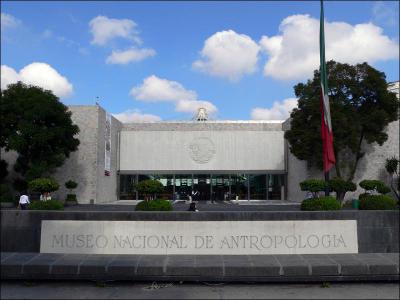
National Museum of Anthropology
5) National Museum of Anthropology
Located between Paseo de la Reforma and Calle Mahatma Gandhi in the Chapultepec Park, Mexico City is the National Museum of Anthropology. The institution seeks to preserve the archeological and anthropological heritage of pre Columbian Mexico and promote modern Mexican ethnography.
The building housing the anthropology museum has a modernist design with halls surrounding a central courtyard or patio. There is a large pond in the patio and a large concrete umbrella supported by a single concrete pillar. An artificial cascade falls around the umbrella. All the halls are surrounded by landscaped gardens, many of which have outdoor exhibits. Significant artifacts at the museum include the Aztec Stone of the Sun, a 16th century Aztec Statue of Xochipilli, the 8th century tomb of the Mayan ruler Pacal, a monkey cup made of black obsidian and giant stone heads from the Olmec civilization. There are impressive reproductions of Mayan murals in a reconstructed temple. The institution not only presents the anthropology of the pre-Columbian era but also helps visitors to learn of ethnic groups in modern Mexico and how they live today.
The National museum of anthropology stays open Tuesdays through Sundays. Admission is free on Sundays for Mexican nationals and international residents of Mexico.
Image Courtesy of Wikimedia and SimonHGBG
Tamayo Contemporary Art Museum
6) Tamayo Contemporary Art Museum
The Tamayo Contemporary Art Museum is the storehouse of the vast art collection of Rufino Tamayo and his wife Olga. Rufino Tamayo, a well known artist of Zapotec descent also acquired unique pieces of art. The family donated selected art works from the collection to the museum. Rufino Tamayo was closely associated with the construction of the building and when it was opened in 1981, it was regarded as another one of the Tamayo collection of contemporary art.
The Tamayo Contemporary Art Museum located on the Paseo de la Reforma at Calle Mahatma Gandhi was designed by Mexican architects Teodoro Gonzalez de Leon and Abraham Zabludovsky. Both the architects were well known professionals besides being close friends of Rufino Tamayo. Initially it was the first museum on Mexico City not run by the government. The personal collection of paintings, sculpture and drawings belonging to Rufino and his wife, pianist Olga Flores Zarate forms the basis of the permanent art exhibits in the institution. The museum also features temporary art exhibits by Mexican and International artists. Paintings from the collection of Rufino Tamayo include the works of Picasso, Joan Miro, Rene Magritte, Francis Bacon and Henry More.
The Museum stays open from Tuesdays to Sundays for visitors and on one Wednesday every month, the institution plays host to a live Jazz performance.
Image Courtesy of Wikimedia and Cesarth
Modern Arts Museum
7) Modern Arts Museum
Located on the East side of Chapultepec Park, to the left of the Paseo de la Reforma is a repository of paintings, lithography, photography and sculpture by Mexican artists of the 19th and 20th centuries.
The Museo de Arte Moderno was designed by renowned Mexican architects Rafael Mijares and Pedro Ramirez Vazquez. The main museum has a round design with two floors and a central stairway. The institution has six galleries featuring a range of artistic masterpieces under sky lit rotundas. The building has a permanent collection of paintings by the great 20th century Mexican artists, Frida Kahlo, Olga Costa, Gelsen Gas, Diego Rivera, Rufino Tamayo and Vladimir Kora among others. The surrounding gardens have many examples of free standing works of eminent modern Mexican sculptors. The works of the three great muralists, Diego Rivera, Jose Clemente Orozco and Manuel Alvarez Bravo are also showcased at the museum. The institution also hosts some of the finest temporary Mexican and international modern art collections. Las dos Fridas by Frida Kahlo and La Vendedoras de Frutas by Olga Costa are the world renowned works of art featured in the collection.
The museum is open from Tuesdays to Sundays. Guided tours are conducted around the exhibits for the benefit of visitors. Informative reference books are also available at the library.
Image Courtesy of Wikimedia and Maurice Marcellin
Niños Héroes Memorial
8) Niños Héroes Memorial
At the entrance of Chapultepec Park is an imposing monument that honors 6 Mexican teenage military cadets who died defending Mexico when the US army laid siege to the Chapultepec castle in Mexico City.
The Ninos Heros memorial is made of Carrara marble. The structure was designed by architect Enriquez Aragon and executed by sculptor Ernesto Tamariz in 1952. The young heroes in whose memory the structure was built were young military cadets between the ages of 13 and 19. These brave young men fought from Chapultepec Castle and resisted the invading US army till their last breath. Juan Escuitia, the last of the cadets wrapped himself in the Mexican flag and jumped to his death to prevent it from falling in the hands of the enemy. After their heroic deed, they were buried in a part of Chapultepec Park. In 1952, their remains were interred in the monument to ensure that the memory of their courage would live forever. The monument has a statue of a mother holding a dying son in her arms with six pillars representing each of the six young men surrounding the sculpture in a semicircle. Each pillar is topped by a bronze torch.
Visitors can pay homage to the young men who showed that bravery is a virtue that knows no age while visiting the Ninos Heroes Monument in Mexico City.
Image Courtesy of Wikimedia and Ricardo Stuckert/PR
Castillo de Chapultepec
9) Castillo de Chapultepec
Commanding spectacular views of Mexico City, this castle is the only structure to have served as a seat of a sovereign in North America. The building stands majestically on Chapultepec Hill and now houses the National Museum of History.
The Castillo de Chapultepec was built for the then Spanish viceroy, Bernardo de Galvez in 1725. The building was purchased by the city of Mexico in 1806. In 1833, the castle became a military academy and a tower called the Caballero Alto (Tall Knight) was added to the existing structure. In 1847, boy heroes aged between 14 and 20 died defending the castle when US troops laid siege. They were later honored by a mural in ceiling at the entrance of the castle. In 1864, Emperor Maximilian I and his Empress Carlota of Mexico chose the building as their residence and extensive changes were made to the architecture and landscape to make it a palace, fit for a king. In 1882, Porfirio Diaz converted the castle as the official residence of the Mexican President.
In 1939, the castle ceased to be the residence of the President and was open to visitors as the National Museum of History. The museum is arranged in chronological order and one can see exhibits from the Aztec Empire till the 1930s.
Image Courtesy of Flickr and * CliNKer *
Attractions Map
Visitor's Comments (0)
Visitor's Gallery (0)