
Chiang Mai Temples Walking Tour (Self Guided), Chiang Mai
Amid the multitude of impressive sights in Chiang Mai, religious temples really stand out. The city isn't just about one or two of them but has over 300 ‘wats’, which is more than elsewhere in Thailand. Some of these temples are as old as the city itself and were built by the kings not only to demonstrate their faith, but also to show off their wealth and power.
In the past, apart from being places of worship, they also served as schools and hospitals. Today, the holy structures of Chiang Mai are very much as active as ever, representing invaluable bridges between the past and present, enabling people to maintain links with the timeless traditions of their ancestors.
The majority of Chiang Mai's temples are of the ‘Lanna’ style, characterized by curved wooden roofs pointing up at the top. Among them, Wat Chedi Luang complex in the middle of the Old City is a definite must-see. Loosely translating from the old Lanna language to “very big”, the enormous Luang temple certainly lives up to its name. Its main chedi stands 80 meters tall, which is the highest point in the Old City.
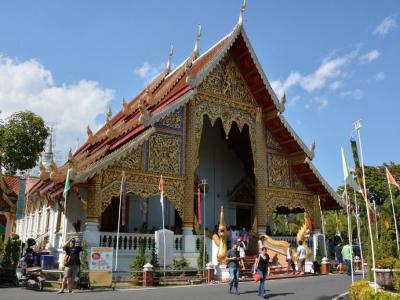
A walking distance from Luang is another not-to-be-missed – Wat Phra Singh. Thanks to a thorough renovation in the 19th century, followed by numerous licks of paint ever since, it has been one of the most visually impressive temples in Chiang Mai. Its main building steals the show with the iconic slanted Lanna-style roofs and intricately decorated façade that shines brightly in the sunlight.
To explore these and other temples of historic and cultural importance in Chiang Mai, take this self-guided walking tour.
In the past, apart from being places of worship, they also served as schools and hospitals. Today, the holy structures of Chiang Mai are very much as active as ever, representing invaluable bridges between the past and present, enabling people to maintain links with the timeless traditions of their ancestors.
The majority of Chiang Mai's temples are of the ‘Lanna’ style, characterized by curved wooden roofs pointing up at the top. Among them, Wat Chedi Luang complex in the middle of the Old City is a definite must-see. Loosely translating from the old Lanna language to “very big”, the enormous Luang temple certainly lives up to its name. Its main chedi stands 80 meters tall, which is the highest point in the Old City.
A walking distance from Luang is another not-to-be-missed – Wat Phra Singh. Thanks to a thorough renovation in the 19th century, followed by numerous licks of paint ever since, it has been one of the most visually impressive temples in Chiang Mai. Its main building steals the show with the iconic slanted Lanna-style roofs and intricately decorated façade that shines brightly in the sunlight.
To explore these and other temples of historic and cultural importance in Chiang Mai, take this self-guided walking tour.
How it works: Download the app "GPSmyCity: Walks in 1K+ Cities" from Apple App Store or Google Play Store to your mobile phone or tablet. The app turns your mobile device into a personal tour guide and its built-in GPS navigation functions guide you from one tour stop to next. The app works offline, so no data plan is needed when traveling abroad.
Download The GPSmyCity App



Chiang Mai Temples Walking Tour Map
Guide Name: Chiang Mai Temples Walking Tour
Guide Location: Thailand » Chiang Mai (See other walking tours in Chiang Mai)
Guide Type: Self-guided Walking Tour (Sightseeing)
# of Attractions: 6
Tour Duration: 1 Hour(s)
Travel Distance: 2.5 Km or 1.6 Miles
Author: vickyc
Sight(s) Featured in This Guide:
Guide Location: Thailand » Chiang Mai (See other walking tours in Chiang Mai)
Guide Type: Self-guided Walking Tour (Sightseeing)
# of Attractions: 6
Tour Duration: 1 Hour(s)
Travel Distance: 2.5 Km or 1.6 Miles
Author: vickyc
Sight(s) Featured in This Guide:
- Wat Phra Singh
- Wat Chedi Luang
- Wat Sum Pow
- Wat Umong Mahathera Chan
- Wat Sadeu Muang
- Wat Chiang Man
1) Wat Phra Singh (must see)
Chaing Mai’s most important and sacred image of the Buddha, the Phra Buddha Singh is housed in the assembly hall of this ancient temple. Every year, during the Songkran festival, the statue is taken from the assembly hall and carried through the streets of Chiang Mai in a religious procession during which the spectators honour the statue by sprinkling water over it.
Wat Phra Singh was constructed by King Pha Yu to contain the ashes of his father, Kham Fu. In 1367, the Phra Singh image of the Buddha found its way to Chiang Mai from the Mahabodhi temple in Bodh Gaya in India. The temple gets its name from this statue of the Buddha with a unique lion style. The temple is guarded by stone lions.
The Wat Phra Singh complex consists of a large assembly hall or Viharn with a gilded copper image of the Buddha surrounded by white pillars supporting a red roof. The smaller assembly hall houses the Phra Singh statue. The hall is covered with paintings of the Buddhist folk tales – the Jataka tales. The Ubosot or ordination hall is perpendicular to the small Viharn and is decorated with elaborate mandala designs. The complex also contains a small monastic library and several Chedis including an old one dating back to 1345. The statue of Phra Singh is taken from the temple in procession around Chiang Mai during the Songkran or Thai New Year festival annually.
Why You Should Visit:
This is indeed one of the largest temples in the city, and also one of the prettiest, with a peaceful atmosphere.
There is also the possibility of talking to monks and having one or more days of Buddhism and meditation classes.
Tip:
The monks here are serious and prefer not to have pictures of the Buddha statues, believing this to be disrespectful. They also discourage the use of the Buddha as art, asking that representations be confined to shrines, whether public or private.
Wat Phra Singh was constructed by King Pha Yu to contain the ashes of his father, Kham Fu. In 1367, the Phra Singh image of the Buddha found its way to Chiang Mai from the Mahabodhi temple in Bodh Gaya in India. The temple gets its name from this statue of the Buddha with a unique lion style. The temple is guarded by stone lions.
The Wat Phra Singh complex consists of a large assembly hall or Viharn with a gilded copper image of the Buddha surrounded by white pillars supporting a red roof. The smaller assembly hall houses the Phra Singh statue. The hall is covered with paintings of the Buddhist folk tales – the Jataka tales. The Ubosot or ordination hall is perpendicular to the small Viharn and is decorated with elaborate mandala designs. The complex also contains a small monastic library and several Chedis including an old one dating back to 1345. The statue of Phra Singh is taken from the temple in procession around Chiang Mai during the Songkran or Thai New Year festival annually.
Why You Should Visit:
This is indeed one of the largest temples in the city, and also one of the prettiest, with a peaceful atmosphere.
There is also the possibility of talking to monks and having one or more days of Buddhism and meditation classes.
Tip:
The monks here are serious and prefer not to have pictures of the Buddha statues, believing this to be disrespectful. They also discourage the use of the Buddha as art, asking that representations be confined to shrines, whether public or private.
2) Wat Chedi Luang (must see)
The Wat Chedi Luang is a large ruined temple located in the heart of the old city area of Chiang Mai. It gets its name from the large Chedi or Stupa that once formed part of the temple complex.
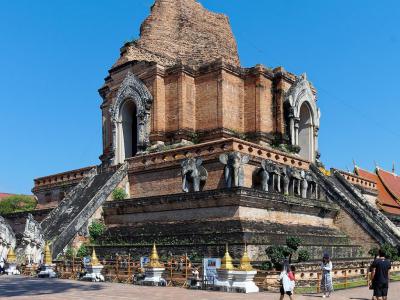
The construction of Wat Chedi Luang was begun by King Saen Muang Ma to hold the ashes of his father, Ku Na. His successors further expanded the temple and construction was completed in 1475. At the time, it housed the Emerald Buddha regarded as the holiest religious object in Thailand. In 1575, the temple fell to ruin and was never rebuilt. In the 1990s, the UNESCO and the Japanese Government built a new Chedi in Central Thai style rather than in the traditional Lanna style of other temples in Chiang Mai.
Visitors can still see the old brick wat. The large stairway that leads to the temple is guarded by stone figures of mythical snakes and elephants. The large Viharn or assembly hall has a brass statue of a standing Buddha installed by King Saen Muang Ma. He also planted the ancient Dipterocarp tree in the grounds. It is believed that a great catastrophe will befall the city when the tree falls. A small cross-shaped building adjacent to the tree houses the city pillar dedicated to the spirit of the city. The tree and the spirit are said to protect Chiang Mai from evil and disaster.
Why You Should Visit:
If you want to see the monks chanting, this is the best place to go. Twice a day, 8am and 5:30pm, monks gather in the main hall to chant.
Tip:
If possible, go at (or stay until) nightfall to walk around this one. You can feel the peacefulness and the ambiance going after dark because these parts of the city are full of magic!
The construction of Wat Chedi Luang was begun by King Saen Muang Ma to hold the ashes of his father, Ku Na. His successors further expanded the temple and construction was completed in 1475. At the time, it housed the Emerald Buddha regarded as the holiest religious object in Thailand. In 1575, the temple fell to ruin and was never rebuilt. In the 1990s, the UNESCO and the Japanese Government built a new Chedi in Central Thai style rather than in the traditional Lanna style of other temples in Chiang Mai.
Visitors can still see the old brick wat. The large stairway that leads to the temple is guarded by stone figures of mythical snakes and elephants. The large Viharn or assembly hall has a brass statue of a standing Buddha installed by King Saen Muang Ma. He also planted the ancient Dipterocarp tree in the grounds. It is believed that a great catastrophe will befall the city when the tree falls. A small cross-shaped building adjacent to the tree houses the city pillar dedicated to the spirit of the city. The tree and the spirit are said to protect Chiang Mai from evil and disaster.
Why You Should Visit:
If you want to see the monks chanting, this is the best place to go. Twice a day, 8am and 5:30pm, monks gather in the main hall to chant.
Tip:
If possible, go at (or stay until) nightfall to walk around this one. You can feel the peacefulness and the ambiance going after dark because these parts of the city are full of magic!
3) Wat Sum Pow
When exploring the vibrant city of Chiang Mai, the numerous temples are an essential part of the cultural experience. Among them, Wat Sum Pow, also known as Wat Sam Phao, stands out as a testament to the rich history and architectural heritage of the region. This magnificent Buddhist temple dates back to the reign of the Mang Rai dynasty, showcasing the traditional Lanna style that was prevalent during that era.
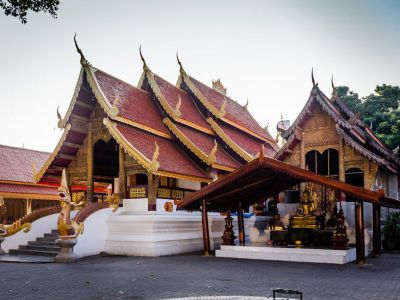
Located along the famous Rachadamnoen Road, Wat Sum Pow immediately captures visitors' attention with its striking entrance adorned by magnificent dragon sculptures. These mythical creatures serve as guardians, symbolizing protection and power, inviting visitors to step into a world of spirituality and serenity. As you enter the temple grounds, you are greeted by a majestic golden Buddha image, exuding a sense of tranquility and reverence.
The complex of Wat Sum Pow is a captivating sight, showcasing the unique blend of architectural elements and decorations used by the Lanna people, the early inhabitants of the region. The intricate design, elaborate carvings, and ornate detailing are a testament to the skilled craftsmanship of the Lanna artisans, leaving visitors in awe of the temple's beauty and historical significance.
The temple grounds feature stalls where visitors can purchase tiny souvenirs and merchandise, allowing them to take home a piece of the temple's charm and spirituality. These offerings add a touch of local flavor to the temple visit and serve as reminders of the profound cultural experience found within Wat Sum Pow.
Located along the famous Rachadamnoen Road, Wat Sum Pow immediately captures visitors' attention with its striking entrance adorned by magnificent dragon sculptures. These mythical creatures serve as guardians, symbolizing protection and power, inviting visitors to step into a world of spirituality and serenity. As you enter the temple grounds, you are greeted by a majestic golden Buddha image, exuding a sense of tranquility and reverence.
The complex of Wat Sum Pow is a captivating sight, showcasing the unique blend of architectural elements and decorations used by the Lanna people, the early inhabitants of the region. The intricate design, elaborate carvings, and ornate detailing are a testament to the skilled craftsmanship of the Lanna artisans, leaving visitors in awe of the temple's beauty and historical significance.
The temple grounds feature stalls where visitors can purchase tiny souvenirs and merchandise, allowing them to take home a piece of the temple's charm and spirituality. These offerings add a touch of local flavor to the temple visit and serve as reminders of the profound cultural experience found within Wat Sum Pow.
4) Wat Umong Mahathera Chan
Wat Umong Mahathera Chan, located in the heart of Chiang Mai's old town, is a venerable temple that holds a rich history dating back 700 years. The temple's name pays homage to the renowned monk Mahathera Chand, who lived in Chiang Mai during the 14th and 15th centuries and frequently resided at this sacred site. One fascinating aspect of the temple's past is the underground tunnel, from which the name "Umong" derives, that once connected the chedi to the viharn.
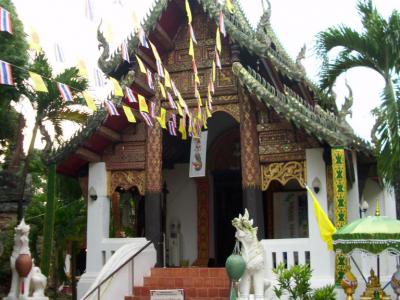
Within the temple grounds, there are a viharn, an ubosot, and two chedis. Notably, an ancient Bodhi tree, over 700 years old, stands as a living testament to the temple's antiquity. The viharn stands out with a unique Lanna architectural style, featuring a two-tier roof adorned with green and gold nagas. Chofa eagle finials top the roof, adding elegance. Two majestic chinthe lions guard the entrance, exuding protection and reverence.
In the dimly lit viharn, strategically placed lights create a mesmerizing effect on the central Buddha image. The floor has plain tiles, and the grand ceiling is supported by five massive pairs of teak columns. The walls are adorned with vibrant murals depicting the Buddha's previous lives and scenes from the Jataka, providing insights into Buddhism's teachings. The main altar features four Buddha images, with the principal one exuding serenity in the Subduing Mara mudra. Three smaller Buddha images accompany it, including one made of black granitic stone, adding to the temple's religious artifacts.
Within the temple grounds, there are a viharn, an ubosot, and two chedis. Notably, an ancient Bodhi tree, over 700 years old, stands as a living testament to the temple's antiquity. The viharn stands out with a unique Lanna architectural style, featuring a two-tier roof adorned with green and gold nagas. Chofa eagle finials top the roof, adding elegance. Two majestic chinthe lions guard the entrance, exuding protection and reverence.
In the dimly lit viharn, strategically placed lights create a mesmerizing effect on the central Buddha image. The floor has plain tiles, and the grand ceiling is supported by five massive pairs of teak columns. The walls are adorned with vibrant murals depicting the Buddha's previous lives and scenes from the Jataka, providing insights into Buddhism's teachings. The main altar features four Buddha images, with the principal one exuding serenity in the Subduing Mara mudra. Three smaller Buddha images accompany it, including one made of black granitic stone, adding to the temple's religious artifacts.
5) Wat Sadeu Muang
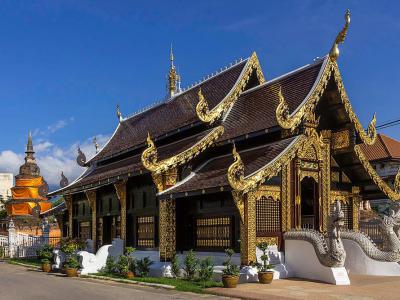
Wat Sadeu Muang, also known as Wat Inthakin Sadeu Muang, holds a significant place in the history of Chiang Mai. Legend has it that the city pillar called "Inthakin" was erected in 1296 by King Mangrai when he founded the city of Chiang Mai. The name "Wat Sadeu Muang" translates to "Temple of the Naval of the City," emphasizing its central and pivotal position in the old town.
The historical Inthakin pillar, which was believed to offer protection against misfortune, stood within the temple until it was moved by King Kawila in 1800 to Wat Chedi Luang. Today, the Inthakin Festival is celebrated annually around May, where the pillar is venerated, and offerings are made during the week-long festivities.
Located next to the Three King's Monument in the heart of the old town, Wat Sadeu Muang is one of the most frequently visited temples in Chiang Mai. Its viharn, a prayer hall, is a stunning example of Lanna temple architecture. The viharn's exterior is adorned with dark teak, coated in almost black lacquer, and embellished with beautiful gilt decorations, creating an exquisite visual appeal.
The temple's interior exudes a dark and atmospheric ambiance due to the use of dark teak and wooden bars in the windows, which allow limited natural light inside. The pillars and walls are richly adorned with floriated gilding, and panels display intricate carvings depicting scenes from Buddhist texts, further adding to the temple's cultural and historical significance.
The historical Inthakin pillar, which was believed to offer protection against misfortune, stood within the temple until it was moved by King Kawila in 1800 to Wat Chedi Luang. Today, the Inthakin Festival is celebrated annually around May, where the pillar is venerated, and offerings are made during the week-long festivities.
Located next to the Three King's Monument in the heart of the old town, Wat Sadeu Muang is one of the most frequently visited temples in Chiang Mai. Its viharn, a prayer hall, is a stunning example of Lanna temple architecture. The viharn's exterior is adorned with dark teak, coated in almost black lacquer, and embellished with beautiful gilt decorations, creating an exquisite visual appeal.
The temple's interior exudes a dark and atmospheric ambiance due to the use of dark teak and wooden bars in the windows, which allow limited natural light inside. The pillars and walls are richly adorned with floriated gilding, and panels display intricate carvings depicting scenes from Buddhist texts, further adding to the temple's cultural and historical significance.
6) Wat Chiang Man
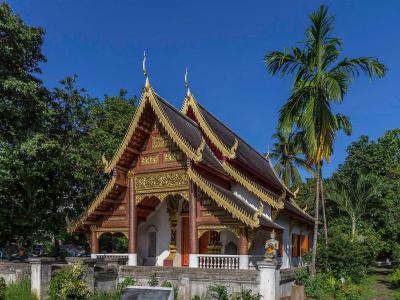
Chiang Mai's oldest temple, Wat Chiang Man was built in 1296 by the Lanna King Mengrai who laid the foundations of the city. It is said that King Mengrai lived at the temple while his palace was being built. A stele dated 1581 near the Ubosot records that the foundation of the city of Chaing Mai was on April 12th, 1296 at 4 pm.
The small Viharn or assembly hall in the Wat Chiang Man complex contains the crystal Buddha which once belonged to Chama Devi the queen of Haripunchai. King Mengrai burned the kingdom of Haripunchai and founded Chiang Mai. The Crystal Buddha dates back to the year 663 AD. The other statue in the Viharn is the Marble Buddha. Locals pray to the idol for rain and on April 1st a rain festival is held annually. The large Viharn has the oldest Buddhist statue in Chiang Mai. Installed in the year 1465, it depicts the Buddha holding a begging bowl. There is a 15th-century Stupa with carved elephants on its stone walls showing the influence of monks from Sri Lanka. The temple complex also has a repository of religious scriptures and a lotus pond.
Why You Should Visit:
If you enjoy architecture, this will blow you away. The main temple is over the top with decorations and ornateness. Deep reds and gold accentuate everything.
The details on the outside of the buildings are breathtaking when the sun hits them. The complex is immaculately kept all of the time.
Tip:
The Tha Phae Gate along the river is on the way to Wat Chiang Man if walking from the Night Bazaar direction and is worth a quick 10 min stop off also – nice opportunity for a photo!
The small Viharn or assembly hall in the Wat Chiang Man complex contains the crystal Buddha which once belonged to Chama Devi the queen of Haripunchai. King Mengrai burned the kingdom of Haripunchai and founded Chiang Mai. The Crystal Buddha dates back to the year 663 AD. The other statue in the Viharn is the Marble Buddha. Locals pray to the idol for rain and on April 1st a rain festival is held annually. The large Viharn has the oldest Buddhist statue in Chiang Mai. Installed in the year 1465, it depicts the Buddha holding a begging bowl. There is a 15th-century Stupa with carved elephants on its stone walls showing the influence of monks from Sri Lanka. The temple complex also has a repository of religious scriptures and a lotus pond.
Why You Should Visit:
If you enjoy architecture, this will blow you away. The main temple is over the top with decorations and ornateness. Deep reds and gold accentuate everything.
The details on the outside of the buildings are breathtaking when the sun hits them. The complex is immaculately kept all of the time.
Tip:
The Tha Phae Gate along the river is on the way to Wat Chiang Man if walking from the Night Bazaar direction and is worth a quick 10 min stop off also – nice opportunity for a photo!
Walking Tours in Chiang Mai, Thailand

Create Your Own Walk in Chiang Mai
Creating your own self-guided walk in Chiang Mai is easy and fun. Choose the city attractions that you want to see and a walk route map will be created just for you. You can even set your hotel as the start point of the walk.

Chiang Mai Introduction Walking Tour
Situated in the mountainous northern part of Thailand, Chiang Mai ("New City" in Thai) was founded in 1296 as the new capital of the then independent Kingdom of Lan Na, succeeding its former capital, Chiang Rai. The strategic location on the Ping River (a major tributary of the Chao Phraya River) and its proximity to major trading routes contributed to the city's historic... view more
Tour Duration: 2 Hour(s)
Travel Distance: 3.3 Km or 2.1 Miles
Tour Duration: 2 Hour(s)
Travel Distance: 3.3 Km or 2.1 Miles

Shopping and Food Walking Tour
One of the reasons tourists visit Chiang Mai is shopping. Indeed, this city is fit to captivate anyone with its shopping opportunities, especially when it comes to diverse and unique goods such as silk, silver, clothing, ceramics, antiques, Buddhist art, lacquer and neilloware, of consistently good value and quality and at affordable prices. Chiang Mai is one of the cheapest places to shop in... view more
Tour Duration: 1 Hour(s)
Travel Distance: 1.3 Km or 0.8 Miles
Tour Duration: 1 Hour(s)
Travel Distance: 1.3 Km or 0.8 Miles
The Most Popular Cities
/ view all