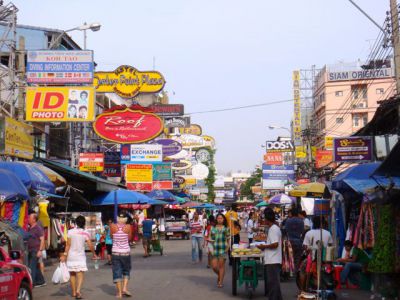
The ideal way to start a trip to Bangkok is to get a glimpse of its busy backstreets and to gape at its grandest holy places. Why not start your sightseeing in Krungthep, where you will see pretty squares, thronged streets and impressive temples. Then you can roam the backstreets and get a peep at the local street markets. You can also make a stop at a great local Thai restaurant that's always packed with visitors. Check out our list of the top tourist sights to kick off your trip to Bangkok.
1) Chitraladarahotarn Palace
This striking palace is situated on the Rama V Road in Dusit. Around the building you'll notice some eye-catching man-made lakes enveloped by walls. Every corner has a fountain decorated with baroque stylings drawn from legends, a reflection of the refined taste of Thailand's leaders. Nowadays it's not just a palace but is also home to an agricultural study station and even some farms and factories.
Image Courtesy of Flickr and my_soul_insurance2004
2) Vimanmek Mansion
The Vimanmek Palace, officially named Vimanmek Mansion, is a former royal palace in Bangkok. Located in the Dusit Palace in Dusit District and built in early 20th century, it was the first permanent residence constructed in 1900 by royal command of King Rama V. On March 27, 1901, the celebration for the completion of Vimanmek Mansion was held and King Rama V moved his residence from the Grand Palace to stay permanently at Vimanmek Mansion. He stayed there for five years until the completion of Amporn Satarn Residence in 1906 where he lived until his death in 1910. After King Rama V left the Vimanmek Mansion, the palace was closed down and members of the royal family moved back to the Grand Palace.
Near the end of his reign, King Rama VI gave permission to Her Majesty Indharasaksaji to stay at Vimanmek Mansion. After the death of King, she left the Vimanmek Mansion and the Mansion was closed again. Though King Rama VII renovated it several times, the mansion was used only as a storage place of the Bureau of Royal Household for a long time.
In 1982, Her Majesty Queen Sirikit took permission from King Rama IX to renovate the Mansion so that it can be used as a museum to commemorate King Rama V by displaying his photographs, personal art and handicrafts, and to serve as a showcase of the Thai national heritage for future generations.
Vimanmek Mansion Museum now includes more than 20 restored structures of the old Dusit Palace displaying everything from ancient artifacts of Thailand's history to contemporary photographs donated by His Majesty the King. The buildings themselves form part of the "collection" on display.
With its intricate architectural style reflecting a western influence, Vimanmek Mansion is the world’s largest golden teakwood mansion. The building has two right-angled wings and is three storied except for the King Rama V residence which is octagonal and four-storied. Ground floor is made of brick and cement but the upper floors are made of beautiful golden teakwood. There are 31 exhibition rooms in total including bedrooms, throne room and bathrooms maintaining the atmosphere of the Thai past and displaying items of Thai art including silverware, ceramics, crystal ware, and ivory.
Visited by a large number of people every year, the mansion is now a major tourist attraction and is the world's largest golden teakwood mansion.
Image Courtesy of Flickr and Honou
3) Ananta Samakhom Throne Hall
The Ananta Samakhom Throne Hall is a two-storey white marble building constructed during the reign of King Rama V. Designed by Italian architects, this magnificent dome building features the superb renaissance architecture. A large dome, 49.5 m high, in the centre is surrounded by six smaller domes. The domes and walls are covered with paintings that depict the history of the Chakri Dynasty from the first to the sixth reign. The building was completed in 1915. Once served as the site of the National Assembly and as a place to receive state guests, it is now a venue for important royal ceremonies and state meetings.
In late December 2007, an Arts of the Kingdom V Exhibition was held in this hall. Masterpieces of handiwork created by members of agricultural families are displayed here. Thais and the foreigners alike appreciated the exhibition. As a result, a permanent exhibition is held in the Ananta Samakhom Throne Hall. Replicas of royal thrones and barges are shown here along with beautiful embroidered screens and the replica of the royal dinner table once used for entertaining the royal guests.
During the four days of 1932 Revolution, the Throne Hall was used as the headquarters of the People’s Party which transformed the country's political system from an absolute monarchy to a constitutional one. The first National Assembly was convened on June 28, 1932 in this throne hall. It had been used as the Parliament House until 1974 when a new Parliament house was built. However, the previous Parliament House is still in use.
While visiting the Throne hall, do not forget to stop at the souvenir shop. A café is also present right in front of the building. You can enjoy a cup of coffee while viewing the spectacular images of Ananta Samakhom Throne Hall from the coffee shop.
Image Courtesy of Wikimedia and BrianAdler
4) Ladawan Palace
Ladawan Palace was built in 1907 by King Rama V. Its huge green gardens, wide passages and large bay windows as well as interior decoration based on biblical stories highlight the king's taste for European ideas. This two-story brick and marble edifice is sometimes known as the Red Palace because of its cherry hued exterior. It's also got a four-story watchtower. Later in the 20th Century the palace fell into disuse, but after a modern renovation the building once again now reveals all the splendor of East meets West.
5) Phra Sumen Fort
Built in the reign of King Rama I, Phra Sumen Fort is a hexagonal-shaped concrete fort built to protect Bangkok. The fort has three levels and the walls have steps which lead up to the top. Inside the fort there are 38 rooms which primarily housed ammunitions and weapons. It is one of two forts that have survived modernization. After its renovation, items found inside were collected and displayed in a museum on the top floor.
Wat Sangvej Printing School is situated next to the fort in a century-old building. Early editions of the textbooks of Thailand are produced here. Behind the building is the quiet canal named Klong Bang Lamphu which offers a good relaxing place to its visitors. Nearly 10,000 Khmer laborers dug the canal during the reign of King Rama I in 1782. Klong Bang Lamphu has many names according to different communities residing along the canal. It was believed that in the past this whole area was covered with a 100 years old Lamphu tree that grew on swamp land and was loved by fireflies. It had vertical roots that grew up to the sky. Hence the area was called Bang Lamphu. The tree was discovered again in 1997 after a long disappearance.
When Bangkok was established as the new capital, forts were built to cover the Chao Phraya River. The defensive rings of canals protected the old city to the east. The Phra Sumen Fort is situated at the convergence point of the Chao Phraya River and the Banglamphu Canal. The fort had two levels of battlements, one was used as the observation tower and the other was used to deploy cannons. It covered the bend of the Chao Phraya River at the northern end of Rattanakosin Island. The old cannons are still in place.
Santichaiprakarn Park is a well maintained park that lies between the old fort and the river making it a pleasant area to spend the day by the river. One can have a magnificent view of the riverfront and can watch activities going along the river bank with the marvelous Rama VIII suspension bridge in the distance.
Image Courtesy of Wikimedia and Ahoerstemeier
6) The National Gallery of Thailand
Thailand, primarily not a country of art and artists, has some worth watching galleries and museums related to art. Thai art is exclusive and identifiable in its style. Modern schools of art such as cubism have affected the Thai art but are unsuccessful in dominating it. On February 4, 1902 King Rama V presided over the construction and operated the machine himself to start the construction of a building to serve as a mint. The architectural ornamentation of the mint is astonishing. Made of brick with a gabled roof, the Royal Mint is in a western architectural style influenced by a factory in Birmingham, England. The building has two wings with a courtyard in the center. All windows on the ground floor are curved and decorated with strips and those of the upper floor are decorated with Roman arches. The outside wall of the building is etched with shallow horizontal lines while the edges of the roof seem to be beautifully decorated with embroidery. The lintel above the front door is made of stained glass. The floor of the first story is ornamental marble, while that of the second story is made of teak. On April 19, 1974, Ministry of Finance presented the old Royal Mint building to the Fine Arts Department for use as a National Gallery. On August 22, 1978, this old Royal Mint, one of the most beautiful buildings in the country, was registered as a national monument. A special exhibition on the topic Traditional Thai Painting was held in 1978 to tell the public that the aim of the museum was to serve as an art education institution for the country, concentrating both on contemporary and traditional art. Considering the importance of the role played by the National Gallery, Treasury Department extended the space available for the museum in September 15, 1983. For the past 27 years, the National Gallery has been serving as the sole art exhibition and art education center in the country. Numerous art exhibitions of the local and international artists are held here. It has also served as an international art corporation encouraging exchange programs of exhibitions between nations. The National gallery exhibits traditional Thai art from 17th century up to this day. If art is not your persuasion, you may not want to spend much time here. But a visit to this contemporary art lover’s gallery is worth the time you spent there.
Image Courtesy of Flickr and adaptorplug
7) Bangkok National Museum
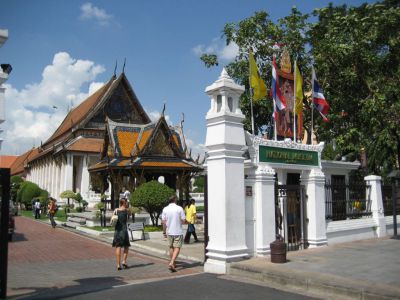
The Bangkok National Museum features exhibits of Thai art and history. Opened in 1874 by His Majesty King Rama V, the Bangkok National Museum is the first public venue to display the royal collection of King Rama IV and other objects of general interest. It occupies the 18th Century Wang Na Palace or Palace to the Front which had previously been the residence of the Prince Successor. Named the Bangkok Museum in 1926 it had subsequently transformed into the National Museum Bangkok under the direction of the Department of Fine Arts by 1934. King Rama VII presided over the opening ceremony of the National Museum Bangkok in 1926. The museum was originally intended to exhibit the antiques and gifts bestowed to Rama V by his father. Initially a non-organized gathering of dusty relics, it now features exhibits arranged into three areas consistent with Thai history. A good English-language description of all the masterpieces is also available. Thai History Gallery covering the periods from Sukothai to the Rattanakosin is placed at the front of the Sivamokhaphiman Hall. The Archaeological and Art History Collection exhibits items from Thailand's prehistory to the modern Thai Kingdom, including many ancient sculptures. Decorative Arts and Ethnological Collection showcases Chinese weapons, gold treasures, precious stones, masks and many items of historical importance from all over Southeast Asia. Other exhibits include a funeral chariot hall featuring carriages used for royal cremations along with many excellent examples of Thai architecture. Today the galleries contain exhibits covering Thai History back to Neolithic times. It houses the largest collection of Thai art and artifacts in the country and is definitely worth a visit.
Image Courtesy of Wikimedia and ScorpianPK
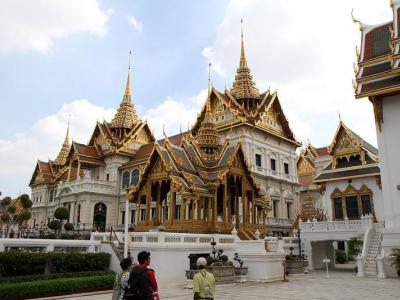
8) Royal Grand Palace
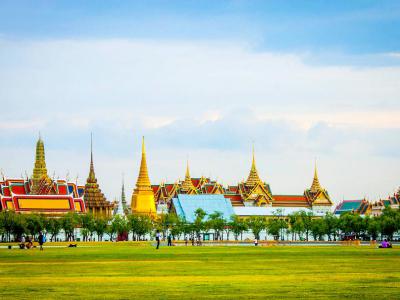
The Royal Grand Palace, a building complex in Bangkok, served as the official residence of the Kings of Thailand from the 18th century onwards. King Rama I ordered the construction of a magnificent new Palace in 1782 when he moved the capital from Thonburi to Bangkok. The area chosen was, however, occupied by Chinese merchants whom he asked to relocate. The Palace has been constantly expanded and many additional structures were added over time.
Originally the palace consisted of several wooden buildings surrounded on four sides with a high defensive wall, 1900 meters in length and enclosing an area of 218,400 square meters. The Palace is rectangular in shape with the western side next to a river, the royal temple situated to the east side and all structures facing north. The King ordered the construction of the Temple of the Emerald Buddha as a royal temple and as his personal place of worship. Around the turn of the twentieth century, Thai Kings stopped living in the palace. Today, the palace is used for all kinds of other ceremonial and auspicious happenings including royal funerals, marriages and state banquets.
The palace is divided into three quarters: the outer quarters, the middle quarters and the inner quarters. The Outer Court housed the government departments in which the king was directly involved including civil administration, army and the treasury. The Temple of the Emerald Budha takes up one corner of the complex next to the outer court. In the middle is the Central Court, where the residence of the king and the halls for conducting state business were located. Behind the central court was the inner court where the king's royal consorts and daughters lived. It was like a small city entirely populated by women and boys under the age of puberty.
The Grand Palace with its beautiful architecture and intricate details is a living proof of the creativity and craftsmanship of Thai people. Today, the complex remains the spiritual heart of Thai Kingdom. The Grand Palace with The Temple of the Emerald Buddha is Thailand's most sacred site. All visitors must be properly dressed before being allowed entry to the temple. No bare feet and no see through clothes are allowed.
Definitely the city's most famous landmark, the dazzling and spectacular Grand Palace is one must-see sight. Your visit to Bangkok would not be complete without seeing it.
Image Courtesy of Wikimedia and FlickrLickr
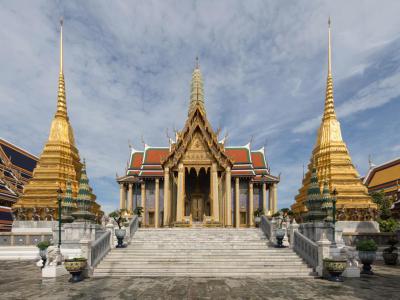
9) Wat Phra Kaew
Wat Phra Kaew, commonly known as the Temple of the Emerald Buddha, is located on the ground of the Royal Palace in Bangkok. It is the most respected Buddhist shrine in Thailand. About 2 feet tall dark green statue known as Emerald Buddha stands in the center of the temple.
Some believe that the Emerald Buddha has come from Sri Lanka while art historians believe that it is crafted in Thailand in the 14th century. A legend associated with the Buddha is that the Emerald Buddha was once kept covered in the plaster in a monument in Chiang Rai. In 1434, a lighting storm revealed the Buddha image underneath.
Considering the importance of the Emerald Buddha, the king of Chiang Mai tried very hard to carry the statue to his land. But the elephant that was transporting the statue stopped three times at a crossroads in Lampang. Taking it as a sign from the Buddha, the statue was placed in a monumental temple in Lampang. It stayed there for 32 years until the next King succeeded in bringing the Emerald Buddha to his city. It remained there in a temple until 1952 when Laotian invaders took it. For many years, the statue stayed in Laos until General Chakri (King Rama I) brought it back to the Thai capital at Thonburi after his victorious operation in Laos.
Several wars have been fought in the history because of this Buddha image. It was brought in Bangkok in 1782 and is considered a talisman and holds tremendous significance for Thailand. Wat Phra Kaew, the Temple of the Emerald Buddha and the adjoining Grand Palace together form perhaps the greatest attraction for the visitors to Bangkok and are surely well worth looking at.
Image Courtesy of Wikimedia and Ahoerstemeier
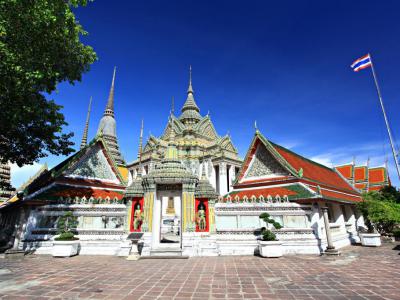
10) Wat Pho
Wat Pho (the Temple of the Reclining Buddha) is located behind the splendid Temple of the Emerald Buddha. It is one of the largest and the oldest Buddhist temple in Bangkok. Built around 200 years before Bangkok became Thailand's capital, the temple is mainly famous for the huge Reclining Buddha statue and the largest number of Buddha images it houses. The Wat was almost entirely rebuilt by Rama I when the capital was moved to Bangkok.
The highly impressive gold plated reclining Buddha is 46 meters long and 15 meters high and is designed to illustrate the passing of the Buddha into nirvana. The feet and the eyes are engraved with mother-of-pearl decoration. The bottoms of the Buddha's feet are intricately decorated with 108 auspicious scenes in Chinese and Indian styles.
The Wat Pho complex consists of two walled compounds, bisected north-south by Sanamchai Road running east-west. Reclining Buddha and massage school are found in the northern walled compound. People mostly go to visit this section which includes a large temple hall enclosed by 394 bronze Buddha images. There are also 91 Chedis of varying sizes around the ground. The library, decorated impressively with figures and pagodas made of porcelain is also present nearby. The large grounds of Wat Pho contain more than 1000 Buddha images in total, most from the ruins of the former capitals Ayuthaya and Sukhothai.
Wat Pho is also famous as Thailand's first university and is known as the birthplace and a training centre of traditional Thai massage. Rich and famous people have been known to come here. Traditional Thai dance and music are also taught to the students on Sundays. Astrologers and palm readers are also available here for consultation. For a very small donation that helps to maintain the temple, you can also receive a blessing from a monk.
Wat Pho is a good place to try a traditional Thai massage. Stimulating rather than relaxing and incorporating yoga style postures to relieve stress and improve blood circulation, it is quite different than other forms of therapeutic massage. Try this massage yourself to see if you like it!
Image Courtesy of Wikimedia and Éclusette
11) Chalermkrung Royal Theater (Sala Chaloem Krung)
Chalermkrung Royal Theater or Sala Chaloem Krung in Bangkok is the most popular theatre that specializes in traditional Thai dances specifically in 'Khon' performances. In 1932, King Rama VII ordered the construction of Sala Chalermkrung Royal Theatre as a memorable gift to the Thais on the occasion of 150th anniversary of Bangkok. The construction of the theater was completed in 1933. Built as a royal project and featuring high-tech lighting and sound system, this theater has added an entirely new dimension to Thai dance named “Khon”. ‘Khon’ is a traditional breathtaking Thai dance of nearly two hours which presents a storyline based on aspects of Thai history and ancient Thai myths and legends. It is the peak of Thai dramatic arts which usually draws its stories from the Indian epic Ramayana. Khon is staged here annually during winter months while other Thai performing arts are staged all year round.
In 2006, Thais celebrated the 60th anniversary of H.M. King Bhumibol’s succession to the throne. In order to follow the King’s footsteps to preserve Thai heritage and to share it with the rest of the world, Sala Chalermkrung Foundation, the Tourism Authority of Thailand, and the Crown Property Bureau jointly organized “Sala Chalermkrung Khon Project”.
Sala Chalermkrung has been serving as a national venue for holding exhibitions to maintain the authenticity of Thai arts and culture for more than 70 years. It has the distinction of being Southeast Asia’s first air-conditioned cinema where plays are staged throughout the year.
Beyond doubt, Sala Chaloem Krung or Chalermkrung Royal Theatre is a distinguished place where you can spend time easily watching fantastic performances under the excellent light arrangements that add sparkle to the classical dance art. This combination of modern technique and classical performances has truly raised the status of this theatre to sublime height.
Image Courtesy of Wikimedia and Heinrich Damm
12) Wat Saket (Temple of the Golden Mount)
Wat Saket, a Buddhist temple and a famous landmark in Bangkok, dates back to Ayutthaya era. The towering gold chedi of Wat Saket, once the highest point in Bangkok, is notable for its spectacular views and its hosting of the annual Loy Kratong festival. The small dome is covered with small golden squares that reflect in the sun. Due to these shiny squares, the place got the name of Golden Mount.
Golden Mount, a steep hill inside the Wat Saket compound, is not a natural mountain but an artificial one. It was constructed under King Rama III when he tried to build a chedi here which collapsed because of the soft soil beneath. He therefore made a sturdy mound of mud and bricks to support it. For about half a century, it was left alone until it took the shape of a natural hill and became overgrown with weeds. From then onward, it received its name of "Phu Khao". King Rama IV built a small Chedi on the hilltop and put nearly 1,000 teak logs all along the shore to give support to the sinking structure into the swampy ground.
Finally Rama V added the chedi that stands here today. A Buddha relic from India was housed in chedi. The concrete walls were added during World War II to prevent the hill from eroding and the structure collapsing.
Wat Saket was used for cremation ceremonies because these were not allowed inside the walled city. During the following 100 years, the temple became the dumping ground for some 60,000 plague victims.
During the Loy Kratong festival, Wat Sakhet hosts Bangkok's most important temple fair that takes place from late October to mid-November (for 9 days around the full moon). A red cloth is wrapped around the Golden Mount during this event. A carnival starts around it and many food stalls, theatrical performances, freak shows and animal circuses mushroom up here. The festival also includes a candlelight procession up to the Golden Mount. Religious visitors place flowers and light candles near the temple.
A large number of 318 steps must be ascended to reach at the peak of Golden Mount but it is worth the effort as the panoramic view of Bangkok from the top of old Rattanakosin Island is fabulous and fantastic!
Image Courtesy of Wikimedia and Gerold Kogler