

Home City Search Washington D.C. City Orientation Tour in Washington, D.C.
City Orientation Tour in Washington, D.C., Washington D.C.
Download iPhone Walking Tours Application for Washington D.C.
iPhone Walking Tours Application for Washington D.C.
Bookmark and Share
City Orientation Tour in Washington, D.C.
Guide Location: USA » Washington D.C.
Guide Type: Self-guided city tour
# of Attractions: 15
Tour Duration: 5 hour(s)
Transportation Mode: by foot
Travel Distance: 11.4 km
Image Courtesy of Wikimedia and Tina Hager
Author: irene
Washington, D.C is the capital of the United States, founded on July 16, 1790. The city combines politics, cosmopolitan energy and multiculturalism with thriving and diverse dining, nightlife and shopping. It is well-known for its historic neighborhoods, world-class museums, memorials, beautiful gardens and arts venues. Take the following tour to discover the city which defines some of the greatest American values!
Tour Stops and Attractions
The White House
1) The White House
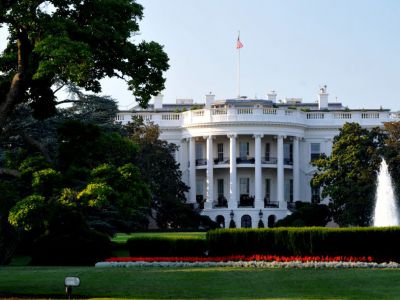
The White House is both home and office to the President of the United States. Located at 1600 Pennsylvania Avenue in Washington, D.C. it symbolizes America. While it is not the first home of American presidents, it has been the home of every American President since John Adams moved in during his presidency in 1800. The design was made by James Hoban and building was started with the laying of the cornerstone in1792. Each president since then have added their own touches to the people’s house, some big and some small.

That original White House was burned in 1814, almost to the ground, by British troops during the War of 1812. Designing and rebuilding soon began and was completed by 1817. The South Portico was added in 1824 and the North Portico was added in 1830. The West Wing came during an addition that began in 1901 and then later the Oval Office was added. A fire in 1929 damaged the West Wing but the damage was repaired. In 1930’s a second story and basement were added and the oval office was moved to its present location.

By 1948 the building was in need of a serious overhaul to keep it standing after several additions had been made over the years. Load bearing beams were added and a complete dismantling of the interior was undertaken. Most of the glorious handcrafted work was lost during this process of reconstruction. In the 1960’s Jacqueline Kennedy oversaw an extensive redecoration of the White House to bring back some of the artifacts that had been lost over the years and return it to it grander days.

Today the White House has six stories, 132 rooms, and such amenities as a tennis court, swimming pool, bowling alley, and of course the First Garden. Since the attacks of 9/11 the White House is no longer open for tours except on a very limited basis. All those wanting a tour must ask their Congressional representatives to put them on a list and have background checks completed prior to the tour.
Image Courtesy of Wikimedia and Cezary p
Sight description based on wikipedia
Ford's Theater
2) Ford's Theater
Ford’s Theater is where President Abraham Lincoln was shot while viewing a theatrical performance on April 14, 1865. However, this building did not start out as a theater. It was built in1833 to house the First Baptist Church of Washington. The church used the building until 1861, when they moved to a new building. John Ford bought the building and with renovations, turned it into a theater. The building was destroyed by fire in 1862 and soon rebuilt.

The newly built Ford’s Theater opened in August of 1863. It was huge and had seating for over 2,000 theater patrons. On that fateful April day, President Lincoln, his wife and a group of friends, went to the theater to see Our American Cousin. The country was still feeling the keen sting of the Civil War; in fact General Lee had surrendered less that one week before. John Wilkes Booth, feeling anger at the loss of the Confederacy, entered the Presidential box and shot the President in the head. President Lincoln died the next day at a home across the street from the theater, the Petersen House.

Congress reacted to the assassination of President Lincoln by purchasing the theater and passing a law that the building could never again be used as a theater. The government then used the building for various purposes such as storage and office space. In 1893 part of the building collapsed killing 22 people. The fire, assassination and building collapse made some believe the building was cursed. Repairs were made to the building and it was used until 1931.

In the 1940’s there was recognition that a very valuable historical legacy was being lost. It was not until 1955 that Congress passed a bill that the theater could be restored. In 1968, Ford’s Theater was once again opened as a theater. Today both the theater and the Petersen House are preserved together as a National Historic Site at 511 10th Street, NW in Washington, D.C.
Image Courtesy of Flickr and Kyle Rush
Sight description based on wikipedia
International Spy Museum
3) International Spy Museum
The International Spy Museum is a must see for all who find the spy business intriguing. It is the only museum of its kind in America. It may also be one of the most fun museums in Washington. When entering the museum, guests are asked to assume an identity and enter the spy game.

In the museum are exhibits on tiny buttonhole cameras, microdots, bugs and disguises. Stories about famous and not so famous spies, even a nod to Julia Child are all part of the intrigue. Civil War spies and Cold War spies, the exhibits will open up some of the most interesting secrets. Along the way, guests will learn how to keep their cover and work with the tools of spy craft. New gadgets are also discovered in the modern spy game, the cyber spies.

In addition to the exhibits there are some spy experiences. No, not really going on a mission, but it almost feels that real. For an extra fee, there are four experiences that a budding spy can participate in. These adventures take from one to two hours and some can be purchased without purchasing a museum ticket. There will be a time on the ticket as to when the experience starts, do not show up late, or the ticket will be forfeited.

There are some rules to visit the museum, no strollers; no photography or videography; no food, drink, gum, or smoking; no use of phones of any kind. There is also an entrance charge for this museum; even so, tickets are assigned an entry time because the crowds can be large. Plan to be there early to get a ticket with a good time.
Image Courtesy of Wikimedia and Kmf164
The U.S. Capitol
4) The U.S. Capitol
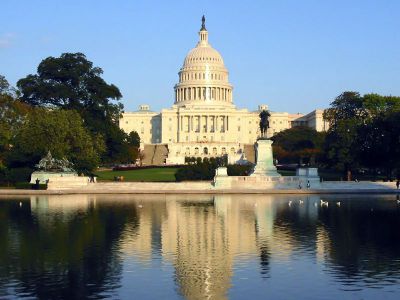
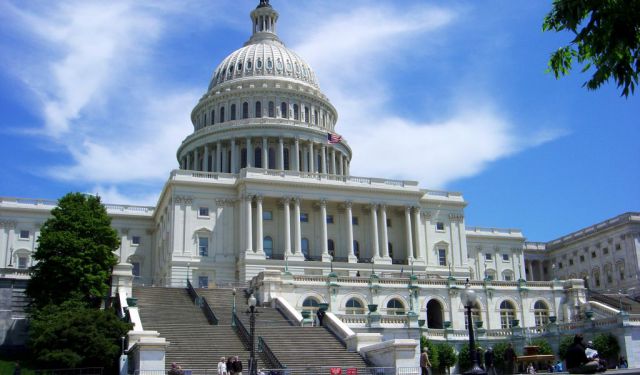
The U.S. Capitol stands at the opposite end of the National Mall from the Washington Monument. This huge building holds the House of Representatives in the south wing, and the Congress in the north wing. There are 540 rooms, five floors and the beautiful Capitol Rotunda which additionally houses art and sculptures. This art work depicts events and figures from American history. Interestingly, both the east side and west side of the Capitol can be designated as the front, so just be aware that “front” is not the best descriptive designation here.

After much wrangling about the design, the Capitol cornerstone was laid by President Washington on September 18, 1793. President Washington was dressed in full Mason attire as he laid the stone. The building was completed in 1811. Portions of the Capitol were burned in August of 1814 during the burning of Washington during the War of 1812. The damaged portions were rebuilt and the Rotunda was added. Construction was completed in 1826. In the 1850s the Capitol was expanded and a new cast-iron dome was added to replace the wooden Rotunda. Several renovations and expansions have been done since then. The Apotheosis of Washington is the fresco painted on the inside of the dome and is visible through the oculus from the Rotunda floor.

The Capitol is open to visitors and the tour is free. Tickets are available at the Capitol Visitor Center and they are first come-first served. This center is new, having opened in 2008. There is about a 15 minute orientation film about the Capitol that is worth viewing. A cafeteria, two gift shops and restrooms are also available here.

The Capitol also has galleries where visitors can watch Congress in action. Passes are available from the offices of Senators and Representatives. If visiting when Congress is in session, be sure to contact your local official and see government in action.
Image Courtesy of Wikimedia and F.Malotaux
Library of Congress
5) Library of Congress
The Library of Congress was established in 1800 by President John Adams. The mission was to provide books that would be needed by Congress to help them perform their duties. Thomas Jefferson reinforced the need for the Library and in 1802 signed a law that helped establish the Library’s structure and allowed the President and Vice-President to borrow books. The Library of Congress was destroyed when the Capitol was burned by British troops in 1814.

President Jefferson offered his personal library to replace the books destroyed by the fire. In 1815, Congress accepted the President’s offer and paid him around $24,000 for his collection of 6,487 books. Unfortunately, another fire in 1851 destroyed around 4,000 of the books that President Jefferson sent to the library along with another 31,000 volumes. The Smithsonian Institution, after some dissent about whether it should be in charge of the Library of Congress, transferred around 40,000 volumes to the Library in 1866.

Finally, serious expansion started, and the Library grew to 840,000 volumes by 1897. It was around this time that a sentiment developed that the Library should be a library for America. Assistance programs were set up to help those with physical disabilities have access to the books. In addition to books, the Library also houses manuscripts, sheet music, maps, sound recordings and films. It is an incredible collection.

Today the Library of Congress has the largest collection of books and manuscripts in the world. Although it is a library for the people, only members of Congress, other high ranking officials and Supreme Court Justices can check out books. However, anyone is free to use the books that are housed in three separate buildings on Capitol Hill in Washington, D.C. The libraries are all connected by tunnels, so visitors only need to go through security once.
Image Courtesy of Wikimedia and TheAgency
Sight description based on wikipedia
U.S. Botanic Garden
6) U.S. Botanic Garden
The United States Botanic Garden (USBG) is a botanic garden on the grounds of the United States Capitol in Washington, D.C., near Garfield Circle. The Botanic Garden is supervised by the Congress through the Architect of the Capitol, who is responsible for maintaining the grounds of the United States Capitol. The USBG is open every day of the year, including federal holidays. It is the oldest continually operating botanic garden in the United States. The USBG proper consists of three locations: the Conservatory, Bartholdi Park, and the Production Facility. The historic Lord & Burnham greenhouse, built by the Architect of the Capitol in 1933, contains eight garden rooms under glass, totaling 28,944 square feet of growing space. In 2001, the Conservatory re-opened after a four-year renovation that required it to be completely dismantled and rebuilt using 21st century building standards.
Image Courtesy of Flickr and bob.stovall
Sight description based on wikipedia
National Air and Space Museum
7) National Air and Space Museum
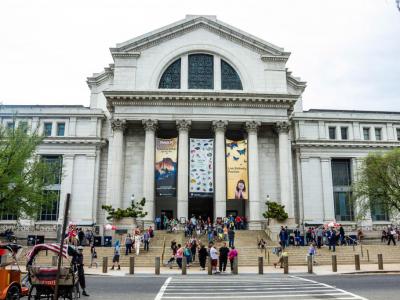
The National Air and Space Museum of the Smithsonian Institution is a must see for all aviation and space aficionados. It houses the largest collection of planes and spacecraft in the world. This is one of the most popular of the Smithsonian museums, so plan to go early and spend a day.

The original inception of the museum began in 1946, although some of the pieces in the museum are from the 1876 Centennial Exposition. At that time the name was to be the National Air Museum. As man ventured to the heavens and landed on the moon, the name was changed to include “Space”. In fact the exhibition hall was opened by Director Michael Collins who has been to space on the Apollo 11 mission to the moon.

The Spirit of St. Louis that Charles Lindbergh flew over the Atlantic is displayed here along with Wright Flyer that made its famous flight at Kitty Hawk in 1903 piloted by Orville Wright. The Apollo 11 Command module is here too. The Bell X-1, Mercury Friendship 7, and SpaceShipOne are also on display. More conventional aircraft include a DC-3 and a 747. Even the USS Enterprise from Star Trek fame is here.

The museum is located at Independence Ave at 6th Street SW. Hours are 10am to 5:30pm and admission is free.
Image Courtesy of Wikimedia and David Bjorgen
Smithsonian Institution
8) Smithsonian Institution
The Smithsonian Institution is dedicated to education and research. That knowledge is then diffused to all. This is done in the form of 19 museums, a zoological park, nine research centers, as well as publishing two magazines. The Institution is funded by the United States government as well as by endowment, profits and contributions. The Smithsonian Institution is the largest complex of museums in the world.

There are 11 Smithsonian Institution museums located on the National Mall in Washington D.C. Additionally; the National Zoological Park is part of the system. The other museums are located elsewhere around Washington, as well as New York City and Chantilly, Virginia.

While the museums garner most of the attention, the Smithsonian is involved in significant research around the world. For instance, the Archive of American Art is involved in preserving the 16 million items that are part of the Smithsonian collections. Research involves participating museums from around the world. The Conservation Biology Institute works to help endangered species survive and recover. For example, they are taking part in the Global Tiger Initiative.

The museums are absolutely spectacular. There is literally something for everyone’s tastes. Most of these museums are free to the public. They are truly a national treasure. A full two weeks in Washington could be filled by visiting Smithsonian Institution venues exclusively and everything still could not be seen. Make the most of the time in Washington and plan out the venues ahead of time, leaving a little room for flexibility. Just when you think your kids hate history and only allow 2 hours at the American History Museum, the kids will surprise you and whine when they have to leave after four hours.

Words to the wise, all the museums are popular, and parking around them is fairly nonexistent. Take public transportation or the Tourmobile when you come to visit the Smithsonian Institution. Wear comfortable walking shoes.
Image Courtesy of Flickr and yeowatzup
Arthur M. Sackler Gallery of Art
9) Arthur M. Sackler Gallery of Art
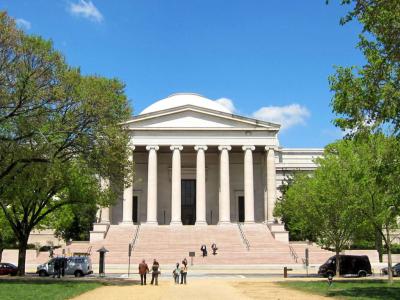
The Arthur M. Sackler Gallery of Art is part of the Smithsonian Institution. The gallery opened in 1987 after Dr. Sackler donated his collection of Asian art to the Smithsonian. He also donated some $4 million to help build the museum so the art could be appreciated by all.

Art exhibits include ceramics from Southeast Asia as well as sculpture from the same area and the Himalayas. There is a special section devoted to the arts of China. Coming soon to the gallery will be a permanent exhibit called the Buddhist Shrine Room.

The Sackler Gallery along with the Freer Gallery boast one the largest collections of Chinese art outside of China. The collection of jade is absolutely stunning and some of the pieces are 5,000 years old. Also do not miss the lacquer collection. The work on the food boxes is truely amazing.

Be sure to check out the traveling exhibitions. The Sackler Gallery is renowned for bringing in exhibits of Asian art. Additionally, the Gallery is home to an extensive Asian art research library. This library is open to the public, no appointment needed. About half of the volumes collected are in Asian languages.

The majority of the Gallery is located underground. Because of that design there is an amazing rooftop garden that is at ground level on the Mall. The gardens carry on the Asian theme of the collections in the Gallery.
Image Courtesy of Flickr and rosemanios
Sight description based on wikipedia
Washington Monument
10) Washington Monument
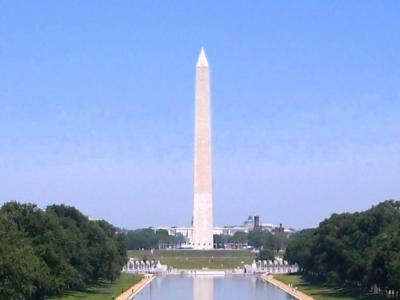
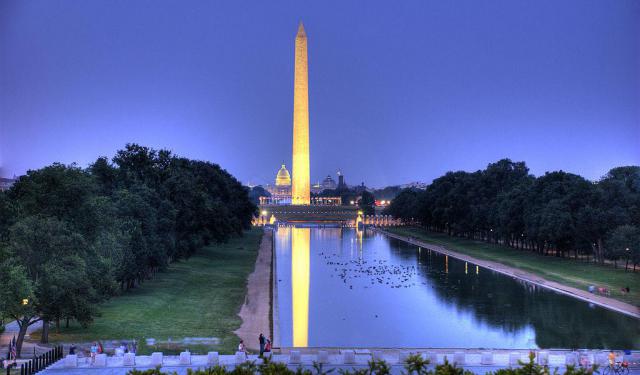
The Washington Monument was built to honor George Washington. It stands in the center of the US Capital to symbolize the importance of President Washington to the country. The idea to raise the monument was first discussed in 1783. It wasn’t until 1847 that a design was agreed upon. However, that design was very different from the monument that stands today. The obelisk was to rise above a temple that would house artifacts of American presidents and heroes. Over the years that plan was dropped, and today the obelisk is rather plain. The first cornerstone was laid in a Masonic ceremony on July 4, 1848. The same Masonic trowel that President Washington used to lay the cornerstone for the Capitol was used. Work on the Washington Monument was slow and eventually stopped altogether during the civil war. Modifications were made to the design and work began again in 1880, with the capstone placed December 6, 1884. The hollow shaft of the monument contains an elevator to the top plus a staircase with 897 steps. There are 188 interesting, carved blocks of stone to be viewed along the staircase. There are stones from all 50 states, quarried of native stones. These stones were originally supposed to arrive with a donation attached to raise funds. Usually the stones arrived but the donation did not. Ride the elevator to the top and walk down to view these works of art. Entrance is free, but a ticket is a must for everyone going into the monument. Get in line by 7A.M. for a ticket. One person from your party can obtain 6 tickets and pick a time to go up in the monument. Tickets can also be ordered ahead of time for a fee.
Image Courtesy of Flickr and Jeff Kubina
Sight description based on wikipedia
The Bureau of Engraving and Printing
11) The Bureau of Engraving and Printing
The Bureau of Engraving and Printing is in charge of printing all the U.S. paper currency. In addition it prints White House invitations, Treasury bonds, military identification cards, U.S. passports and materials for Homeland Security. But the reason most people come for a tour is to see the money.

The Bureau was established in 1862. The workers were responsible for signing and trimming the notes for the Treasury department, but not the actual printing. Eventually the whole process was turned over to this group. In 1877 all paper currency, stamps, government obligations and other government documents were printed by the Bureau. Stamps are printed elsewhere now, but this group is responsible for being the largest producer of government security documents in the world.

During a tour millions of dollars will be printed, cut, stacked. The printing process starts with large rolls of special paper and continues on through the application of the special ink, examination for defects and then cutting and stacking are completed. This newly printed money is ready to head out into the money supply. Redesign of the currency to prevent counterfeiting is also tasked to this department. The $100 bill is the latest to get a new facelift.

Visiting the Bureau of Engraving and Printing is free; however, from March through August, tickets are required. The line forms at the door of the visitor’s center located on 14th Street. Tours leave every 15 minutes. The facility is at 14th and C Street in Washington, D.C.
Image Courtesy of Wikimedia and JosephBarillari
Thomas Jefferson Memorial
12) Thomas Jefferson Memorial
The Thomas Jefferson Memorial is located in Washington, D.C. and stands on the banks of the Potomac River. It is one of the least visited memorials, probably because it is not part of The Mall, so visiting is usually relaxing. It is located just south of the White House which makes for a very scenic setting. The idea for the memorial originated in 1901. After much debate and several design changes, the memorial was finally dedicated on April 13, 1943. That date is significant because it was the 200th celebration of Thomas Jefferson’s birth. Part of the debate surrounding the memorial is its size. There were conflicted opinions about whether the memorial was too big as opposed to those who thought Thomas Jefferson, as one of the Founding Fathers, deserved a memorial on the scale of the Washington Monument or the Lincoln Memorial. In the end, Jefferson’s love of classical architecture won out and the large classic structure was built. This open building with its beautiful sweeping portico is very picturesque. Under the dome, there is a 19 foot tall bronze statue of President Jefferson. This is not the statue that was present at the dedication. Bronze was in short supply during the war effort and the original statue was made of plaster and painted to look bronze. The present statue was installed four years after the dedication. On the walls around the statue are inscriptions of Jefferson’s writings. An interesting fact for history buffs is the inscription of the Declaration of Independence. Mr. Jefferson wrote “inalienable rights” but in the final document it was “unalienable rights”. In the Jefferson Memorial the inscription is as he wrote it. While the area is pretty any time of year, during cherry blossom time the site is breathtaking. The cherry trees planted around the area are a gift from the people of Japan. The Jefferson Memorial is open 24 hours a day, and rangers are present from 9AM to 11:30PM except on major holidays.
Image Courtesy of Wikimedia and Elvert Barnes
Sight description based on wikipedia
Franklin Delano Roosevelt Memorial
13) Franklin Delano Roosevelt Memorial
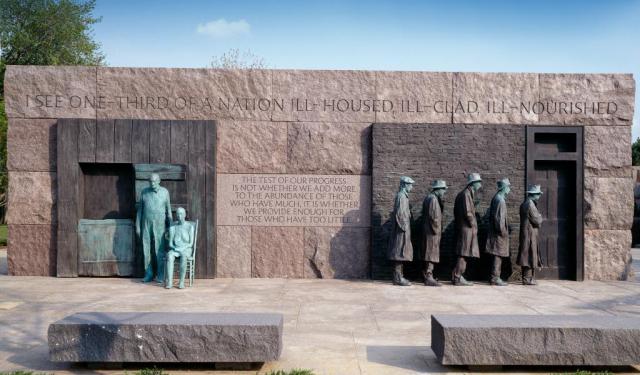
The Franklin Delano Roosevelt Memorial is a presidential memorial dedicated to the memory of U.S. President Franklin Delano Roosevelt and to the era he represents. For the memorial's designer, landscape architect Lawrence Halprin, the memorial site represents the capstone of a distinguished career, partly because the landscape architect had fond memories of Roosevelt, and partly because of the sheer difficulty of the task. Dedicated on May 2, 1997 by President Bill Clinton, the monument, spread over 7.5 acres, traces 12 years of the history of the United States through a sequence of four outdoor rooms, one for each of FDR's terms of office. Sculptures inspired by photographs depict the 32nd president alongside his dog Fala. Other sculptures depict scenes from the Great Depression. A bronze statue of First Lady Eleanor Roosevelt standing before the United Nations emblem honors her dedication to the UN. It is the only presidential memorial to depict a First Lady.
Image Courtesy of Flickr and onecle
Sight description based on wikipedia
Lincoln Memorial
14) Lincoln Memorial
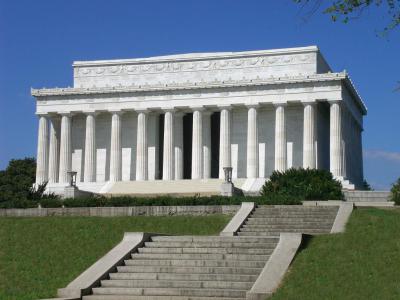
The Lincoln Memorial is one of the most famous monuments and historical places in the United States. It is a nationally recognized location that was built in honor of the Abraham Lincoln, who was the 16th President of the United States, during the bloody years of the Civil War. The monument is a fine example of a classic Greek Doric temple. Even the sculpture of the President which resides there is done in Olympic Godlike fashion. Two well known speeches from the former President are also engraved there: the Gettysburg Address and Lincoln’s Second Inaugural Address. The Lincoln Monument Association was form two years after the death of the President. Planning for the memorial, though, stretched out until 1901. The Lincoln Memorial Bill was signed by President Taft in 1911. Interestingly, the entire monument was built for $2 million dollars. Today, the site is still famous as the location for many historic speeches, like the “I have a dream” speech by the Rev. Martin Luther King. It has also been the site for many famous protests. The Monument is cared for by the National Park Service, and is listed on the National Register of Historic Places. The monument is open 24 hours a day.
Image Courtesy of Wikimedia and David Bjorgen
Sight description based on wikipedia
Vietnam Veterans Memorial
15) Vietnam Veterans Memorial
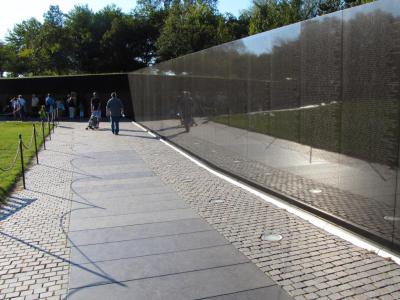
When most people think of the Vietnam Veterans Memorial (VVM), they typically envision the Vietnam Veterans Memorial Wall. There are two other components to the memorial: The Vietnam Women’s Memorial and the Three Soldiers statue. All three components are located in Constitution Gardens of the National Mall. The U.S. involvement in Vietnam began in 1959. The last US service man died in Vietnam on May 15, 1975. Throughout this time the country had varying degrees of support for the war. One of the precepts of the VVM was to not let any of the controversy mar the honoring of the service men and women who served during that time. Even though the memorial itself has had some controversy, time is healing the wounds. The somber reflecting wall with all the names etched into stone lets visitors to the VVM focus on the sacrifice that has been made. There are currently 58,267 names listed on the wall of service personnel that were killed in action or missing in action. There are no civilian names listed on The Wall. The Vietnam Women’s Memorial is situated just south of The Wall. It shows three uniformed women helping a wounded soldier. The women’s names are Faith, Hope and Charity. A total of 59 women died during the Vietnam War, 8 were service women, and 59 were civilians there in a support role. The Three Soldiers portion of the VVM was created amid the controversy that surrounded The Wall. Some members of congress wanted a more traditional memorial. The bronze statues of the service members depict the soldiers wearing the common gear of the Vietnam War. They are positioned so they are looking at the names on The Wall. The VVM is open 24 hours a day with rangers available to answer question from 9:30 A.M. to 11:30 P.M. There are directories at the entrance to The Wall to help you find a specific name. There are also several websites that list the names on The Wall.
Image Courtesy of Flickr and Américo Nunes
Sight description based on wikipedia
Attractions Map
Visitor's Comments (0)
Visitor's Gallery (0)