Beijing has been a political, educational, cultural and economic center for centuries. Today, it is one of the greatest remnants of the Chinese Imperial past. Along with its famous Great Wall and Forbidden City, this sightseeing tour will guide you through Beijing's most popular attractions:
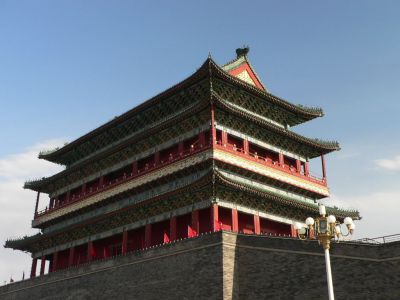
1) Zhengyangmen
When you visit the historic Beijing city wall, do not miss out the Zhengyangmen, a gate on this wall. Popularly called the Qianmen, this wall was constructed during the Ming Dynasty in 1419. The gate featured a large barbican all with an archery tower, the side walls and the side gates. Direct entry to imperial city was guarded by this gate.
Qianmen Station, the first railway station in the city was constructed just outside the gate. During the Boxer Rebellion of 1900, extensive damage was done to this gate. In 1914, the gate was completely reconstructed and restored to its original glory. In 1915, the Barbican side gates were completely damaged and torn down.
The People’s Liberation Army Beijing garrison occupied the Zhengyangmen gatehouse in 1949 after the victory of Communists. The gate became a major tourist attraction after the military vacated in 1980. This gate stands tall at 42 meters and is the highest gate in the city wall. On your trip to Beijing, make sure that a visit to Zhengyangmen gate house is in the itinerary. This is a must visit destination that offers visitors a deep insight into an interesting portion of Chinese history.
Image Courtesy of Wikimedia and Nagyman
2) Tiananmen Square
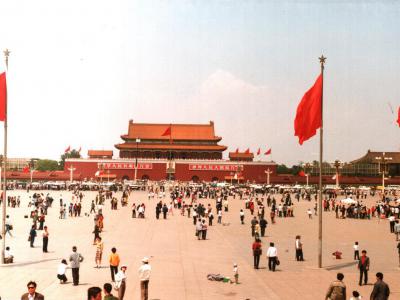
The name Tiananmen Square is immediately associated with Beijing. This popular square is at the centre of the city. Tourists flock from around the world to this square that features the Tiananmen tower, Mao Zedong Memorial Hall, the Monument to the People’s Heroes and the Great Hall of the People.
Functionally this square was Forbidden City’s front door. Constructed during the Ming Dynasty in 1417, the square was used to inform people when there was change of ruling power. The tower located to the north of the square was accessible only to the aristocrats and royal family and was not open to public until 1911 when feudal rule came to an end. Monument of People’s Heroes, constructed in 1952 is the largest in China. This granite monument is located at the centre of the square.
Great Hall of the People is located to the west of the square. Constructed in 1959, this hall is an impressive site where prominent diplomatic activities and political meetings are held. To the south of the square, you can find the Memorial Hall of Chairman Mao. Chairman Mao’s body is kept here in a crystal coffin and decorated with flowers.
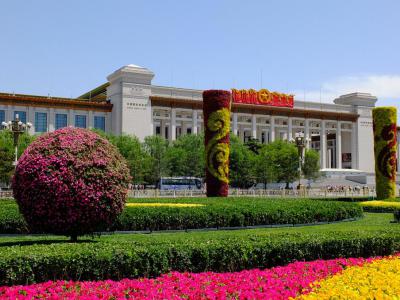
National Museum of China is located to the square’s eastern side. This museum showcases the country’s rich history. Above the Square, flying high in the sky, you will find the majestic Chinese national flag. It is indeed a grand moment when the flag is raised by the guard of honor. To witness this moving moment, you must be at the Square very early in the morning.
Image Courtesy of Flickr and d'n'c
3) Beijing Opera
If you wish to enjoy the quintessence of China, you must not miss the Beijing Opera on your trip to Beijing. Also known as the Oriental Opera, this is the biggest form of Chinese opera in existence for the past 160 years.
Beijing Opera has witnessed an abundance of repertoires, opera troupes, artists and spectators through ages. Developed from the “Huiban”, a local drama art of the 18th century China, Beijing Opera has grown into a scenic art that integrates literature, performance, music, face-painting and aria.
Ever since it came into existence, Beijing Opera has had different names such as Pingju, Daxi, Jinghuang and Jingxi. Four artistic methods namely dancing, dialogue, singing and martial art are used by the artists in Beijing Opera to present dramatic figures and plays.
Male characters, known as Xiao Sheng and Lao Sheng, are the two groups of male characters in the opera. Xiao Sheng refers to beardless young men and Lao Sheng to bearded middle-aged wise men. Dan or female characters, on the other hand, are subdivided into Laodan - a senior woman, Huadan - little girls at the bottom rung of society, Zhengdan - a middle aged, strong woman, and Wudan - a female fighter.
Simple settings and stage properties based on real life experiences are used in Beijing Opera performances. On your visit to Chinese capital, do not miss out the unique and interesting opera experience.
Image Courtesy of Flickr and Saad.Akhtar
4) The National Museum of China
If you are an art lover, you must not miss a visit to the National Art Museum of China on your trip to Beijing. This museum has an extensive display of contemporary and modern art collections.
Title board of the museum was inscribed in Chinese language by Chairman Mao Zedong in 1963. Chinese ethnic architecture is portrayed by the style featured in the main building that is surrounded by pavilions and corridors. The roof is covered with yellow glazed tiles.
National Art Museum of China spans an area of 18,000 square meters. The five storied building has a total of 17 exhibition halls. Visitors from around the world flock this museum to view the vast collection. Some of the prominent collections here include masterpieces from the early Republic of China, the Qing Dynasty and the Ming Dynasty.
You will also find contemporary and modern art pieces, among them award winning works from other art exhibitions by renowned Chinese masters and folk artists. Works of famous painters such as Wu Changshuo, Ren Bonian, Xu Beihong, Qi Baishi, Huang Binhong, Wu Zuoren, Li Keran, Situ Qiao, Jiang Zhaohe and Wu Guanzhong are displayed here alongside a variety of works by foreign artists. Make sure to see the four Picasso’s oil paintings. Enjoy a visit to the National Art Museum of China that stands in all its glory and offers aesthetic education to the public.
Image Courtesy of Wikimedia and BrokenSphere
5) Wangfujing Street
Wangfujing Street is a very popular street in Beijing. This street is 1500 meters long and is well known for its combination of commerce, culture, modernity and tradition. Starting from the East Changan Street, Wangfujing Street extends to the China Art Museum.
You can find a relief sculpture measuring 70 square meter on the Women’s Department Store’s southern wall. Do not miss out the symbolically restored ancient well after which the street was named. Some of the prominent tourist attractions close to the street include the Tiananmen Square and the Forbidden City.
As you walk around this charming and attractive street, enjoy browsing around the 200 odd shops. Some of the most popular shopping spots here include Wangfujing Book Store, Beijing Department Store, Sun Dong An Market and Donghuamen Night Fair.
The Catholic Church on this street was originally built in 1905. This church was refurbished in 2000 and today stands in all its glory lit by bright lights. There are many luxury hotels around Wangfujing Street where tourists prefer to stay. Some of the popular hotels include The Grand Hotel Beijing, Beijing Hotel, Taiwan Hotel, Peace Hotel, Palace Hotel and Tianlun Dynasty Hotel.
A visit to this street is a must on your trip to Beijing. Shop to your heart’s content for exclusive Chinese artifacts and enjoy delicious food at any of the fine dining restaurants here.
Image Courtesy of Wikimedia and Nggsc
6) Donghuamen Night Market
Do you love eating delicious food? Especially on a holiday, every traveler loves to enjoy mouthwatering, good local cuisine. If you are planning a visit to Beijing, it is a good idea knowing about one of the best places where you will find amazingly tasty and unusual food.
Donghuamen Night Market is where you will find a rich variety of foods including snake meat, fried scorpions, sea horses, starfish and ostrich heads. A visit to this market will ensure that you go back with a hugely satisfied stomach.
This market is located to the north of Wangfujiang shopping street and to the east of the Forbidden City. The one and a half kilometer market was opened in 1984 and is named after its address, Donghuamen Street. Today it is one of the most popular street markets in Beijing frequented by thousands of foreigners and locals every day.
Just walk around the market and you will be impressed with the extensive range of food from various Chinese provinces. Food stalls here offer the most authentic and unlikely delicacies such as centipedes, chicken hearts, dog meat, silk worms and goat testicles.
This exotic street market will certainly be a culture shock for many. An average Westerner will be overwhelmed on their memorable visit to the market by the noise, stink of raw meat and eager salespeople. Donghuamen Night Market, as the name suggests, is open only at nights. Food is offered at cheap prices enabling visitors to enjoy unique delicacies without breaking their banks.
Image Courtesy of Wikimedia and Samflash
7) Forbidden City
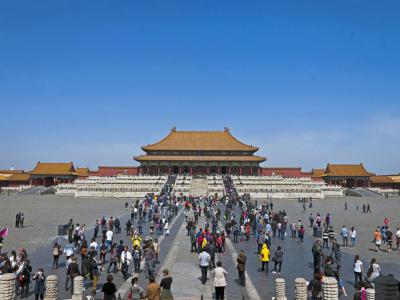
A trip to Beijing is incomplete without a visit to Forbidden City, the huge, majestic and best preserved imperial Chinese palace. This impressive and gorgeous palatial structure is the very epitome of splendid architecture. Forbidden City in fact showcases the essence of traditional architecture of this country.
This Palace Museum houses precious historical and cultural relics of China. In 1961, it was listed by the Chinese central government as a historical monument to be specially preserved. Forbidden City was declared by UNESCO as World Cultural Heritage in 1987.
This palace is listed along with four others as the five most important palaces in the world. It was home to 21 Ming and Qing dynasty emperors between 1368 and 1911. In keeping with the traditional beliefs, the palace was constructed to resemble the Purple Palace in heaven, believed to be the residence of God. Entry for ordinary people was forbidden and hence the name Forbidden City.
This palace is built over an area of 72 hectares. There are 8704 rooms, 980 buildings and 90 palaces with a total of 150,000 square meter total floor space. Structures including the palace and all the gates of the Forbidden City are arranged around Beijing’s south-north central axis.
A ten meter high wall encloses this complex of 3,430 meter circumference. The moment you reach this impressive complex, you will be stunned by the magnificence of the four watchtowers at each corner and the moat that acted as the first line of defense.
Image Courtesy of Wikimedia and Kallgan
8) Jingshan Park
Jingshan Park is a popular tourist attraction in Beijing. This park is situated at the city’s center on Jingshan Hill and is spread over an area of 230,000 square meters. The royal, spectacular garden features a unique and stunning landscape and is located right opposite Forbidden City’s north gate. You can enjoy an amazing view of the Forbidden City from the peak of Jingshan Park.
Jingshan Hill was laid out in a proper manner during the Ming Dynasty rule though it had been serving as the imperial garden during the Yuan, Ming and Qing dynasties between 1271 and 1911.
Jingshan Park was first opened to public in 1928 and was completely rebuilt with paved paths. Today this park attracts millions of tourists from around the world. The first thing you will see the moment you enter the park’s front gate is the Qiwang Pavilion. Green cypresses embrace this charming pavilion where the memorial tablet of Confucius was worshipped by the emperors. This two-storied, majestic and dignified pavilion features golden-glazed roof and white marble balustrades.
There are five summits in Jingshan Hill and on each summit, you can find a pavilion. There was a copper Buddha statue on each pavilion representing the five tastes namely sweet, bitter, salt, sour and acrid. During the 1900 war, all the statues were destroyed.
Wanchun Pavilion is the most popular among the five located in the middle of the five summits. This is Beijing’s highest point from where you can enjoy a spectacular view of the city. As you stand on the pavilion, to your north you can see the dignified Bell and Drum Towers, the magnificent and resplendent Forbidden City to the South and the White Dagoba Temple and Beihai Park to the West.
Image Courtesy of Flickr and Haldini
9) Beihai Park
Beihai Park is situated at the center of Beijing and is a popular tourist attraction for various reasons. This park is an imperial garden preserved till today with great care. This largest and oldest park lies to the east of Jingshan Park and Forbidden City.
This 1000 year old park was created in keeping with a traditional Chinese legend. More than fifty percent of the 0.71 sq km of the park is covered by a like. The Northern Shore Area, Eastern Shore Area, the Circular City located near the north gate and the Botanical Garden are the four major scenic areas in this park.
You can find the Jade Flowery Islet at the center of the lake. The imposing White Dagoba, focal point of Beihai Park can be found at this islet. White Dagoba Temple is situated right opposite the White Dagoba. As you tour Beihai Park, do not miss any of the beautiful and famous places here such as the Bell and Drum Towers, Zhengjue Hall and the Stone Tablets of Qiongdao Chunyin scattered across the Qionghua Islet slope.
Qionghua Islet stands at the center of the park densely distributed with pavilions, rockeries and halls. Do not miss out the exquisite garden at the Circular City located to the Southeast of the park.
Image Courtesy of Flickr and Canary Wu
10) Xishiku Cathedral
One of the most ornate and grand churches in China, the Xishiku Cathedral is located in the Xicheng District. This Catholic Church affiliated to the Patriotic Catholic Church of China and is home to the Beijing Cardinal Bishop Office.
The Jesuits built this church in 1703 on a land near Zhongnanhai given to them by Qing Dynasty Emperor Kangzi. He gifted the Jesuits with the land in gratitude for treating and curing him of a serious illness. The plaque and calligraphic couplets you find on the door of the cathedral was written by the Emperor.
Emperor Guangxu wished to create a park at Zhongnanhai and moved the cathedral in 1887 to its present location. The park area went on to function as a residence of popular communists such as Zhou Enlai, Deng Xiaoping and Chairman Mao and is today the Chinese Communist Party headquarters.
Today the Xishiku Cathedral stands in all its glory with a rich marble façade. It was redesigned in Gothic style by Bishop Pierre Favier. When the cathedral was besieged by 10,000 boxers during the 1900 Boxer Uprising, Bishop Favier played a major role in successfully defending the church and over 3000 converts. Enjoy the grandeur and soak in the intrinsic essence of this popular Cathedral on your trip to Beijing.
Image Courtesy of Flickr and Gene Zhang
11) The Palace of Prince Gong
The Palace of Prince Gong was constructed during the Qing Dynasty rule between 1644 and 1911. This is a stately mansion preserved with care till today. It is also the largest mansion in Beijing and is located to the north of Shichahai at Qianhai Xijie.
The Palace of Prince Gong is especially known for its cultural connotations and grand architecture. It exudes an aesthetic value and is a treasure house for those who wish to study the bygone feudal society’s elite class lifestyle.
This mansion was originally the residence of an intelligent and handsome imperial guard Heshen’s residence. It was remodeled as the palace in 1777 and stands in all its glory till today. Emperor Qianlong of the Qing Dynasty especially noticed this bright twenty five year old guard and swiftly promoted him to higher positions. In charge of civil servant appointments and finance control, Heshen rapidly became wealthy.
After the demise of the aging king, his son Emperor Jiaquing who ruled between 1796 and1820 executed Heshen for his corrupt activities and confiscated his property. In 1799, the mansion was passed on to Emperor Jiaqiing’s successor Prince Qing and then on to Emperor Xianfeng. Prince Gong received ownership of the mansion which was eventually named after him.
The traditional courtyard, the living quarters with three courtyards and the 40 rooms in this mansion is definitely worth a visit on your trip to Beijing.
Image Courtesy of Flickr and onion83