

Home City Search Strasbourg City Orientation Tour of Strasbourg
City Orientation Tour of Strasbourg, Strasbourg
Download iPhone Walking Tours Application for Strasbourg
iPhone Walking Tours Application for Strasbourg
Bookmark and Share
City Orientation Tour of Strasbourg
Guide Location: France » Strasbourg
Guide Type: Self-guided city tour
# of Attractions: 15
Tour Duration: 3 hour(s)
Transportation Mode: by foot
Travel Distance: 6.3 km
Image Courtesy of Flickr and Fr Antunes
Author: irenebo
Strasbourg is the capital of the Alsace Region in France and is referred to as the "crossroads of Europe". The Grande Ile, the city's historic center, was named "the World's Heritage" by UNESCO. You will find culturally historical treasures mixed with modern attractions scattered all around the city. This tour will take you to some of the most significant sites in Strasbourg.
Tour Stops and Attractions
Place Kléber
1) Place Kléber
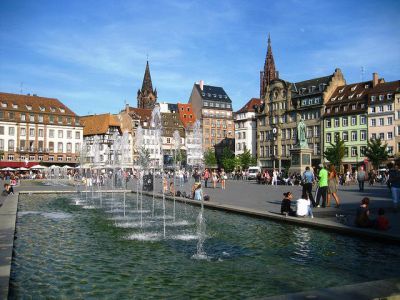
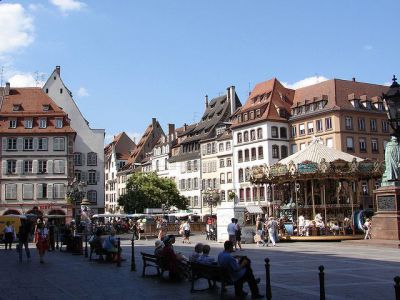
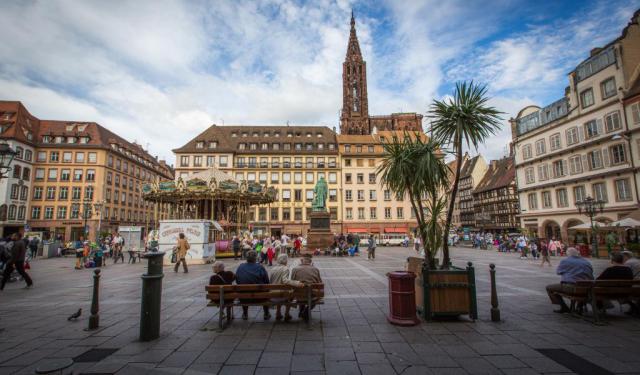
It is well worth taking time to visit the Place Kleber which is the biggest square in the heart of the city’s commercial district.

The square has been a central meeting place since it was laid out in the 14th century and it took its name in 1840 after the General Jean Baptiste Kleber, whose statue stands in the center of the square. The statue was erected in 1838 by Philippe Grass. The general’s remains are in a vault under the statue.

The general served in Napoleon’s army during the campaign in Egypt in 1798 and 1799. When Napoleon returned to Paris, he named the general Commander of the French Forces. Kleber was assassinated in 1800 in Cairo. His body was repatriated and kept in the Chateau d’If off the Marseille coast until being interred in his native Strasbourg thirty years later.

An interesting building along the north side of the square is the Aubette, built in 1772 by Jacque-François Blondel. Once a military post, it was given its name in the 19th century, from the dawn (aube) changing of the guard.

In 1928 the artists Jean Arp, Theo van Doesburg and Sophie Taeuber-Arp decorated the dance hall; this work of art is called the “Sistine Chapel of Abstract Art”

The Aubette today is a leisure center that often holds art exhibitions. One part of the building has been a shopping mall since 2008.
Image Courtesy of Wikimedia and Demonwhip
Antiquités Bastian
2) Antiquités Bastian
Antiquites Bastian is located in the heart of the city. Here you will find a huge assortment of historical objects, such as furniture and ceramics, with some dating all the way back to medieval times.
Image Courtesy of Flickr and ctruongngoc
Cathédrale Notre-Dame
3) Cathédrale Notre-Dame
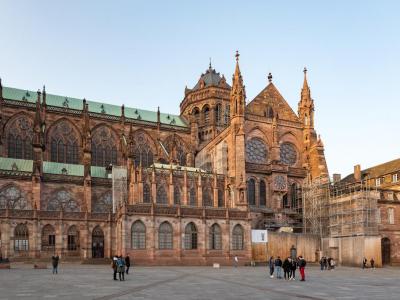
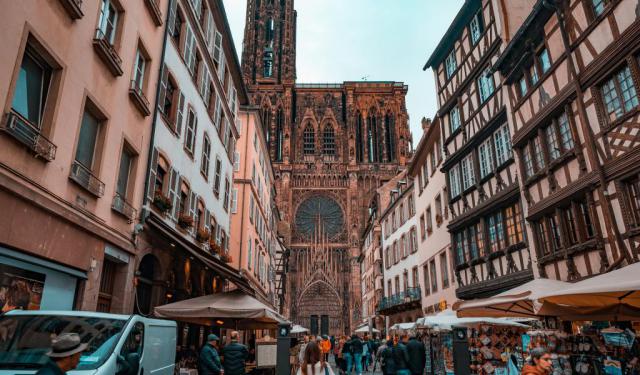
Until 1874 the Cathédrale Notre Dame was the tallest church in the world; today it is the 6th tallest and its tower dominates the Strasbourg skyline.

The ground on which this magnificent edifice stands has been used for religious purposes for over 3000 years: in 12 BC a Roman sanctuary was built here with shrines to at least three of their gods; when Christianity arrived in the region a temple to the Virgin Mary was built over the ruins of the sanctuary.

The 1st cathedral was built in the 7th century and was replaced by a larger one in the 8th century. This in turn was supplanted by another in 1015 Romanesque building with wooden naves, which burned down in 1176.

The cathedral you can visit and admire today took many centuries to finish and has three distinctive styles. Only the crypt dates back to 1015 and it has been expanded over the centuries.

The North Transept and the Quire were built in the Romanesque style. In 1225 the Gothic style was introduced by stonemasons from Chartres and the statue of the “Pillar of Angels” in the South Transept was sculpted during the same period. The famous West Front with its 1000’s of sculpted figures representing the saints, the martyrs and the Virtues is a magnificent example of the Gothic style.

The North Tower, built in 1439, is 142 metres high and on a clear day you can see for over 30km from the observation level. The Lawrence Portal in the North Transept was finished in 1505 in the Renaissance style.

Most of the statues in the cathedral are copies of the originals which can be seen the Museum de l’Oeuvre Notre dame. The stunning Astronomical Clock, built in 1843 to replace an earlier clock, is 18 metres high and is one of the largest in the world.
Image Courtesy of Wikimedia and Benh LIEU SONG
Cabinet des Estampes et des Dessins
4) Cabinet des Estampes et des Dessins
The Cabinet des Stamps et des Dessins is a fascinating museum to visit. You will find it on the Place du Chateau not far from the Strasbourg Cathedral.

This small museum (the Gallery of Prints and Drawings) was founded during Wilhelm von Bode’s rebuilding and relocation of the Strasbourg museums in 1890. It is dedicated to drawings, engravings, woodcuts and lithographies from the 14th to the 19th centuries.

The collection is magnificent and comprises over 200,000 items, including Antonio Pollainolo’s 15th century engraving of “La Combat des Hommes Nus” (Battle of Naked Men).

Several works by Albrecht Dürer are on display a 15th century woodcut of Saint Michael killing a dragon and a copper engraving dating back to 1513 called “Le Chevalier, la Mort et le Diable” (The Knight, Death and the Devil).

Other marvelous works are by Augustin Hirschvogel, Heinrich Aldegrever and Rembrandt. The pride of the collection is the beautiful and rare 15th century engraved mask by Maso Finiguerra.

You can admire over 300 items delicately executed and engraved by 16th and 17th century goldsmiths. In another room of the museum is a fine private collection of coins and medals. There is also a collection of original architectural designs.
Musée Archéologique
5) Musée Archéologique
The Musée Archeologique is housed in the basement of Rohan Palace; it is the largest of all the Alsatian museums and one of the best of its kind in France.

It was founded in the 19th century when the historian Jean Schoepflin bequeathed his personal collection to the Society of the Conservation of the Historical Monuments of Alsace.

The items on display are regional archaeological findings dating from Prehistory and comprise an important collection including tools and fossils of mammoths found in the Rhine area dating back to the Paleolithic epoch and human bones found in the Mannlefelsen Grottos from the Mesolithic era.

The Neolithic epoch is represented by human skulls that had been trepanned, early ceramic vases and jewelry made of pearls, horns and boar tusks. From the Bronze Age you can admire bronze bowls and see a skeleton from the Bell Beaker civilization.

In the Iron Age section of the museum you will find the reproduction of a funeral chariot, ceramics and bronze jewelry, while the Gallo-Roman section has a fine example of a funeral stele, part of a Roman altar to the god Mars and bronze statues.

In the section dedicated to the Merovingian epoch there are gold and silver funerary artifacts, ceramics, bowls and vases in engraved bronze, jewelry in molten glass and human remains.
Image Courtesy of Wikimedia and Tangopaso
Musée Alsacien
6) Musée Alsacien
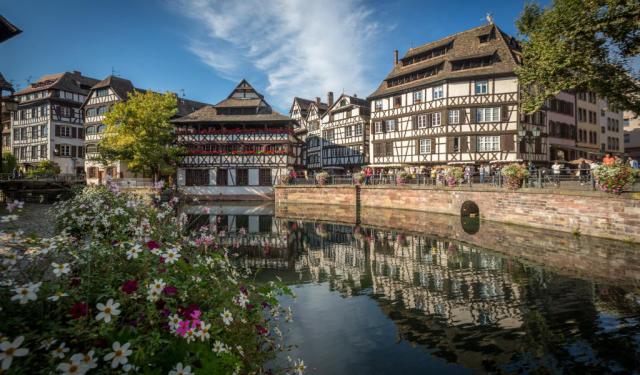
You will love the Alsatian Museum which is housed in various timber framed Renaissance houses on the Quai Saint Nicholas. Unfortunately it isn’t accessible to persons of reduced mobility.

The idea of this type of museum began in 1900 with an article in the “Revue Alsacienne Illustrée”, calling for the preservation of objects from the past for future generations. The museum opened in 1907 with a very pro-French festival that annoyed the German City Council no end. In 1917 the museum was bought by the City of Strasbourg, which was once again under French rule.

You will see over 5000 items devoted to art and folk tradition and rural life in the 18th and 19th centuries. You will find costumes, earthenware crockery, furniture and both religious and non-religious paintings.

The museum tour consists of visiting the city’s old houses that are linked by passageways and stairways. The reconstructed rooms represent Alsace’s wine country, the agricultural plains and the mountain area of the Vosges.

There are also reconstructions of craftsmen’s workshops and an excellent representation of Strasbourg’s Jewish community. When you arrive in the “country kitchen” you almost expect the smell of fresh bead to linger in the air, and the pharmacy displays a mixture of 18th century medicines and alchemy.
Image Courtesy of Wikimedia and Denis.helfer
Galerie L'Estampe
7) Galerie L'Estampe
Galerie L'Estampe can be found in the historical heart of Strasbourg. Its founder, Thierry Lacan, specializes mainly in the making of original contemporary art prints. L'Estampe is one of the largest printing units in France, working with more than 50 recognized international artists.
Saint William's Church
8) Saint William's Church
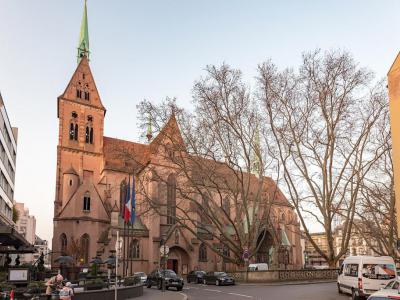
The rather lopsided aspect of Saint William’s Church is only one of its charms and it is one of the most beautiful churches in Strasbourg.

A monastery was built on the marshy banks of the River Ill in 1307 by Hénri de Mullenheim, a knight who survived the Crusades and who wanted to give thanks for his safe return to his homeland. It was the home of the mendicant monks of the Order of the Hermits of Saint William, but only the church remains of the original monastery.

As it wasn’t far from the wharfs, in 1331 it became the parish church of the Corporation of Shipbuilders. In the 15th century a second portal was added as well as a triple-arched gallery. It was more or less abandoned during the late 16th century and was extensively restored in the 17th century.

One of the most important relics in the church is a 14th century tomb effigy – a wooden relief in polychrome depicting the conversion of Saint Catherine and Saint William. The pulpit dates back to 1656 while the altar was installed in the 18th century.

Although the organ was installed in 1987, the organ cases belong to an original instrument built by Andreas Silbermann in 1728.
Image Courtesy of Wikimedia and Jonathan M
Tomi Ungerer Museum
9) Tomi Ungerer Museum
The Museum of Tomi Ungerer is to be found in the Villa Greiner on Avenue de la Marseillaise, and you shouldn’t miss a visit to this interesting museum
The museum was opened in 2007 by the City of Strasbourg to honor one of its most illustrious children. Tomi Ungerer is an author, a draftsman and a wonderful illustrator and he donated 1000 drawings, engravings and 6000 toys from his personal collection.

He is French-German and was born in Strasbourg in 1931. As an adult he lived in Canada and the United States where he designed posters for films and theatrical performances. He also illustrated posters for the CND movement, and made his views on fascism, racism and the Vietnam War clear in his political posters.

The museum dedicated to his works takes up two rooms, painted in white, the better to expose the vibrant colours of his work. His favorite drawings are those he did to illustrate his children’s books, but he has also written and illustrated erotica for adults.

He has illustrated over 140 books for children, including “Otto: the Autobiography of a Teddy Bear” and his own, rather satirical view of the Matchstick Seller and Little Red Riding Hood.
Image Courtesy of Wikimedia and Ji-Elle
Place de la République
10) Place de la République
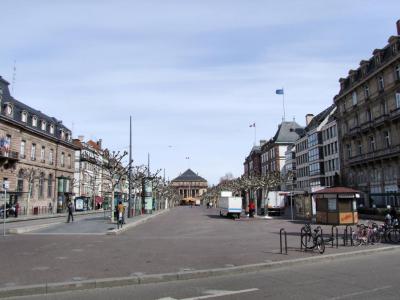
Place de la République is located in the un-official "German" district of Strasbourg. It serves as the junction between the historic city and new city and is surrounded by prestigious buildings that include the National Theatre, the University Library of Strasbourg and the Palais du Rhin. The "A Nos Morts" monument that sits in this square was erected in 1936 in memory of the children who died during World War I.
Image Courtesy of Wikimedia and Jonathan M
Saint Paul Church
11) Saint Paul Church
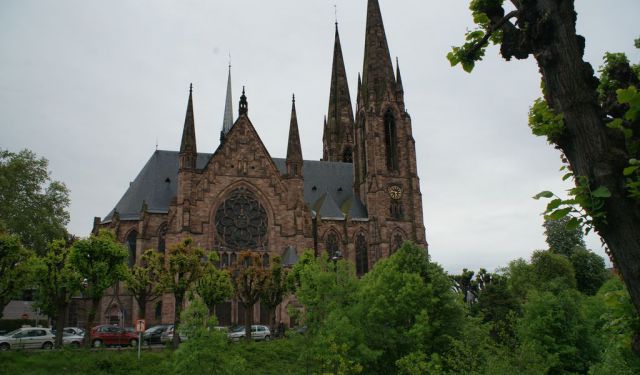
Strasbourg offers many wonderful sites to visit and you will be hard pressed to choose among them, but don’t miss Saint Paul’s Church which stands in Gothic Revival splendor on the south bank of an island in the center of the widest part of the River Ill.

This magnificent church was built in 1897 for the Lutheran congregation of the Imperial German Army who were billeted in Strasbourg. The graceful twin spires are 76 metres high and dominate the skyline.

If the church is wider than its length and has 19 separate entrances, it is because the army had a defined idea of what was due to each rank, so the portals were assigned from the Emperor – when he was in residence – to the generals down to the lowly foot soldiers.

The architect was Louis Muller and he based his designs loosely on the beautiful Elizabeth Church of Marburg, with the 3 huge ornate rose windows copied from the smaller one in St Thomas’ Church.

The building was damaged during the Anglo-American bombing in 1944, as were the stained glass windows. The windows suffered further damage during a terrible hailstorm in 1958 and the only remaining original ones are to be found along the nave and the eastern and southern rose windows.

Under the rose window in the eastern transept you will see the heraldic banners of Alsace, Baden, Bavaria, the Empire, Mecklenburg and Prussia. The pipe organ dates back to 1897 and is one of the biggest in Alsace.
Image Courtesy of Wikimedia and Richieman
Le Pont Kennedy
12) Le Pont Kennedy
Le pont Kennedy takes it's name because of its location in the vicinity of the Consulate of the United States. It is also known as the "Four Men's Bridge", because it is surrounded by four monumental sculptures in sandstone, each representing a worker in action.
Image Courtesy of Wikimedia and Klaus D. Peter, Wiehl, Germany
Palace of Europe
13) Palace of Europe
If you have visited several of Strasbourg’s magnificent ancient buildings before heading for the Palace of Europe, don’t get a fixed idea that it will look like something out of a German fairy tale or you’ll be rather shocked but its startling and somewhat aggressive modernity.

It looks more like a futuristic scientific building where strange experiments are carried out than a palace, but actually it has been the home of the Council of Europe since 1997.

After the Second World War the assemblies took place in one of the buildings in the University; in 1950 the Council moved to the House of Europe, which was pulled down in 1977 and became the lawns of the new building.

The palace is square and rather like a fortress, with its sloping walls of glass, sandstone and steel. In the central courtyard are two domed buildings, the larger one being the Assembly Chamber, the smaller one is the Debating Chamber.

The palace is 38 metres high and has a floor space of 64000 square metres, with 17 meeting rooms and 1000 offices for the Council’s secretariat. It also houses the office of the Secretary General of the Council of Europe.

The palace is used by the Committee of Members, the Congress of the Council of Europe and the Parliamentary Assembly of the Council of Europe. It is open to the public only by official guided tours, which are very interesting and informative about the functions of the Council of Europe.
Image Courtesy of Wikimedia and High Contrast
European Court for Human Rights
14) European Court for Human Rights
The European Court of Human Rights is recognized by 47 European countries, but it is not part of the European Union. It was established in 1959 as a Commission and became a full-time court in 1998 when the European Commission of Human Rights was abolished.

The court is housed in an ultra-modern building made of steel and glass and that uses natural light and ventilation in an effort to be planet friendly. The building is designed to be people friendly and inviting; from an aerial point of view it looks a little like a giant bug with two circular chambers like eyes on each side of the entrance hall, with myriad offices in the “tail” behind it.

It was designed by Sir Richard Rogers (London) and Claude Berger, a local architect. At its early stages the designs were enlarged to make a bigger building due to the fall of communism. The architects didn’t want the building to be a monument but rather a symbolic landmark and they certainly achieved their aim. There are four slabs from the Berlin Wall in front of the entrance.

The Court Room occupies one of the circular chambers that is 28000 square metres and has 342 seats all told. The Commission Room in the other chamber covers 520 square metres. There is a large Deliberating Room, a Projection Room, 420 offices and a cafeteria.
Image Courtesy of Flickr and Eugene Regis
The European Parliament
15) The European Parliament
The European Parliament is housed in the Louise Weiss Building in the Wacken district of Strasbourg, and you can book tickets to sit in the public gallery of this most important institution.

Louise Weiss was a Member of the European Parliament and the building that bears her name called so in her memory and inaugurated in 1999. It was designed by Architect Studio and is a huge building, covering 220,000 square metres of floor space, making it one of the biggest buildings in Europe.

The building comprises 18 assembly rooms, 1133 offices and the famous Hemicircle, so reminiscent of a Roman amphitheatre. It has 785 seats for the Members of the European Parliament, interpretation rooms in glass-fronted booths around the walls and the press and public galleries above.

The building’s tower is 60 metres high and is actually finished – the half completed look with the open west side, is done on purpose to represent the unfinished work of reuniting the Europe. According to popular belief the tower represents the painting of the Tower of Babel by Bruegel.

There is an inner courtyard named “Bronislaw Geremek Agora” after the Polish Member of the European Parliament who died not so long ago. A covered footbridge links the Parliament building with the Winston Churchill Building on the other side of the River Ill.
Image Courtesy of Wikimedia and Andreas Tille
Attractions Map
Visitor's Comments (0)
Visitor's Gallery (0)