Edinburgh has an abundance of famous cultural landmarks. For history and architectural enthusiasts there is much to see. Edinburgh’s landmarks are plentiful. Although many monuments are in ruins and date back centuries they are all impressive. Take the following tour to discover the most popular landmarks Edinburgh has to offer.
1) Greyfriars Bobby Memorial
Everyone loves a nice, weepy story about love and loyalty, especially if there is an animal involved! In Edinburgh, the people have erected a statue to their favourite four-legged hero and you will find the Greyfriars Bobby Memorial at the south end of the George IV Bridge.
The beginning of Bobby’s history is a little vague: he was either a policeman’s dog or a stray adopted by a “bobby” on his rounds, which would account for his name. The policeman’s name was John Grey and he kept Bobby for two years before dying of tuberculosis in 1858.
Whether Grey lived alone or whether his widow kicked Bobby out after his master’s death, isn’t clear; but the little Skye Terrier found himself without a home, so he made one for himself – on his master’s grave in Greyfriars Kirkyard, where he stayed for the next fourteen years until his death.
Usually dogs aren’t welcome in church yards, but the curator took pity on him and fed him. Other people also gave him food and William Chambers, the Lord Provost of Edinburgh paid every year for his dog licence, without which he would have been destroyed as a stray.
When he died, Bobby wasn’t allowed to be buried on consecrated ground, so he was buried beside the Greyfriars Kirkyard gate. One of the rich ladies of the city had the memorial erected in his name with a double fountain below his statue – the upper one for humans, the lower for animals.
Many versions of the story exist, and a lot of books and films have been made about him. The race of the dog often changes, but Bobby’s character remains the same – a dog who remained loyal to his master beyond the grave.
Image Courtesy of Flickr and Steve Montgomery
2) Heart of Midlothian
While you are exploring the Royal Mile in Edinburgh you might see some of the locals taking part in a rather disgusting ritual as they pass one spot near the west door of St Giles Cathedral. Drawing closer, but being careful to keep out of range, you will see that they are spitting on the Heart of Midlothian.
This is a heart-shaped mosaic set in the cobbled-stone pavement, marking the entrance of a building that was demolished 195 years ago, but which still remains in the memories of the people who grew up in the area, which is why they spit – for good luck.
The building was the Old Tolbooth, which was a medieval customs house, also used for meetings by the Estates of Scotland for a short time. In 1640 it housed the Court of Session the principal jail of the burgh, where prisoners were often tortured before being taken out for public execution in front of the entrance.
According to legend, Edinburgh’s petty thieves and not-so-petty criminals spat on the door as they passed to bring them luck against the day when they found themselves being taken through it.
The building was demolished in 1817 and the heart set into the cobble stones to remind the population of the misery and torture carried out behind the ancient walls.
Image Courtesy of Wikimedia and SeanMack
3) Real Mary King's Close
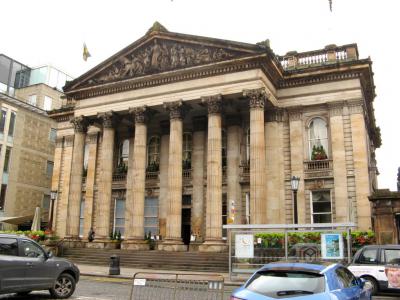
If you are a fan of ghost stories and haunted houses, you’ll love Real Mary King’s Close, which is reputed to be one of the most haunted places in Edinburgh and which can be visited deep under the Royal Exchange building.
The close is a series of winding streets and tenement houses that were used as the foundations of the Royal Exchange, many years after they had been closed off during the Great Plague that struck the city in 1645.
The plague, which came from Europe, was carried here by the fleas on the merchant ships’ rats and infested the poorer parts of the city, where hygiene was minimal to say the least. Carried by flea bites, the plague spread and many of the poorer tenement areas were closed off as urgent quarantine measures.
Mary King’s Close was one of the areas and according to legend, the people left inside the streets and buildings were bricked in and left to die either of the plague or of starvation. Their ghosts, and particularly one of a small girl, named Annie, are supposed to haunt the place.
The area was uncovered during renovations to the building over it and was opened to the public in 2003 as a tourist attraction. Guides in costume dress will lead you through the underground streets, which have been restored to 17th century designs, and tell you the history of Mary King the master seamstress after whom the close was named, and about Annie.
You can leave a toy or make a small donation to the poor little spirit who wanders the streets looking for her favourite doll. All these gifts are in turn given to the hospital for sick children and other charities.
Image Courtesy of Flickr and Kevin Pluck
4) Scott Monument
Sir Walter Scott was perhaps Scotland’s best loved poet and novelist, so it is only natural that the nation wanted to pay him homage. You will find the Scott Monument in Princes Gardens.
When Scott died in 1832 an architectural competition was launched to build a monument in his honour. A great many noted architects submitted their ideas; the winning design was by George Meikle Kemp, a draughtsman who had no architectural experience, so he had submitted his design under the name of “John Morvo”, who had been a 15th century stonemason and architect.
The 61 metre high monument has several viewing galleries reached by narrow winding stairways. The highest gallery is reached after climbing 287 stairs and when you reach the top you are given a certificate to prove that you survived the climb!
The monument was built out of Binny Sandstone, a substance so oily that it attracts dirt very fast, so that a year after the construction was finished, it looked as if it had been there for centuries. The American author, Bill Bryson described it as a “Gothic rocket-ship”.
The lovely marble statue of Sir Walter, seated with his writing implements and his faithful dog at his feet, was sculpted by John Steell. The 64 statues decorating the monument feature characters from Sir Walter’s books. You will also see many grotesques – those hideous character faces so beloved by Gothic architects, which Kemp included in his design to add to the monument’s “ancient” appearance.
Image Courtesy of Wikimedia and Adambro
5) Melville Monument
While you are in Edinburgh, you will probably visit St Andrew Square and in the middle of the lovely gardens you will find the Melville Monument.
The monument was erected in 1823 in honour of the 1st Viscount of Melville, Henry Dundas, a politician who wielded so much power that he was known as the “uncrowned king of Scotland”. He was also the 1st Lord of the Admiralty and the monument was paid for by officers and sailors of the Royal Marines Scotland.
It was designed by the great architect William Burn, who modelled it on Trajan’s Column in Rome, but without the intricate inscriptions. It is 42.6 metres high and during construction the residents were worried that the foundations wouldn’t be strong enough for it, so William Burn turned to Robert Stevenson for advice.
Stevenson was a noted lighthouse architect and he had developed the first line-balance crane in the world in 1813, while he was overseeing the construction of the Bell Rock Lighthouse. He put his crane into good use once again and the monument was raised with little problem onto the solid foundations he designed.
The statue of Dundas on the top of the monument was sculpted by Francis Chantrey and Robert Forrest and was added in 1828.
Image Courtesy of Wikimedia and Jonathan Oldenbuck
6) Dugald Stewart Monument
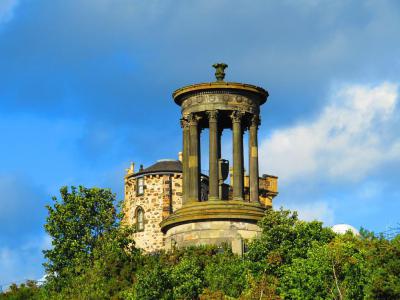
Edinburgh’s Calton Hill is a fascinating place to visit with its fine buildings and monuments. Some of these monuments have been raised for famous people or events, but the Dugald Stewart Monument remains a mystery for many people. Just who was Dugald Stewart and who had a monument be raised in his name?
To answer the second part of the question first – the monument was commissioned by the Royal Society of Edinburgh in 1831. It was designed by William Henry Playfair, who modelled it on the Choragic Monument of Lysicrate, in Athens. It is one of the many Greek Revival structures in the Calton Hill area.
Dugald Stewart was a Scottish Enlightment Philosopher who was responsible for the predominance of Scottish Philosophy in Europe at the beginning of the 19th century. He held the chair of Moral Philosophy (Ethics) at the University from 1785 to 1810 and although his ideals are considered out of date today and he is mostly forgotten, in his day, he was highly respected for his views.
The Scottish Enlightment Movement, of which he was an important member, believed that, guided by reason and virtue, man could bring about great changes for the better in nature and society.
Image Courtesy of Wikimedia and Morpheus1703
7) Nelson's Monument
Another monument worth visiting while you are on Calton Hill is the Nelson Monument, which was put up in honour of Horatio Nelson’s victory at the Battle of Trafalgar in 1805 and his subsequent death from wounds sustained during the battle.
The monument was built in 1815 on the highest point of the hill, on the site where a mast was once used to send signals to ships entering the Firth of Forth. The monument was designed by the architect Robert Burn in the appropriate form of an up-ended telescope.
It is 32 metres high and its 143 stairs lead to the public gallery, where you will have a wonderful view of the city and the Firth.
In 1853 the Astronomer Royal of Scotland, Charles Piazzi Smith commissioned a time ball to be placed on top of the monument. The ball was connected to the City Observatory by an underground wiring system.
Each day, just before one o’clock in the afternoon the ball was raised and at 1pm precisely it was lowered. Ships in the Firth set their marine chronometers by the time ball. Accurate time-keeping helped sailors determine their longitude once they were out at sea.
The time ball was in use until 2007 when it was damaged in a storm. It was restored and brought back into use in 2009, but as the City Observatory is now closed, the raising and lowering of the ball is done mechanically from a room at the bottom of the monument.
Image Courtesy of Wikimedia and Stuart Caie
8) National Monument
The National Monument stands in unfinished splendour on Calton Hill and has been called a lot of names over the years, such as “Edinburgh’s Folly”, or “The Shame of Scotland”, but the idea behind building it was neither a folly nor a shame.
The idea to build a monument to the Scottish soldiers and sailors who died in the Napoleonic Wars of 1803 to 1815, was a good one; the only problem was that when asked to put their hands in their pockets, a lot of people lost their initial enthusiasm for the venture.
The monument was designed in 1823 by William Henry Playfair and Charles Robert Cockerall, but they kept fiddling with it and changing it until producing a final draft in 1826. They modelled it on the Athenian Parthenon and from the outset it should have been obvious that they had set their sights too high.
Building started in 1826 and 12 columns were built, along with the foundations and the inscription, which turned out to be rather ironic: “A Memorial of the Past and Incentive to the Future Heroism of the Men of Scotland”.
Funds finally ran out completely in 1829 and the monument you can see today hasn’t been touched since. Several proposals have been put forward over the years to complete the monument, but these plans have come to nothing.
Image Courtesy of Wikimedia and Stuart Caie