Mexico City is considered to be one of the most interesting and diverse cities in the world. It is one of the world's largest cities, being the cultural, financial and political center of Mexico. Mexico City features a wide range of exciting things to see and do. Take this city orientation walking tour to explore some of the most famous tourist attractions in Mexico City.
1) Alameda Central Park
Located between Juarez Avenue and Hidalgo Avenue in Mexico City lies a green oasis called the Alameda Central Park. The paved park has landscaped gardens, fountains and statues and is the venue for many civic events held by the city.
The site of Alameda Central Park was once an Aztec marketplace. The location became a park in 1592 under the orders of the then Spanish viceroy, Luis de Velasco. The park was named after the poplar trees, Alamo in Spanish, that were planted to provide shade for visitors. At first the venue was half its present size. Expansions in 1770 and 1791 resulted in the present extent of the Alameda Central Park. The park has been the center of celebrations in Mexico City especially the grand revelry on the day when Mexico attained independence in 1821.
Alameda Central Park has five fountains designed by the French in Greco Roman style. Statues were added to the park in the 19th and 20th centuries. The central kiosk was installed in the late 19th century. The park was lighted in 1868 with gas lamps before electric lamps were installed. Two well known statues at Alameda Central Park are a monument dedicated to Beethoven, donated by the German community, and the Despoire and the Malgre Tout statues sculpted by artist Jesus Contreras.
Alameda Central Park is a green recreational space in the midst of Mexico City where all classes of Mexicans and international visitors can enjoy quiet moments in tranquil surroundings.
Image Courtesy of Wikimedia and Thelmadatter
2) Palacio de Bellas Artes
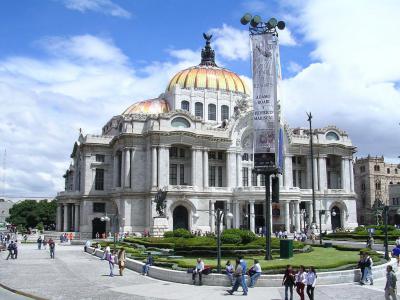
The main opera house of Mexico City, the Palacio De Bellas Artes is not only an arena for musical performances but a treasure house of art and sculpture. It is the home of the National Symphony Orchestra of Mexico, the Bellas Artes orchestra, The Baile Folklorico, The Bellas Artes chamber orchestra and the National Dance Company.
The location of the Palacio De Bellas Artes was first an Aztec temple. The first European structure on the site was the Convent of Santa Isabel. Later the convent was closed down and replaced by lower class housing under the reform laws. In the 19th century, the old buildings were destroyed and a new theatre was built where upper class Mexicans attended operettas, plays and Viennese dances. In 1901 the old structure was demolished and plans were underway to build a new larger theatre as a celebration of Mexican Independence. Italian architect Adamo Boari drew up plans to build an art nouveau and art deco style building but political, economic and geological hurdles stood in the way of the construction of the new opera house. In 1932 Mexican architect Fredrico Mariscal took up the task of constructing the building with Adamo Boari’s plans as the basis. The new theatre opened its doors in 1934.
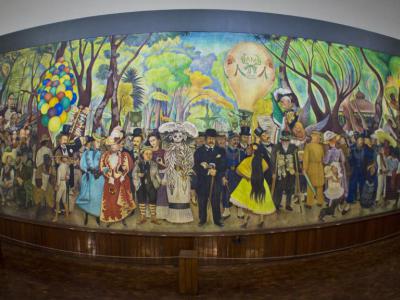
The building has a Beaux Art Exterior and an interior clad in Italian marble. The theatre has extensive murals by great Mexican artists including Diego Rivera, Rufino Tamayo and David Alfaro Siqueros. There is also a unique stained glass curtain that portrays a volcano and a valley in Mexico.
Image Courtesy of Wikimedia and Carolina López
3) Torre Latinoamericana
This monument in Mexico City is a member of the World federation of Great Towers. The architectural beauty and strength of the tower has made it a historical Mexican monument, a symbol of safety and one of the finest examples of construction engineering in the world. The building withstood the powerful earthquakes that destroyed many others in 1956 and 1985 and received the American Institute of Steel Construction Award of Merit.
The Torre Latinomericana, built in 1956, was one of the first skyscrapers in Mexico. The purpose of the tower was to serve as the headquarters of the La Latinoamericana Seguros insurance company. Part of the building is owned by the company even now. Two Mexican engineers, Dr. Leonardo Zeevaert and his brother Adolfo Zeevaert, designed and oversaw the construction with the help of American structural engineer Nathan M. Newmark. The tower stands more than 180 meters high and has 44 floors. It has a steel frame and deep seated pylons. These give the structure stability despite the high seismic activity of the earth below. For its 50th anniversary in 2006, the Torre Latinoamericana underwent renovations including complete refurbishment of the 37th to the 44th floors, the addition of a museum, and the remodeling of the Mirador or observation deck by architect Palle Seiersen Frost.
As one of the oldest skyscrapers in Mexico, the Torre Latinamericana has great historical significance and still remains a wonder of modern engineering in the world.
Image Courtesy of Flickr and LWY
4) Zócalo Plaza
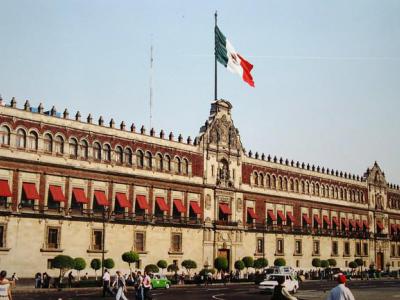
The formal name of the main square in Mexico City popularly called Zocalo is Plaza de la Constitucion. It is the venue of every important Mexican event from the times of the Aztecs.
At first the Zocalo was the center of the Aztec capital Tenochtitlan and extended in front of the palace of the Aztec ruler Moctezuma II. After the destruction of Tenochtitlan, the Spanish conqueror, Cortes built a church that is now the cathedral of Mexico City. The plaza in front of the cathedral was paved with the stones from the palace of Moctezuma after its destruction by the Spanish. The square through history has been frequently flooded and periodically became a marketplace with makeshift stalls. The plaza was also paved and decorated several times over by different rulers and demolished and ransacked by their successors. Extensive repairs and beautification efforts are underway to improve the ambience of the square.
The Zocalo has an area of 57,600 square meters that makes it one of the largest public squares in the world second only to the Red Square in Moscow. The square is an empty space with a large Mexican flag in the center. The flag is lowered every evening at 6 pm and visitors come to view the ceremony. Large gatherings, events and concerts take place at the Zocalo. Recently the largest attendance was for the 2007 performance by Shakira that attracted 210,000 fans.
Image Courtesy of Wikimedia and Victormoz
5) Cathedral Metropolitana
Dominating the Zocalo in Mexico City, the Cathedral Metropolitana, is the oldest and largest cathedral in Latin America. The church is also called the metropolitan cathedral of the Assumption of Mary of Mexico City. Over the centuries the cathedral’s foundations have sunk into the soft soil beneath as a result the cathedral and the nearby chapel did not have a level floor. The efforts of the administration of Mexico City led to its extensive reconstruction and in the year 2000 the structure was removed from the World Monuments Fund’s list of the 100 most endangered sites.
Cathedral Metropolitana was built over the location of the destroyed Aztec palace of Moctezuma. The material used during its construction was from the destroyed palace. The design of the cathedral has several architectural styles including baroque, neoclassic and Churrigueresque. Spanish architect Claudio de Arciniega drew up the initial plans for the structure. The foundations of the building were laid in 1567 and completed in 1788.
The church is filled with paintings, altarpieces and colored statues by well known Mexican artists and sculptors. The cathedral has two bell towers with 25 bells and two of the largest 18th century organs in the Americas. A sound and light show, with a focus on choral music takes visitors on a candle lit walking tour around the cathedral.
Image Courtesy of Wikimedia and Adrian Sampson
6) Templo Mayor
The Templo Mayor located near the Zocalo in the Historic Center of Mexico City contains the ruins of an ancient Aztec temple and a museum containing its artifacts. The temple was dedicated to Huitzilopochtli, the Aztec God of war and Tlaloc, the God of rain. The site became part of the UNESCO World Heritage List in 1987.
The remains of the ancient Templo Mayor were discovered when an electric company found a pre Hispanic monolith in 1978. The monolith had a relief with the image of the moon goddess Coyolxauhqui from the 15th century. From 1978 to 1982, archeologist Eduardo Moctezuma and his team of experts worked to excavate the area that forms the present location of the temple. 13 buildings had to be demolished for the excavation and more than 7000 objects from the ancient Aztec temples were recovered from the site.
A museum designed by architect Ramirez Vazquez was constructed to house the discoveries made during the excavation of the remains of the Templo Mayor. Eight exhibition halls dedicated to different themes make up the museum. Some themes represent different Aztec Gods while others showcase the flora and fauna and the ancient agricultural technology used in the land that now is modern Mexico. Notable remains of the Aztec civilization include the Wall of Skulls, two life size figures of Aztec warriors dressed in Eagle costume and a large pot with a Gods face in blue paint that has not faded through the centuries.
The museum is open from Tuesdays to Sundays and admission on Sunday is free for all. Visitors can make reservations for a guided tour in English.
Image Courtesy of Wikimedia and Soman
7) National Art Museum
The building formerly known as the Communications Palace that served as the main post office in Mexico City now houses the National Art Museum. The museum has a large collection of art from the 16th century to the works of 20th century Mexican artists.
The architect Silvio Contri designed and supervised the construction of the Communications Palace between 1905 and 1911. The building was constructed for the regime of Poforio Diaz a former military dictator of Mexico. The style was an eclectic combination of renaissance and neoclassical styles. The entrance hall has Corinthian columns and an ornate iron staircase designed by the Florentine firm Pignone. The ceiling is decorated with an elaborate allegorical painting representing peace.
The museum houses over 3000 artworks from 1550 to 1955. There are two large art galleries within the National Art Museum that showcase western assimilation and the construction of the nation of Mexico. The collection at the museum includes paintings, drawings, sculpture and ceramics. The museum has paintings by notable Mexican artists including Juan Correa, Miguel Cabrera, Eugenio Landesio and a large collection of landscapes by Jose Maria Velasco.
The museum stays open from Tuesday to Sunday. Admission is free for visitors on Sunday.
Image Courtesy of Wikimedia and SCOTTNICHOLAY
8) Plaza de las Tres Culturas
The main square in the Tlatelolco neighborhood of Mexico City is the Plaza de last Tres Culturas dedicated to the three cultures that make up modern Mexico. The three cultures represent three periods in Mexican history, the Aztec period, the colonial period and the modern Mestizo nation of Mexico.
The plaza was designed by Mexican urban architect and designer Mario Pani and completed in 1966. The square has the remains of the Aztec city of Tlatelolco, the 16th century Santiago de Tlatelolco Catholic Church and a large modern housing complex. The last battle of the conquest of Mexico by the Spanish was fought here on August 13th 1521. The 16th century church is constructed with volcanic stone and has frescos in white plastered walls. There are also deep blue stained glass windows and a stone altar. The location was also the scene of a massacre of protesting students in 1968. A stone memorial called the Memorial ’68 dedicated by the National Autonomous University of Mexico UNAM to the students and other victims of the massacre is erected at the southern edge of the plaza.
Visitors can take a walk through Mexican history from the Aztecs to the 20th century by taking a trip to the Plaza de las Tres Culturas.
Image Courtesy of Wikimedia and Manuel Velez