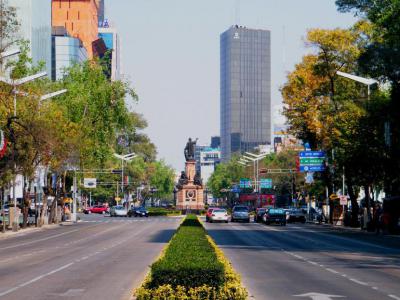
Home City Search Mexico City Exploring Zona Rosa, Mexico city
Exploring Zona Rosa, Mexico city, Mexico City
Download iPhone Walking Tours Application for Mexico City
iPhone Walking Tours Application for Mexico City
Bookmark and Share
Exploring Zona Rosa, Mexico city
Guide Location: Mexico » Mexico City
Guide Type: Self-guided city tour
# of Attractions: 7
Tour Duration: 2 hour(s)
Transportation Mode: by foot
Travel Distance: 4.4 km
Image Courtesy of Wikimedia and Thelmadatter
Author: doris
Zona Rosa, or The Pink Zone is one of the Mexico City's famous neighborhoods. It is located near the historic center of the city. The neighborhood was called the Pink Zone because of the pink tiles that are prevalent here. The area offers amazing Beaux-Art architecture, the city's best handicraft markets and antique shops. Take this walking tour to discover the beauties that Zona Rosa has to offer.
Tour Stops and Attractions
Fountain of Diana
1) Fountain of Diana
The fountain of Diana stands on a roundabout near the Paseo de Reforma in Mexico City. The statue of Diana the Huntress is depicted by the sculptor as aiming her bow and shooting the arrow to the skies.
In 1942, architect Vincente Mendiola and Sculptor Juan Olaguibel were commissioned to build a fountain in a roundabout near the entrance of Chapultepec Park on the Reforma Avenue. The commission was the result of a beautification drive of Mexico City by the then President, Manuel Avila Camacho. A 16 year old secretary, Helvia Martinez was chosen as a model for the fountain. She posed for the sculptor for free knowing that her body would be immortalized in a landmark of Mexico City. On October 10th 1942, the statue was inaugurated. Some sections of the population appreciated the sculpture while ultra conservative sections of society called the Decency League protested against the nude depiction of Diana and forced the artist to put underwear on the statue. Before the 1968 Olympics, it was decided to remove the underwear but the attempt damaged the statue. The statue was removed to Ixmiquilpan, the home town of Juan Olaguibel. By popular demand by artists and citizens, the statue was restored in 1992.
The roundabout at the entrance to Chapultepec Park is decorated by a beautiful fountain and a sculpture that remains a fitting tribute to artistic freedom that survives despite setbacks.
Image Courtesy of Wikimedia and Clinker
El Ángel de la Independencia
2) El Ángel de la Independencia
The focal point for both celebrations and protests, the Angel of Independence serves as a monument of the 100th year of Mexican Independence and as a memorial for its heroes. The statue is located in a roundabout over the Paseo Reforma in Mexico City. The official name of the statue is the Columna de la Independencia.
President Porforio Diaz commissioned the sculpture in 1902. Italian sculptor Aciati made the figures that adorned the structure and architect Antonio Rivas Mercado designed the monument. The first purpose of the Angel was to commemorate the 100th year of Independence of Mexico. In 1925, the monument was also made a mausoleum for heroes. Miguel Hidalgo, the father of the nation, Juan Aldama and Nicolas Bravo are interred beneath the foundations. The angel fell from the pillar in the earthquake of 1957 but was restored to its former glory by sculptor Jose Fernandez Urbina. An eternal flame to honor the interred heroes was added in 1929.
The column is made of steel surrounded by quarried stone. The 36 meter high column is covered with carved garlands, palms and rings. The carved figures contain names of the important personalities who helped to shape the independence of Mexico. The angel on top is 6.7 meters high and is made of bronze coated with 24 carat gold. A hidden staircase within the column takes visitors to the Corinthian style Capital and the angel is lit beautifully for the benefit of those who drive by at night.
Image Courtesy of Wikimedia and Sagitario
Connoisseur Gallery
3) Connoisseur Gallery
Connoisseur Gallery was opened in 1993. It is one of the most famous galleries in Mexico City and a paradise for serious antique lovers. The decor is elegant and it has an amazing collection of art dating from the 15th to the 18th century.
Image Courtesy of Flickr and hortulus
Cinemas Lumiere Plaza La Rosa
4) Cinemas Lumiere Plaza La Rosa
Cinemas Lumiere Plaza La Rosa is located within the Zona Rosa. It has excellent service, with an emphasis on cleanliness and comfort. Lumiere Plaza is a cinema hall with four screens. It is famous for housing a wide variety of art films, and hosting an important number of film festivals.
Image Courtesy of Wikimedia and Rwelizondo
Paseo de la Reforma
5) Paseo de la Reforma
Modeled after the Champs- Elysees in Paris, the Paseo de la Reforma is the main road in Mexico City that runs through the Historic district as well as Embassies and upscale residential buildings. The most visited part of the avenue is the stretch from the Avenido Benito Juarez intersection to the Chapultepec Park.
The Paseo de la Reforma was formerly the Paseo de la Emperatriz or the road of the Empress. It was commissioned by Emperor Maximilian I of Mexico to link his residence at the Chapultepec Castle to the National Palace that flanks the Zocalo. During the reformist reign of President Avenido Benito Juarez, the avenue became the Paseo de la Reforma. It was designed in 1860 by Ferdinand Von Rosenzweig.
The Paseo de la Reforma is 15 kilometers long and 60 meters wide. The road has 6 to 8 lanes and a green strip at the center with a unique design. There is a monument at most of the large roundabouts located at the intersections. Busts of famous personalities who shaped the history of Mexico flank the avenue.
Today, major office blocks, museums, monuments, hotels and cinemas are located on the Paseo de la Reforma. The avenue is also the location of the embassies of the United States, the European Union and the Mexican Stock Exchange.
Image Courtesy of Flickr and mykewithwai
Monument to Christopher Columbus
6) Monument to Christopher Columbus
Located in one of the many rotundas intersecting the Paseo de la Reforma in Mexico City, is a statue dedicated to Christopher Columbus and the Christianization of the Americas.
The plan for installing a statue in honor of Christopher Columbus was conceived during the rule of Emperor Maximilian I. The emperor’s father in law King Leopold I of Belgium expressed his desire to donate a statue of Columbus commemorating the discovery of America. At the time, the Emperor commissioned the architect Ramon Rodriguez Aragoity to design the monument and sculptor Manuel Vilar was to fabricate the figures that would adorn the edifice. The statue was not erected because the Emperor was deposed and executed during the reign of the liberals in Mexico. Later, Antonio Escandon, a loyalist of the emperor and the pioneer of railways in Mexico commissioned a sculpture of Christopher Columbus while in exile in Paris. The sculptor to whom the work was entrusted was Frenchman Henri Joseph Cardier. Escandon later donated the sculpture to Mexico City and it was erected at the location originally planned by Emperor Maximilian.
The statue is placed on a pink pedestal with renaissance art and two stone carvings called the Landing of Christopher Columbus and the Founding of the Church. Four other sculptures are those of the first catholic missionaries who began the task of conversion of the native people of the Americas.
Image Courtesy of Flickr and Hessee
Mercado de Artesanias San Juan
7) Mercado de Artesanias San Juan
Mercado de Artesanias San Juan features many original and traditional handicrafts like pottery, fabric, pewter, wood, silver, precious and semi-precious stones, amate paper and leather. The market has over 100 stores that focus on Mexican hand made souvenirs.
Image Courtesy of Flickr and saguayo
Attractions Map
Visitor's Comments (0)
Visitor's Gallery (0)