Georgian Architecture Walking Tour (Self Guided), Bath
Another prominent attraction of Bath is its wonderful Georgian architecture. Many a street and square here are richly adorned with distinctively stylish buildings. In large part, the city owes it to two architects – father and son: John Wood, the Elder, and John Wood, the Younger. Constructed mostly from Bath Stone, a creamy limestone obtained in Combe Down and Bathampton Down Miles, these 18th-century architectural marvels left an indelible mark on the cityscape and more recently have attracted to Bath visitors from around the globe.
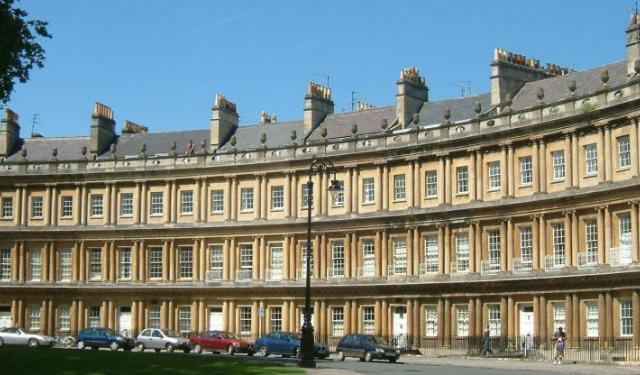
The Royal Crescent, one of Bath's most iconic landmarks, is a crescent-shaped row of 30 terraced houses whose grandeur and uniformity make it a prime example of Georgian style. Each house features three stories with imposing Ionic columns and ornate stucco decoration, creating an imposing yet harmonious facade.
Not far away from it is The Circus, another architectural gem. Designed by John Wood the Elder, it consists of three crescent-shaped terraces arranged in a circular pattern. The Circus showcases Georgian architecture at its finest with its elegant townhouses adorned with decorative elements and a central space occupied by a group of large plane trees.
Bath Assembly Rooms, created by John Wood the Younger, are yet another testament to Georgian grace. These rooms served as venues for social gatherings and cultural events during the 18th century. The grand ballroom, adorned with chandeliers and intricate plasterwork, remains a sight to behold.
Paragon, Camden Crescent, Lansdown Crescent, and Somerset Place are additional Georgian treasures scattered throughout Central Bath. These series of dignified structures are characterized by symmetrical facades, sash windows, and classical details, reflecting the Georgian era's emphasis on proportion, balance, and classical design principles.
Combined, all these sites offer a window through which to marvel at the craftsmanship of yesteryear. To fully appreciate Bath's cultural heritage, embark on this self-guided tour and delve into the architectural genius of the Georgian era!
The Royal Crescent, one of Bath's most iconic landmarks, is a crescent-shaped row of 30 terraced houses whose grandeur and uniformity make it a prime example of Georgian style. Each house features three stories with imposing Ionic columns and ornate stucco decoration, creating an imposing yet harmonious facade.
Not far away from it is The Circus, another architectural gem. Designed by John Wood the Elder, it consists of three crescent-shaped terraces arranged in a circular pattern. The Circus showcases Georgian architecture at its finest with its elegant townhouses adorned with decorative elements and a central space occupied by a group of large plane trees.
Bath Assembly Rooms, created by John Wood the Younger, are yet another testament to Georgian grace. These rooms served as venues for social gatherings and cultural events during the 18th century. The grand ballroom, adorned with chandeliers and intricate plasterwork, remains a sight to behold.
Paragon, Camden Crescent, Lansdown Crescent, and Somerset Place are additional Georgian treasures scattered throughout Central Bath. These series of dignified structures are characterized by symmetrical facades, sash windows, and classical details, reflecting the Georgian era's emphasis on proportion, balance, and classical design principles.
Combined, all these sites offer a window through which to marvel at the craftsmanship of yesteryear. To fully appreciate Bath's cultural heritage, embark on this self-guided tour and delve into the architectural genius of the Georgian era!
How it works: Download the app "GPSmyCity: Walks in 1K+ Cities" from Apple App Store or Google Play Store to your mobile phone or tablet. The app turns your mobile device into a personal tour guide and its built-in GPS navigation functions guide you from one tour stop to next. The app works offline, so no data plan is needed when traveling abroad.
Download The GPSmyCity App



Georgian Architecture Walking Tour Map
Guide Name: Georgian Architecture Walking Tour
Guide Location: England » Bath (See other walking tours in Bath)
Guide Type: Self-guided Walking Tour (Sightseeing)
# of Attractions: 7
Tour Duration: 1 Hour(s)
Travel Distance: 2.2 Km or 1.4 Miles
Author: rose
Sight(s) Featured in This Guide:
Guide Location: England » Bath (See other walking tours in Bath)
Guide Type: Self-guided Walking Tour (Sightseeing)
# of Attractions: 7
Tour Duration: 1 Hour(s)
Travel Distance: 2.2 Km or 1.4 Miles
Author: rose
Sight(s) Featured in This Guide:
- Royal Crescent
- The Circus
- Bath Assembly Rooms
- Paragon
- Camden Crescent
- Lansdown Crescent
- Somerset Place
1) Royal Crescent (must see)
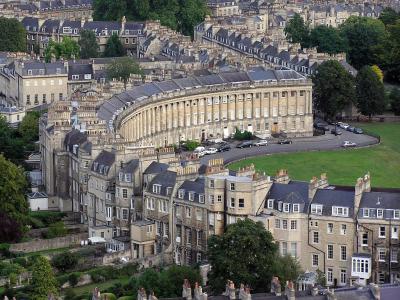
The Royal Crescent in Bath is a notable example of Georgian architecture. It comprises 30 terraced houses, designed by John Wood, the Younger, and constructed between 1767 and 1774. Recognized as a Grade I listed building, the Royal Crescent is a testament to the architectural grandeur of its time and remains a significant historical and cultural landmark.
Spanning 500 feet (about 150 meters), the crescent is distinguished by its 114 Ionic columns on the first floor, supporting an entablature designed in the Palladian style. This design element contributes to its classical and elegant appearance. The Royal Crescent holds the distinction of being the first crescent of terraced houses ever built, embodying the concept of "rus in urbe" or "the country in the city," thanks to its overlooking views of the parkland opposite.
Throughout its history of over 240 years, the Royal Crescent has been home to many notable figures, commemorated by plaques on the relevant buildings. The configuration of the crescent has evolved; of the original 30 townhouses, 10 remain full-size, 18 have been converted into flats of various sizes, one serves as the No. 1 Royal Crescent museum, and two (No. 16 and No. 15) now form The Royal Crescent Hotel & Spa.
Constructed primarily from Bath stone, these houses have slate roofs, although they were originally tiled with stone. The external appearance of each house is remarkably similar, with only minor variations such as some featuring small balconettes on the first floor. Many windows have been restored to their original style with glazing bars, replacing the horned plate glass sash windows installed in later centuries. Despite various internal modifications over the years, the Georgian stone facade of the Royal Crescent has been meticulously preserved, maintaining much of its original aesthetic and charm.
Tips:
No. 1 Royal Cresent is a museum. Here you'll find it preserved as a historic house, with rooms, furniture, pictures, and other items depicting Georgian life between 1776 and 1796. Among the fully furnished and appointed rooms you can tour, there is a Parlour, a Gentleman's Retreat, a Withdrawing Room, Servant's Hall, Kitchen, and Scullery.
Spanning 500 feet (about 150 meters), the crescent is distinguished by its 114 Ionic columns on the first floor, supporting an entablature designed in the Palladian style. This design element contributes to its classical and elegant appearance. The Royal Crescent holds the distinction of being the first crescent of terraced houses ever built, embodying the concept of "rus in urbe" or "the country in the city," thanks to its overlooking views of the parkland opposite.
Throughout its history of over 240 years, the Royal Crescent has been home to many notable figures, commemorated by plaques on the relevant buildings. The configuration of the crescent has evolved; of the original 30 townhouses, 10 remain full-size, 18 have been converted into flats of various sizes, one serves as the No. 1 Royal Crescent museum, and two (No. 16 and No. 15) now form The Royal Crescent Hotel & Spa.
Constructed primarily from Bath stone, these houses have slate roofs, although they were originally tiled with stone. The external appearance of each house is remarkably similar, with only minor variations such as some featuring small balconettes on the first floor. Many windows have been restored to their original style with glazing bars, replacing the horned plate glass sash windows installed in later centuries. Despite various internal modifications over the years, the Georgian stone facade of the Royal Crescent has been meticulously preserved, maintaining much of its original aesthetic and charm.
Tips:
No. 1 Royal Cresent is a museum. Here you'll find it preserved as a historic house, with rooms, furniture, pictures, and other items depicting Georgian life between 1776 and 1796. Among the fully furnished and appointed rooms you can tour, there is a Parlour, a Gentleman's Retreat, a Withdrawing Room, Servant's Hall, Kitchen, and Scullery.
2) The Circus (must see)
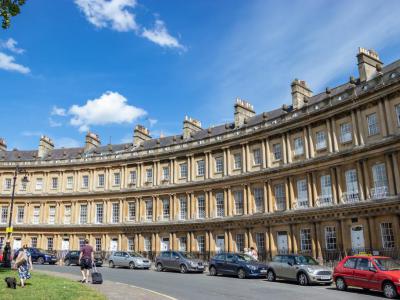
Originally called the King's Circus, The Circus was finished in 1768. The design was formulated by architect John Wood Sr., but he died during construction, and his son finished the project. The plaza consists of three large townhouse buildings, all forming a perfect circle at the meeting of Brock, Gay, and Bennett Streets. The name "Circus" comes from Latin and means a ring or circle.
John Wood Sr. was known for his appreciation of symbology. He admired the Druids and was convinced that Bath had been the hub of much Druid activity in Britain. As such, he studied Stonehenge and built The Circus with the same diameter. He also included many emblems in the design, with serpents, nautical symbols, acorns, and keys from masonic lore. In all, there are more than 525 pictorial emblems and symbols used. The entire design, when viewed from above, looks like a masonic key. A ley-line joins it to the Royal Crescent, which some believe represents the sun and the moon in their designs.
Many wealthy and famous have lived in The Circus over the years. Thomas Gainsborough lived here in the 1700s, and Nicolas Cage had a flat here for awhile. It's also said that if you wander the center plaza, you can find one precise point where all sound will echo.
The building is a Grade I listed building, and like many others in Bath, it is a fine example of Georgian architecture. Each level's facade is designed in a different classical order—Greek Doric, Roman Composite, and Corinthian.
John Wood Sr. was known for his appreciation of symbology. He admired the Druids and was convinced that Bath had been the hub of much Druid activity in Britain. As such, he studied Stonehenge and built The Circus with the same diameter. He also included many emblems in the design, with serpents, nautical symbols, acorns, and keys from masonic lore. In all, there are more than 525 pictorial emblems and symbols used. The entire design, when viewed from above, looks like a masonic key. A ley-line joins it to the Royal Crescent, which some believe represents the sun and the moon in their designs.
Many wealthy and famous have lived in The Circus over the years. Thomas Gainsborough lived here in the 1700s, and Nicolas Cage had a flat here for awhile. It's also said that if you wander the center plaza, you can find one precise point where all sound will echo.
The building is a Grade I listed building, and like many others in Bath, it is a fine example of Georgian architecture. Each level's facade is designed in a different classical order—Greek Doric, Roman Composite, and Corinthian.
3) Bath Assembly Rooms
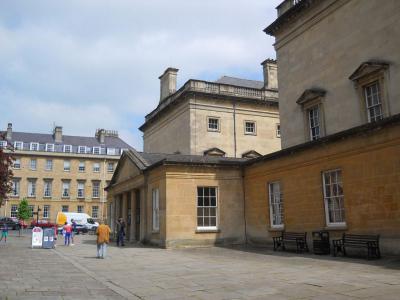
There are two sets of Assembly Rooms: the Lower Rooms and the Upper Rooms. The Lower Rooms were built in 1708 and are located in the older part of the city. The Upper Rooms were built in a more fashionable part of town, near The Circus and the Royal Crescent, hence the "upper" description. The lower rooms burned in 1820 and were not rebuilt.
Today, you can still visit the Upper Rooms and glory in their beauty. Don't miss the original Wayfarers crystal chandeliers. The Fashion Museum is also located in the Assembly Rooms and is well worth a visit. Be sure to admire all the Regency era dresses.
The Assembly Rooms were another center of Regency life in Jane Austen's time. Jane Austen loved dancing, and she spent time in the Assembly Rooms attending evening balls - dancing, watching, and gossiping.
In Persausion, Anne Elliot hopes to visit the Assembly Rooms and meet Captain Wentworth. But her father felt that the Assembly Rooms were not fashionable enough for the Elliots. Later on, however, the Elliots did accept an invitation to a concert in the Upper Rooms, and the meeting did take place.
In Northanger Abbey, Catherine Morland often visits both the Upper Rooms and the Lower Rooms and dances the nights away in crowded rooms. Catherine Morland met Henry Tilney in the Lower Rooms, and Henry Tilney found the Master of Ceremonies to introduce them. Isabella Thorpe was affronted when James Morland asks for more dances without changing partners. These vignettes give insight into the different, more restrictive social norms of Regency England.
Today, you can still visit the Upper Rooms and glory in their beauty. Don't miss the original Wayfarers crystal chandeliers. The Fashion Museum is also located in the Assembly Rooms and is well worth a visit. Be sure to admire all the Regency era dresses.
The Assembly Rooms were another center of Regency life in Jane Austen's time. Jane Austen loved dancing, and she spent time in the Assembly Rooms attending evening balls - dancing, watching, and gossiping.
In Persausion, Anne Elliot hopes to visit the Assembly Rooms and meet Captain Wentworth. But her father felt that the Assembly Rooms were not fashionable enough for the Elliots. Later on, however, the Elliots did accept an invitation to a concert in the Upper Rooms, and the meeting did take place.
In Northanger Abbey, Catherine Morland often visits both the Upper Rooms and the Lower Rooms and dances the nights away in crowded rooms. Catherine Morland met Henry Tilney in the Lower Rooms, and Henry Tilney found the Master of Ceremonies to introduce them. Isabella Thorpe was affronted when James Morland asks for more dances without changing partners. These vignettes give insight into the different, more restrictive social norms of Regency England.
4) Paragon
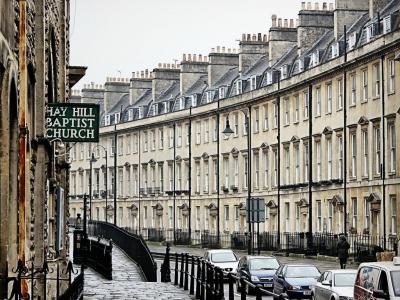
The Paragon, located in the Walcot area of Bath, is a renowned street notable for its Georgian architecture. This historic street is characterized by a series of elegant Georgian houses, each designated as listed buildings, exemplifying the architectural style of the period.
Designed by Thomas Warr Attwood, the street is distinguished by its uniform houses, which contribute significantly to the area's architectural heritage. Numbers 1 to 21 on The Paragon are three-story houses, each featuring mansard roofs. A notable aspect of these buildings is their symmetrical design, with matching doors and windows. The central pediments and flat entablatures flanking the first-floor windows add to their classical Georgian charm. Additionally, the doorways are adorned with Tuscan pilasters and pediments, enhancing the street's aesthetic appeal.
The theme established by the houses from numbers 1 to 21 is seamlessly continued in numbers 22 to 37. These additional houses were completed in 1775 by Joseph Axford, a local mason. The continuity in architectural style across these numbers showcases the planned urban development characteristic of Georgian Bath.
The Paragon's historical significance is further enriched by its possible roots as a Roman road. It is believed to have originated from Aquae Sulis, leading north and connecting with the Fosse Way. Although mapping evidence suggests a medieval origin, the area of Walcot, where The Paragon is located, has a history of Roman residential development dating from the 1st to 3rd centuries.
Notably, Jane Austen visited No. 1 The Paragon on two occasions, which happened to be her aunt's residence. Her first visit was for a casual stay, while her second stay served as temporary accommodation while she searched for her own place to live. Now, you have the opportunity to rent The Paragon as your dwelling and follow in the footsteps of Jane Austen, exploring the places she frequented and even recreating the dances of her beloved characters.
Designed by Thomas Warr Attwood, the street is distinguished by its uniform houses, which contribute significantly to the area's architectural heritage. Numbers 1 to 21 on The Paragon are three-story houses, each featuring mansard roofs. A notable aspect of these buildings is their symmetrical design, with matching doors and windows. The central pediments and flat entablatures flanking the first-floor windows add to their classical Georgian charm. Additionally, the doorways are adorned with Tuscan pilasters and pediments, enhancing the street's aesthetic appeal.
The theme established by the houses from numbers 1 to 21 is seamlessly continued in numbers 22 to 37. These additional houses were completed in 1775 by Joseph Axford, a local mason. The continuity in architectural style across these numbers showcases the planned urban development characteristic of Georgian Bath.
The Paragon's historical significance is further enriched by its possible roots as a Roman road. It is believed to have originated from Aquae Sulis, leading north and connecting with the Fosse Way. Although mapping evidence suggests a medieval origin, the area of Walcot, where The Paragon is located, has a history of Roman residential development dating from the 1st to 3rd centuries.
Notably, Jane Austen visited No. 1 The Paragon on two occasions, which happened to be her aunt's residence. Her first visit was for a casual stay, while her second stay served as temporary accommodation while she searched for her own place to live. Now, you have the opportunity to rent The Paragon as your dwelling and follow in the footsteps of Jane Austen, exploring the places she frequented and even recreating the dances of her beloved characters.
5) Camden Crescent
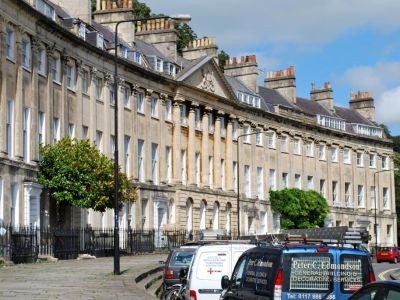
Camden Crescent is located just off Lansdown Road, the main route from the city center into the historic northern suburbs of Bath. The crescent stands on the edge of Margaret’s Hill, an impossibly steep slope that leads down to the A4 and the River Avon beyond. From the ornate railings opposite the main row of houses, visitors can expect a stunning view of the river below, following a brief if steep walk from the eastern edges of the city center. Camden Crescent appears to be perched almost precariously at the edge of the hill, and this perilous placement has lent it a unique architectural feature.
Designed in 1788 by John Eveleigh, Camden Crescent once descended slightly down the hill to the East. A landslide in 1889 caused nine houses to collapse at the eastern end of the crescent, and they were never replaced. As a result, the Grade I listed crescent remains uniquely lopsided. The central pillars, a common feature in symmetrical crescents, no longer sits in the middle of the crescent, but instead leans to the east, adding a quirky feel to this unusual crescent, well placed closer to town than more perfectly formed streets further along Lansdown Road.
Designed in 1788 by John Eveleigh, Camden Crescent once descended slightly down the hill to the East. A landslide in 1889 caused nine houses to collapse at the eastern end of the crescent, and they were never replaced. As a result, the Grade I listed crescent remains uniquely lopsided. The central pillars, a common feature in symmetrical crescents, no longer sits in the middle of the crescent, but instead leans to the east, adding a quirky feel to this unusual crescent, well placed closer to town than more perfectly formed streets further along Lansdown Road.
6) Lansdown Crescent
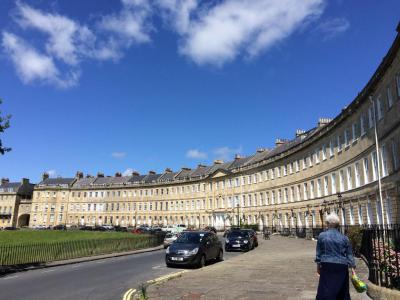
Lansdown Crescent is one of the finest examples of Bath’s architectural trademark – the sweeping, impeccably preserved Georgian crescents dotted around the city’s Georgian suburbs. These crescents are located on the hills north of Bath’s historic city centre. Lansdown Crescent lies further afield than its more famous counterpart, the Royal Crescent, and requires a fifteen minute walk along a series of ever steepening roads from the city centre. When you arrive, however, the extra exertion proves to be worthwhile – as the crescent looks over a truly spectacular view of the city, nestled in the valley below.
Designed by renowned architect John Palmer, Lansdown Crescent was constructed during Bath’s boom years, and was completed in 1793. Comprising twenty houses, it is a Grade I listed building. The large spherical green lying next to the crescent of houses is, improbably enough, occasionally used for grazing sheep. Lansdown Crescent sums up Bath’s two sides – a hilly, isolated country town with a rich urban architectural history. The twin highlights of its sweeping façade and the view it looks onto make it a natural stop to a tour of the other Georgian architecture north of the city centre, including the Royal Crescent, the Circus and the nearby Somerset Place.
Designed by renowned architect John Palmer, Lansdown Crescent was constructed during Bath’s boom years, and was completed in 1793. Comprising twenty houses, it is a Grade I listed building. The large spherical green lying next to the crescent of houses is, improbably enough, occasionally used for grazing sheep. Lansdown Crescent sums up Bath’s two sides – a hilly, isolated country town with a rich urban architectural history. The twin highlights of its sweeping façade and the view it looks onto make it a natural stop to a tour of the other Georgian architecture north of the city centre, including the Royal Crescent, the Circus and the nearby Somerset Place.
7) Somerset Place
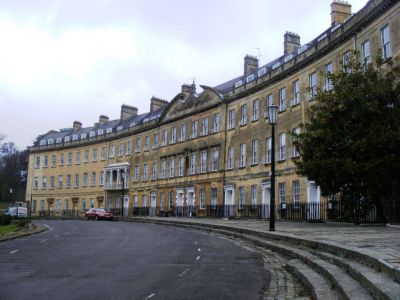
Somerset Place is one of many fine examples of Georgian architecture within the city of Bath. Less renowned than the nearby Royal Crescent, the crescent remains a jewel in the city’s impressive collection of Georgian streets and buildings. Somerset Place, collectively regarded as a Grade I listed building, is situated close to Bath Spa University, among the hills that lie to the north of the city centre. It is accessible from central Bath via a No. 2 bus, or a brisk uphill walk out of the city centre along Broad Street and Lansdown Road, following directions to the university campus.
Somerset Place is a sweeping crescent of adjoining Georgian town houses, designed by renowned architect John Eveleigh. Building work on Somerset Place began in 1790 but following Eveleigh’s bankruptcy was not completed until 1820. The buildings still maintain their original Georgian façade to this day, despite damage inflicted by German bombs during the Second World War. Today the buildings are largely used as student accommodation for the nearby university, and make a worthwhile addition to any walking tour of the elegant streets and crescents north of the city centre. Previously a part of the university campus, they are now privately owned.
Somerset Place is a sweeping crescent of adjoining Georgian town houses, designed by renowned architect John Eveleigh. Building work on Somerset Place began in 1790 but following Eveleigh’s bankruptcy was not completed until 1820. The buildings still maintain their original Georgian façade to this day, despite damage inflicted by German bombs during the Second World War. Today the buildings are largely used as student accommodation for the nearby university, and make a worthwhile addition to any walking tour of the elegant streets and crescents north of the city centre. Previously a part of the university campus, they are now privately owned.
Walking Tours in Bath, England

Create Your Own Walk in Bath
Creating your own self-guided walk in Bath is easy and fun. Choose the city attractions that you want to see and a walk route map will be created just for you. You can even set your hotel as the start point of the walk.
Bath Introduction Walking Tour
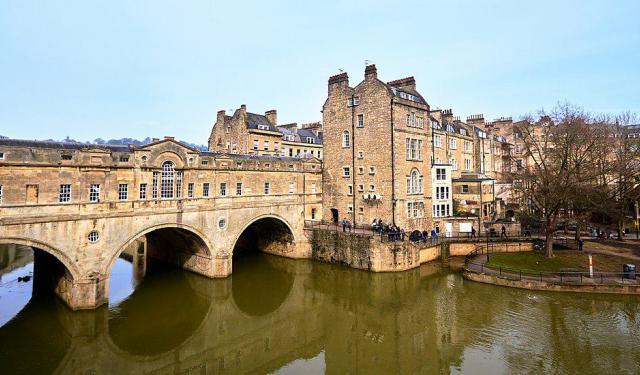
The only English city designated a UNESCO World Heritage site, Bath is a gorgeous city packed with history. Artifacts have been found from the Bronze and Iron Age in the surrounding hills. The Romans were the first to build around the remarkable hot mineral springs at the beginning of the first century. They constructed a temple and baths here, and since then, people have flocked to Bath for its... view more
Tour Duration: 2 Hour(s)
Travel Distance: 2.5 Km or 1.6 Miles
Tour Duration: 2 Hour(s)
Travel Distance: 2.5 Km or 1.6 Miles
Jane Austen Walking Tour
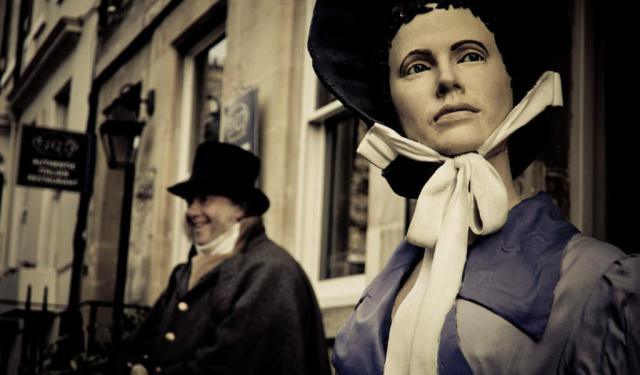
Jane Austen, 1775-1817, was a renowned British author. Her groundbreaking novels offer a witty and humorous look at Regency-era life. Austen's six novels have since inspired many popular TV adaptations and films.
Jane Austen lived in Bath from 1801 to 1806. Two of her novels, Northanger Abbey and Persuasion, were set in this beautiful Georgian city. While interiors have certainly been... view more
Tour Duration: 2 Hour(s)
Travel Distance: 2.5 Km or 1.6 Miles
Jane Austen lived in Bath from 1801 to 1806. Two of her novels, Northanger Abbey and Persuasion, were set in this beautiful Georgian city. While interiors have certainly been... view more
Tour Duration: 2 Hour(s)
Travel Distance: 2.5 Km or 1.6 Miles
Historical Homes Walking Tour
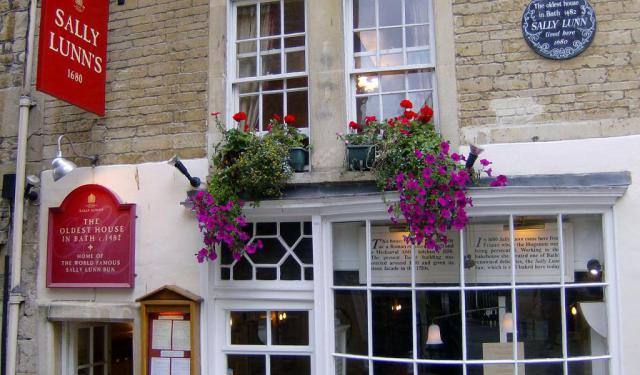
Apart from its Roman thermae, the city of Bath is renowned for its prominent residents who used to live here a long time ago. Their former dwellings – historical monuments in their own right – now offer a captivating glimpse into the city's glorious past.
Among the most famous of them, undoubtedly, is the Jane Austen Centre. This charming Georgian townhouse provides a fascinating look... view more
Tour Duration: 1 Hour(s)
Travel Distance: 1.6 Km or 1 Miles
Among the most famous of them, undoubtedly, is the Jane Austen Centre. This charming Georgian townhouse provides a fascinating look... view more
Tour Duration: 1 Hour(s)
Travel Distance: 1.6 Km or 1 Miles
The Most Popular Cities
/ view all