


Audio Guide: Flower Market to Chinatown (Self Guided), Bangkok
One of the world’s great shopping playgrounds, Bangkok doesn’t just invite you to shop—it dares you to keep up. You can buy almost anything here, from silk and spices to things you didn’t know existed five minutes ago. The trick is knowing where to look. And if your idea of retail therapy involves a bit of chaos, a lot of flavor, and zero predictability, then the city’s markets are where the real action happens.
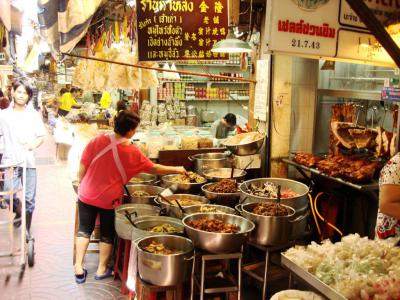
Nowhere is this more evident than along Yaowarat Road, the pulsing spine of Chinatown, where gold shops, street food vendors, and herbal pharmacies line the streets in a constant blur of movement, light, and aroma.
Still, the appeal of Bangkok’s markets isn’t in just what’s for sale—it’s in their energy. The lively chatter and quick smiles complement a dizzying mix of goods that ranges from handcrafted keepsakes to an endless supply of street food that smells so good it reroutes your plans. These markets are part of everyday life here, not staged attractions, and that’s exactly why they work. Most of them hit their stride in the evening, from around 18:00 until midnight, when the heat eases off, and the city collectively decides it’s time to eat, browse, and linger a bit longer than intended.
Among the many options, a few spots stand out for their distinct character. Pak Khlong Talat, the famous flower market, operates around the clock, and if you show up here before dawn, you’ll catch it at its most theatrical—fresh blooms arriving in bursts of color, the air thick with sweet fragrance. Meanwhile, Old Siam Plaza offers a calmer but equally rewarding experience, especially if silk is your thing, with one of the largest selections in the city.
Not far away, Phahurat Market—often called Little India—overflows with textiles, custom tailoring, and Indian goods, complemented by a food court rich in spices and traditional flavors. And then there’s Talat Kao Market, one of the oldest in Bangkok, where long-standing traditions, including early-morning rituals, have kept their place at the table for over a century.
Even if you’re not planning to buy a thing, these markets have a way of pulling you in. You start by browsing, then tasting, then wondering how you ended up holding a bag of something you can’t quite identify—but are absolutely taking with you.
So, don’t overthink it—step into the crowd, follow the smells, trust your curiosity, and let the markets set the pace. Bangkok isn’t waiting to be observed from a distance; it’s waiting for you to jump right in and see where the next turn takes you!
Nowhere is this more evident than along Yaowarat Road, the pulsing spine of Chinatown, where gold shops, street food vendors, and herbal pharmacies line the streets in a constant blur of movement, light, and aroma.
Still, the appeal of Bangkok’s markets isn’t in just what’s for sale—it’s in their energy. The lively chatter and quick smiles complement a dizzying mix of goods that ranges from handcrafted keepsakes to an endless supply of street food that smells so good it reroutes your plans. These markets are part of everyday life here, not staged attractions, and that’s exactly why they work. Most of them hit their stride in the evening, from around 18:00 until midnight, when the heat eases off, and the city collectively decides it’s time to eat, browse, and linger a bit longer than intended.
Among the many options, a few spots stand out for their distinct character. Pak Khlong Talat, the famous flower market, operates around the clock, and if you show up here before dawn, you’ll catch it at its most theatrical—fresh blooms arriving in bursts of color, the air thick with sweet fragrance. Meanwhile, Old Siam Plaza offers a calmer but equally rewarding experience, especially if silk is your thing, with one of the largest selections in the city.
Not far away, Phahurat Market—often called Little India—overflows with textiles, custom tailoring, and Indian goods, complemented by a food court rich in spices and traditional flavors. And then there’s Talat Kao Market, one of the oldest in Bangkok, where long-standing traditions, including early-morning rituals, have kept their place at the table for over a century.
Even if you’re not planning to buy a thing, these markets have a way of pulling you in. You start by browsing, then tasting, then wondering how you ended up holding a bag of something you can’t quite identify—but are absolutely taking with you.
So, don’t overthink it—step into the crowd, follow the smells, trust your curiosity, and let the markets set the pace. Bangkok isn’t waiting to be observed from a distance; it’s waiting for you to jump right in and see where the next turn takes you!
How it works: Download the app "GPSmyCity: Walks in 1K+ Cities" from Apple App Store or Google Play Store to your mobile phone or tablet. The app turns your mobile device into a personal tour guide. For US$14.99 per year, you get access to walking tours in 630+ cities worldwide. In comparison, a guided tour often costs dozens of dollars per person for a single tour. The app works offline, so no data plan is needed when traveling abroad.
Download The GPSmyCity App



Flower Market to Chinatown Map
Guide Name: Flower Market to Chinatown
Guide Location: Thailand » Bangkok (See other walking tours in Bangkok)
Guide Type: Self-guided Walking Tour (Sightseeing)
Tour Duration: 1 Hour(s)
Travel Distance: 2.3 Km or 1.4 Miles
Guide Location: Thailand » Bangkok (See other walking tours in Bangkok)
Guide Type: Self-guided Walking Tour (Sightseeing)
Tour Duration: 1 Hour(s)
Travel Distance: 2.3 Km or 1.4 Miles
Sights Featured in This Walk



Walking Tours in Bangkok, Thailand

Create Your Own Walk in Bangkok
Creating your own self-guided walk in Bangkok is easy and fun. Choose the city attractions that you want to see and a walk route map will be created just for you. You can even set your hotel as the start point of the walk.

Bangkok Old City Walk
The Thai capital, Bangkok, began life in the 15th century in the fertile delta of the Chao Phraya River as a modest trading post—hardly the megacity you see today. As for the name “Bangkok,” no one agrees on its origin. It may come from the Thai words “bang,” meaning a riverside village, and “ko,” meaning island, which is quite fitting for a place once threaded with canals. Or it... view more
Tour Duration: 2 Hour(s)
Travel Distance: 2.8 Km or 1.7 Miles
Tour Duration: 2 Hour(s)
Travel Distance: 2.8 Km or 1.7 Miles

Chinatown Walking Tour
Bangkok's Chinatown is one of the largest Chinatowns in the world. Founded in 1782, the core of it lies along Yaowarat Road, which serves as the main artery and sometimes lends its name to the whole area.
The district has been the center for trading by the Thai Chinese community for almost 200 years, progressively evolving from a vast wilderness outside the city walls to a major... view more
Tour Duration: 1 Hour(s)
Travel Distance: 1.5 Km or 0.9 Miles
The district has been the center for trading by the Thai Chinese community for almost 200 years, progressively evolving from a vast wilderness outside the city walls to a major... view more
Tour Duration: 1 Hour(s)
Travel Distance: 1.5 Km or 0.9 Miles

Wats and Temples of Bangkok
The “City of Angels” – Bangkok – is home to more than 400 temples. Known locally as “wats,” they range from vast ceremonial complexes to modest neighborhood shrines hidden deep within the city’s maze-like, narrow side streets called “sois.” Some of these shrines are landmarks that draw steady streams of visitors, while others remain quiet places of daily devotion. Yet together,... view more
Tour Duration: 2 Hour(s)
Travel Distance: 3.4 Km or 2.1 Miles
Tour Duration: 2 Hour(s)
Travel Distance: 3.4 Km or 2.1 Miles

Food Walk
There aren't many cities out there, if any, beside the Thai capital to be just as voracious and passionate about eating! Food in Bangkok is a key aspect of daily life, attesting to which are the numerous eateries all over the city. And what's more, regardless of where you have it, be it a scrumptious street food stall or a fancy restaurant, the local food never fails to impress.
... view more
Tour Duration: 1 Hour(s)
Travel Distance: 2.8 Km or 1.7 Miles
... view more
Tour Duration: 1 Hour(s)
Travel Distance: 2.8 Km or 1.7 Miles
Useful Travel Guides for Planning Your Trip

7 Places in Bangkok for Superb Street Food
Eating is huge in Bangkok, and luckily for the famished, you won't be that way for long, regardless of the hour. You can find conglomerations of vendors selling five-star fast food (in the you-won't-have-to-wait-long-to-enjoy-it sense, not McDonald's style) for under 100 baht (roughly...

Top 15 Things to Buy in Bangkok
Well-made, local products not only remind people of the trip they've had, but also make great gifts to bring home to family and friends. Following is the list of original and representative of Bangkok local specialties that you might wish to consider as a memorable...
The Most Popular Cities
/ view all