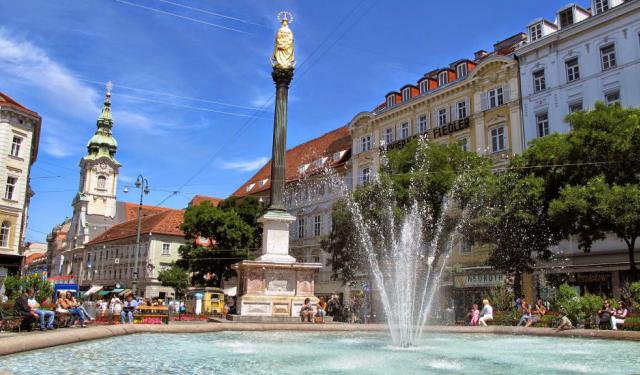


Graz Introduction Walking Tour (Self Guided), Graz
There were settlements in the Graz area as early as the end of the Copper Age. However, Graz, did not truly emerge until the 12th century. The Babenberg dukes swapped hegemony over the area until Otakar III built the Hauptplatz, the main square of the city in 1160.
Otakar was one of the Babenberg dukes. Under Babenberg rule Graz developed into an important commercial center. By 1280 The Habsburg dynasty had established itself in Graz. In the 14th century the Habsburg royalty had settled comfortably in Schlossberg Castle. They ruled Styria, Graz's province, and parts of Italy and Slovenia. They had arrived.
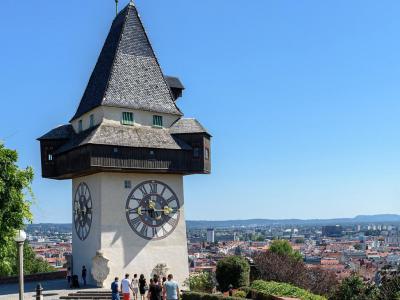
Graz sits astride the Mur River in southeastern Austria. It is at the edge of the Alps, bound by mountains on three sides: north, east and west. Historically, Graz has been the tempting prize of invading armies. Hungarians in 1481, Ottomans off and on until 1699. Schlossberg Castle, however, was never taken by the Turks.
In the 1500s city designs were influenced by Italian architects of the Renaissance. The best-preserved medieval and renaissance architecture can be found in the Old Town. Here one can find a masala of different styles and eras, mostly Baroque and Renaissance.
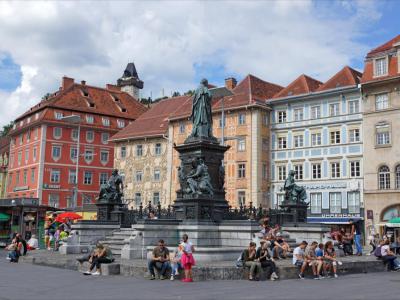
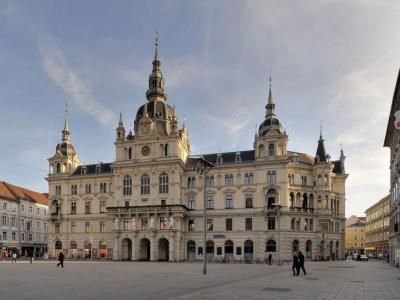
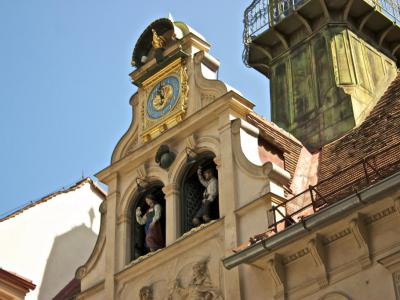
The bronze Fountain of the Archduke Johann faces the enormous the Town Hall. Buildings around the square show medieval and gothic features. The Styrian Armory hold a massive collection of medieval arms and armor. The dancers of the Carillon tell the hours.
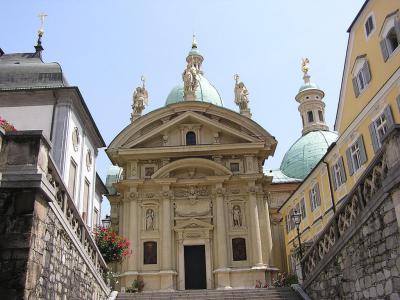
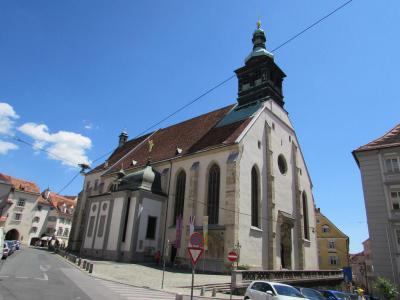
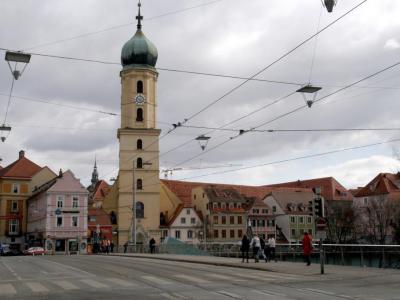
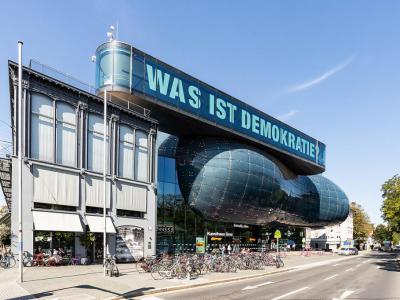
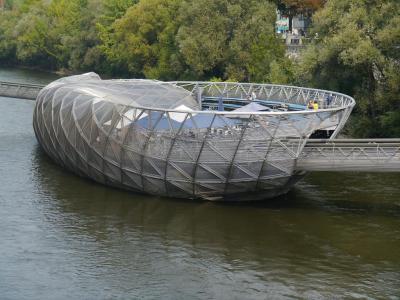
Saint Catherine's Church and Mausoleum, Graz Cathedral, Franciscan Church, the Church of the Holy Blood and Holy Trinity Church, among others, offer styles of architecture including Baroque, Gothic, Mannerist and distinctly Historic Old German. Avant Garde buildings and structures, like the Art House and Island in the Mur, complement the great show.
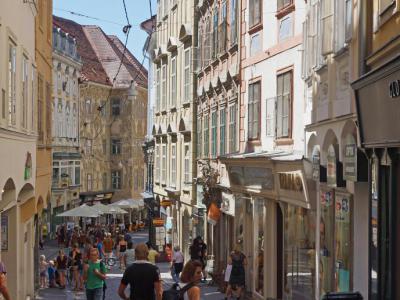
There is a story that the devil built Castle Hill, but Spor Street, the main shopping street, predates the devil and Graz itself. After explorations and adventures of the Old Town, go shopping on the Spor Street and then relax at one of the many shops and cafes. Enjoy an ice cream and watch the world go by.
Otakar was one of the Babenberg dukes. Under Babenberg rule Graz developed into an important commercial center. By 1280 The Habsburg dynasty had established itself in Graz. In the 14th century the Habsburg royalty had settled comfortably in Schlossberg Castle. They ruled Styria, Graz's province, and parts of Italy and Slovenia. They had arrived.
Graz sits astride the Mur River in southeastern Austria. It is at the edge of the Alps, bound by mountains on three sides: north, east and west. Historically, Graz has been the tempting prize of invading armies. Hungarians in 1481, Ottomans off and on until 1699. Schlossberg Castle, however, was never taken by the Turks.
In the 1500s city designs were influenced by Italian architects of the Renaissance. The best-preserved medieval and renaissance architecture can be found in the Old Town. Here one can find a masala of different styles and eras, mostly Baroque and Renaissance.
The bronze Fountain of the Archduke Johann faces the enormous the Town Hall. Buildings around the square show medieval and gothic features. The Styrian Armory hold a massive collection of medieval arms and armor. The dancers of the Carillon tell the hours.
Saint Catherine's Church and Mausoleum, Graz Cathedral, Franciscan Church, the Church of the Holy Blood and Holy Trinity Church, among others, offer styles of architecture including Baroque, Gothic, Mannerist and distinctly Historic Old German. Avant Garde buildings and structures, like the Art House and Island in the Mur, complement the great show.
There is a story that the devil built Castle Hill, but Spor Street, the main shopping street, predates the devil and Graz itself. After explorations and adventures of the Old Town, go shopping on the Spor Street and then relax at one of the many shops and cafes. Enjoy an ice cream and watch the world go by.
How it works: Download the app "GPSmyCity: Walks in 1K+ Cities" from Apple App Store or Google Play Store to your mobile phone or tablet. The app turns your mobile device into a personal tour guide. For US$14.99 per year (with a 3-day free trial), you get access to walking tours in 630+ cities worldwide for an entire year. In comparison, a guided tour often costs dozens of dollars per person for a single tour. The app works offline, so no data plan is needed when traveling abroad.
Download The GPSmyCity App



Graz Introduction Walking Tour Map
Guide Name: Graz Introduction Walking Tour
Guide Location: Austria » Graz (See other walking tours in Graz)
Guide Type: Self-guided Walking Tour (Sightseeing)
Tour Duration: 2 Hour(s)
Travel Distance: 3.0 Km or 1.9 Miles
Guide Location: Austria » Graz (See other walking tours in Graz)
Guide Type: Self-guided Walking Tour (Sightseeing)
Tour Duration: 2 Hour(s)
Travel Distance: 3.0 Km or 1.9 Miles
Sights Featured in This Walk
The Most Popular Cities
/ view all