Home City Search Berlin Orientation Tour of Berlin
Orientation Tour of Berlin, Berlin
Download iPhone Walking Tours Application for Berlin
iPhone Walking Tours Application for Berlin
Bookmark and Share
Orientation Tour of Berlin
Guide Location: Germany » Berlin
Guide Type: Self-guided city tour
# of Attractions: 12
Tour Duration: 3 hour(s)
Transportation Mode: by foot
Travel Distance: 5.2 km
Image Courtesy of Wikimedia and AndreHuppertz
Author: clare
The capital and the largest city of Germany, Berlin is also a major cultural, political, economic and scientific center of Europe. Today's Berlin is a thriving, modern and exciting destination, welcoming those who arrive on a leisure or business trip. Take this tour and find your way to Berlin's main attractions.
Tour Stops and Attractions
Kunsthaus Tacheles
1) Kunsthaus Tacheles
The Kunsthaus Thacheles is a large graffiti covered warehouse in the former Jewish quarter of Berlin. It houses a group of artists who are being threatened with eviction.
The Kunsthaus Thacheles was once a supermarket near the Synagogue that served the Jewish residents of the location. It was a Nazi jail before the Second World War where prisoners from France were imprisoned. It later served as offices of unions during the communist era. After the fall of the Berlin Wall, a group of young artists moved into the building and called it the Thacheles which means Straight Talking in Yiddish.
Kunsthaus Thacheles has five floors and once had a large ribbed dome. Although the building suffered damage during the Battle of Berlin and neglect during the communist era it is still considered structurally sound. The artists have covered the façade with brightly colored contemporary artwork with different themes and reflecting many thoughts and feelings. The courtyard has sculpture made from debris and other objects from scrap yards. It attracts visitors as an unofficial exhibition of modern art and has many art workshops, a café and space for performances and art displays. Despite being a popular tourist attraction in Berlin, the future of the Kunsthaus Thaceles remains threatened.
Image Courtesy of Wikimedia and De-okin
Neue Synagoge
2) Neue Synagoge
The Neue Synagoge ("New Synagogue") was built 1859–1866 as the main synagogue of the Berlin Jewish community, on Oranienburger Straße. Because of its splendid eastern Moorish style and resemblance to the Alhambra, it is an important architectural monument of the second half of the 19th century in Berlin. The building was designed by Eduard Knoblauch. The front of the building, facing Oranienburger Straße, is richly ornamented with shaped bricks and terracotta, accented by coloured glazed bricks. The synagogue's main dome with its gilded ribs is an eye-catching sight. During the November Pogrom (9 November 1938), colloquially euphemised as Kristallnacht, the Neue Synagoge was set ablaze. The New Synagogue, like the synagogue in Rykestr., remained intact and continued to be used as synagogue until 1940. In 1940 the Wehrmacht seized both synagogues and used them for storage. The New Synagogue is now in use again; it now serves as the community's sole Conservative Synagogue.
Image Courtesy of Wikimedia and Dion 1948
Sight description based on wikipedia
Pergamon Museum
3) Pergamon Museum
The Pergamon Museum is situated on the Museum Island in Berlin. The site was designed by Alfred Messel and Ludwig Hoffmann and was constructed in twenty years, from 1910 to 1930. The Pergamon houses original-sized, reconstructed monumental buildings such as the Pergamon Altar, the Market Gate of Miletus, all consisting of parts transported from Turkey. The museum is subdivided into the antiquity collection, the Middle East museum, and the museum of Islamic art. Besides Islamic artwork from the 8th to the 19th century ranging from Spain to India, the main attraction is the Mshatta facade, which originates from an unfinished early Islamic desert palace located south of Amman in present-day Jordan. It was a gift from the Ottoman Sultan Abdul Hamid II to Emperor Wilhelm II of Germany. The Middle East Museum exhibition displays objects, found by German archeologists and others, from the areas of Assyrian, Sumerian and Babylonian culture.
Image Courtesy of Wikimedia and Raimond Spekking
Sight description based on wikipedia
DDR Museum
4) DDR Museum
The DDR Museum is an interactive museum in the centre of Berlin. The museum is located in the former governmental district of East Germany, right on the river Spree, opposite the Berlin Cathedral. Its exhibition shows the daily life in East Germany (known in German as the Deutsche Demokratische Republik or DDR) in a direct "hands-on" way. For example, a covert listening device ("bug") gives visitors the sense of being "under surveillance". The museum was opened on July 15, 2006, as a private museum. The private funding is unusual in Germany, because German museums are normally funded by the state. In 2008, the DDR Museum was nominated for the European Museum of the Year Award.
Image Courtesy of Flickr and Sheetal Lad
Sight description based on wikipedia
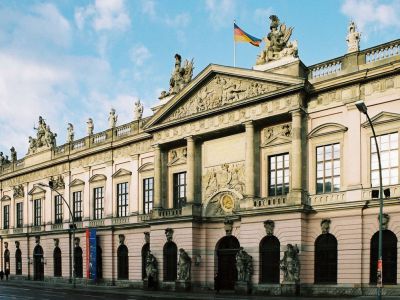
Deutsches Historisches Museum
5) Deutsches Historisches Museum
The Deutsches Historisches Museum gives visitors an insight into the many events and upheavals in the history of Germany. It takes them on a journey through the history of the country over the last 2000 years.
The Deutsches Historisches Museum is housed in two buildings. The older building was the Prussian arsenal constructed between 1695 and 1730. It is one of the oldest surviving structures in Berlin. Many of the permanent exhibits of the museum are displayed here and the building also houses a theater where historic and modern German and international films are screened. The modern annex was designed by the Chinese American architect, I.M. Pei. It houses temporary exhibitions with a historical theme.
Notable exhibits at the Deutsches Historisches Museum are a large globe that was once a part of the Nazi foreign office with bullet holes where Germany is located. There is also a sculpture by artist Andreas Schluter in baroque style depicted dying soldiers and making a statement against war in the courtyard. The modern wing hosts many unique temporary exhibitions including one called Hitler and the Germans that portrayed the methods of propaganda used by the Nazis to gain power. The museum has leaflets and signs in English and other languages to help visitors understand the significance of each historical object on display.
Image Courtesy of Wikimedia and Sir James
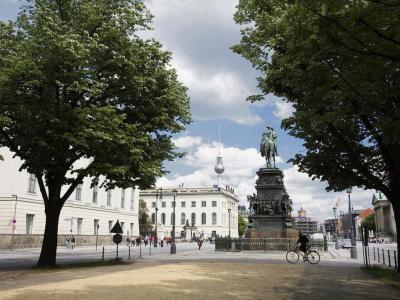
Bebelplatz
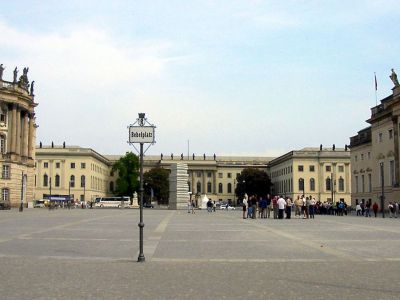
6) Bebelplatz
The Bebelplatz is a public square in the central Mitte district of Berlin, the capital of Germany. The square is located on the south side of the Unter den Linden boulevard, a major east-west thoroughfare in the city centre. The square is named after August Bebel, a founder of the Social Democratic Party of Germany in the 19th century. The square, then called Platz am Opernhaus, was laid out between 1741 and 1743 under the rule of King Frederick II of Prussia. The Bebelplatz is known as the site of the infamous Nazi book burning ceremony held in the evening of May 10, 1933 by members of the SA, SS, Nazi students and Hitler Youth groups, on the instigation of Propaganda Minister Joseph Goebbels. The Nazis burned around 20,000 books, including works by Thomas Mann, Erich Maria Remarque, Heinrich Heine, Karl Marx and many other authors. Today a memorial by Micha Ullman consisting of a glass plate set into the cobbles, giving a view of empty bookcases, commemorates the book burning.
Image Courtesy of Wikimedia and Adam Carr
Sight description based on wikipedia
Deutscher Dom
7) Deutscher Dom
Deutscher Dom (English: German Cathedral) is the colloquial naming for the New Church (German: Neue Kirche) located in Berlin on the Gendarmenmarkt across from Französischer Dom (French Cathedral). In 1701-1708 Giovanni Simonetti built the first church after a design of Martin Grünberg. In 1780-1785 Georg Christian Unger modified the church and added the eastern domed tower after a design by Carl von Gontard. Christian Bernhard Rode created the statues, representing characters from the Old and New Covenant, which are added to the tower. The dome was topped by a statue symbolising the victorious virtue. The New Church became famous as a place of Prussian history. In 1943 the New Church was terribly destroyed in the bombing of Berlin in World War II and was subsequently rebuilt from 1977 to 1988. Meanwhile the German government acquired the building and the site. The church building was updated, deconsecrated and reopened in 1996 as the Bundestag's museum on German parliamentary history.
Image Courtesy of Wikimedia and Wladyslaw Sojka
Sight description based on wikipedia
Komische Oper Berlin
8) Komische Oper Berlin
The Komische Oper Berlin is an opera company in Berlin, Germany, which specializes in German language productions of opera, operetta and musicals. The theatre was built between 1891-1892 by architects Ferdinand Fellner and Hermann Helmer for a private society. It first opened on September 24, 1892 as "Theater Unter den Linden" with Adolf Ferron's operetta Daphne and Gaul and Haßreiter's ballet Die Welt in Bild und Tanz. In 1934 the theatre was nationalized and renamed Staatliches Operettentheater. It operated as part of the Nazi Kraft durch Freude entertainment and leisure programmes. During World War II, the auditorium was damaged by Allied bombing on May 7, 1944. The façade, entrance hall, and auditorium ceiling murals were destroyed by bombs on March 9, 1945. The theatre was completely rebuilt in 1965-1966 by Architektenkollektiv Kunz Nierade, adding functional extensions and giving the theatre a completely new exterior. Today the theatre seats 1270.
Image Courtesy of Wikimedia and Jensens
Sight description based on wikipedia
Holocaust-Mahnmal
9) Holocaust-Mahnmal
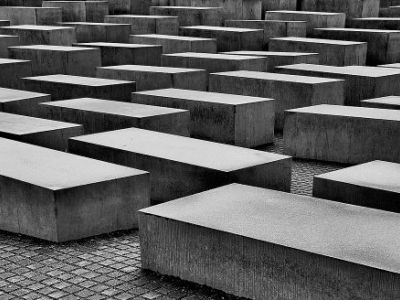
The Memorial to the Murdered Jews of Europe (German: Denkmal für die ermordeten Juden Europas), also known as the Holocaust Memorial (German: Holocaust-Mahnmal), is a memorial in Berlin to the Jewish victims and other victims of the Holocaust, designed by architect Peter Eisenman and engineer Buro Happold. It consists of a 19,000 square meter site covered with 2,711 concrete slabs or "stelae", one for each page of the Talmud arranged in a grid pattern on a sloping field. According to Eisenman's project text, the stelae are designed to produce an uneasy, confusing atmosphere, and the whole sculpture aims to represent a supposedly ordered system that has lost touch with human reason. An attached underground "Place of Information" (German: Ort der Information) holds the names of all known Jewish Holocaust victims, obtained from the Israeli museum Yad Vashem. It was inaugurated on May 10, 2005, sixty years after the end of World War II, and opened to the public on May 12 of the same year.
Image Courtesy of Wikimedia and John C. Watkins V
Sight description based on wikipedia
Unter den Linden
10) Unter den Linden
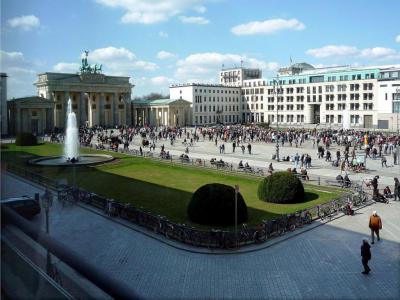
Unter den Linden ("under the linden trees") is an iconic boulevard in the central Mitte district of Berlin, the capital of Germany. It is named for its linden (lime in British English) trees that line the grassed pedestrian mall between two carriageways. Unter den Linden runs east–west from the site of the former Stadtschloss royal palace at the Lustgarten park, where the demolished Palast der Republik used to be, to Pariser Platz and Brandenburg Gate. Unter den Linden at the heart of the historic section of Berlin developed from a bridle path laid out by Elector John George of Brandenburg in the 16th century to reach his hunting grounds in the Tiergarten. It was replaced by a boulevard of linden trees planted in 1647, extending from the city palace to the gates of the city, by order of the “Great Elector” Frederick William. By the 19th century, as Berlin grew and expanded to the west, Unter den Linden became the best-known and grandest street in Berlin.
Image Courtesy of Wikimedia and Dnsob
Sight description based on wikipedia
Brandenburger Tor
11) Brandenburger Tor
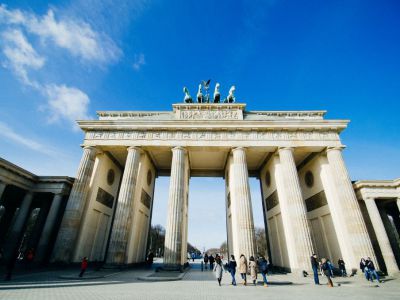
The Brandenburg Gate (German: Brandenburger Tor) is a former city gate and one of the main symbols of Berlin and Germany. It is located west of the city center at the junction of Unter den Linden and Ebertstraße, immediately west of the Pariser Platz. It is the only remaining gate of a series through which one formerly entered Berlin. One block to the north stands the Reichstag building. The gate is the monumental entry to Unter den Linden, the renowned boulevard of linden trees which formerly led directly to the city palace of the Prussian monarchs. The Gate survived World War II and was one of the few structures standing in the Pariser Platz ruins in 1945. Vehicles and pedestrians could travel freely through the gate until the Berlin Wall was built, 13 August 1961. The Wall was erected as an arc just west of the gate, cutting off access from West Berlin. When the Revolutions of 1989 occurred and the Wall fell, the gate symbolized freedom and the desire to unify the city of Berlin.
Image Courtesy of Wikimedia and de:Benutzer:Fridel
Sight description based on wikipedia
Reichstag
12) Reichstag
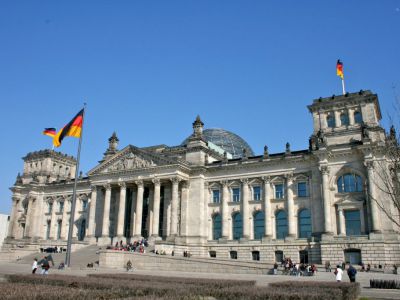
The Reichstag building is a historical edifice in Berlin, Germany, constructed to house the Reichstag, parliament of the German Empire. It was opened in 1894 and housed the Reichstag until 1933, when it was severely damaged in a fire supposedly set by Dutch communist Marinus van der Lubbe. After the Second World War the Reichstag building fell into disuse as the parliament of the German Democratic Republic met in the Palace of the Republic in East Berlin and the parliament of the Federal Republic of Germany met in the Bundeshaus in Bonn. The official German reunification ceremony on 3 October 1990, was held at the Reichstag building, including Chancellor Helmut Kohl, President Richard von Weizsäcker, former Chancellor Willy Brandt and many others. One day later, the parliament of the united Germany would assemble in an act of symbolism in the Reichstag building. The Reichstag dome is the large glass dome at the very top of the building.
Image Courtesy of Wikimedia and Mike Peel
Sight description based on wikipedia
Attractions Map
Visitor's Comments (0)
Visitor's Gallery (0)