

Home City Search Frankfurt Orientation Tour of Frankfurt
Orientation Tour of Frankfurt, Frankfurt
Download iPhone Walking Tours Application for Frankfurt
iPhone Walking Tours Application for Frankfurt
Bookmark and Share
Orientation Tour of Frankfurt
Guide Location: Germany » Frankfurt
Guide Type: Self-guided city tour
# of Attractions: 12
Tour Duration: 3 hour(s)
Transportation Mode: by foot
Travel Distance: 4.8 km
Image Courtesy of Wikimedia and dontworry
Author: helenp
Frankfurt, located in Southwest Germany, is one of the largest cities in the country. Frankfurt is renown not only for business and banking, but also as a vibrant cultural life with spectacular sightseeing. If you are thinking about going to Frankfurt, what's stopping you?
Tour Stops and Attractions
Frau Rauscher Brunnen Statue
1) Frau Rauscher Brunnen Statue
The statue and corresponding fountain is situated in the Old Sachsenhausen district, a location recognized for their apple wine pubs. Frau Rauscher Brunnen was named after an old song and "Rauscher" means "partly fermented cider" in German. The surrounding narrow streets and old homes make this statue a worthwhile stop.
Image Courtesy of Wikimedia and Popie
Museum of Applied Arts (Museum für Angewandte Kunst)
2) Museum of Applied Arts (Museum für Angewandte Kunst)
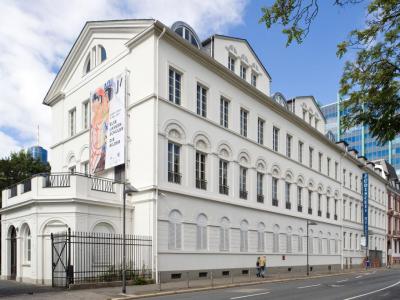
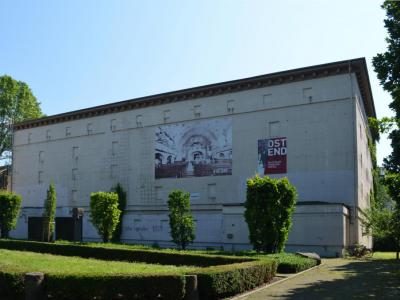
The Museum of Applied Arts or MAK, the acronym of the German Museum für Angewandte Kunst, is a repository of arts and crafts that have a utilitarian purpose. The museum, located at Schaumainkai 17 in Frankfurt has more than 30,000 objects of European and Asian decorative arts.
The museum of applied arts in Frankfurt was initially a crafts museum founded in 1877 by the Central German Handicrafts Association and was the storehouse of objects belonging to over 50 private collectors. The building suffered severe damage during the two World Wars but the collection was carefully preserved for the benefit of future generations. After the wars, the collections were housed in different institutions like a Cermelite Convent until they found a home in the Villa Metzler. The efforts of the present director Annaliese Ohm, resulted in the construction of the new building that houses the Applied Arts Museum today. The MAK building was designed by American architect Richard Meier.
Exhibits at the museum include Chinese Lacquer, art deco artifacts and modern collections of applied arts and crafts. Originally the museum featured furniture, glassware and ceramics. Product design and information design related exhibits are the recent additions to the MAK collections. The facility also has an impressive library with books by leading experts in the subject of applied arts.
Image Courtesy of Wikimedia and dontworry
German Film Museum
3) German Film Museum
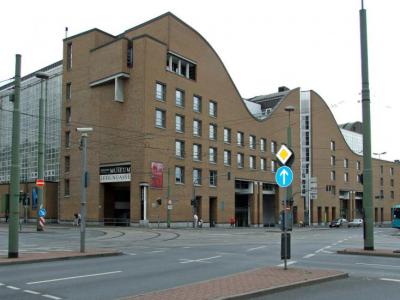
On the south bank of River Main is the Museum Sufer, a collection of museums in Frankfurt. One of them, the German Film Museum, founded in 1949, is the oldest film repository in West Germany.
The German Film Museum is a celebration of the most original art form of the twentieth century, the movie. There are five permanent exhibits. They portray the history of film from the Camera Obscura to the work of the Lumere Brothers. Other sections showcase the language of film and sound in relation to movies. The museum allows visitors to go behind the scenes to view how movies are made. These exhibits include replica studios, background sounds and effects, special effects and artistic developments used in modern cinematography

Visitors can browse the vast archives that preserve old films, cameras and a wealth of objects that relate to cinema production and technology. The museum also has a large library that is open to the public. Visitors can also take part in a car chase or fly in a magic carpet courtesy of the trick technology used in movies. The museum also holds changing exhibitions and themes related to German cinema. There is also a movie theatre that screens old and classic pictures accessible through a separate entrance.
Image Courtesy of Wikimedia and dontworry
St. Leonhard Church
4) St. Leonhard Church
Founded in 1219, this Roman Catholic parish church, located in the heart of Frankfurt, offers an English liturgy to an international congregation. The church has six heavy bells that peal and resonate across the city and one of the best stained glass windows in Hesse.
The St. Leonhard’s church was first dedicated to the Virgin Mary and St. George under a decree by Emperor Freidrich II in 1219. The first building had a Romanesque design and the original portals still remain. In 1323, the parish officials obtained a relic of St. Leonhard and the church adopted St. Leonhard as its patron saint. Between the 1400s and 1500s, gothic style structures were added to the building including the five aisles. The structure served other purposes through the years including as a warehouse for the nearby Book Fair and in the 1700s, as a place to store ammunition. In the 1800s donations by a wealthy parishioner Von Dalberg and purchases made by the then pastor Father Muenzenberger gave the church its ornate altarpieces and sculpted figures that survive till today. In the 1900s the floor of St. Leonhard’s Church was raised to prevent flooding by the River Main.
St. Leonhard’s remains a thriving international catholic parish with a congregation composed of people from over 50 countries coming to mass every week.
Image Courtesy of Wikimedia and Mylius
Saint Bartholomeus' Cathedral
5) Saint Bartholomeus' Cathedral
This 13th century church is the site of the coronation of German kings and Emperors of the Holy Roman Empire for centuries. This event has earned the building the name Kaiserdom. The cathedral is the largest church in Frankfurt and lies on the banks on the River Main.
The present cathedral is the fifth church on the same site. The early church was constructed over a 7th century Merovingian chapel in 1250. The church was subsequently adorned with architectural ornamentation and became the splendid architectural wonder it is today. Emperor Charles IV decreed by his Golden Bull that all German Kings would be crowned in the Kaiserdom from 1356 and from 1562 all emperors of the Holy Roman Empire were also crowned at the cathedral.
The church has many splendid works of art including a unique high altar and the Maria Schlaf altar located in the St. Mary’s chapel. A Gothic tower was added in the 15th century. It has an Anthony Van Dyke Painting, ‘The Lametation’ and a museum with many historic pieces including objects discovered in a grave of a Merovingian girl.
Visitors can also take in panoramic views of the City of Frankfurt by climbing the 328 steps that lead to the top of the cathedral’s tower.
Image Courtesy of Wikimedia and rupp.de
City Hall (Romer)
6) City Hall (Romer)
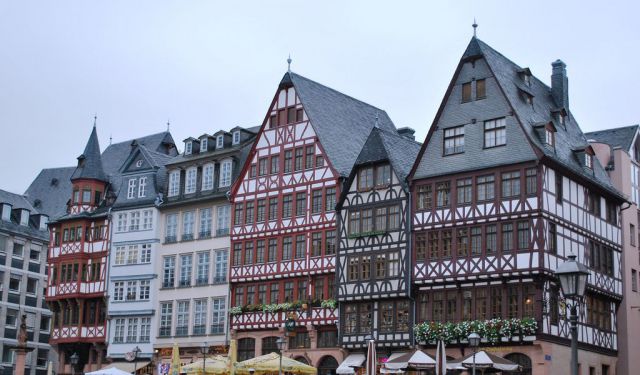
The main city hall, the Romer has served the city of Frankfurt for over 600 years and is one of its main historical landmarks. The Romer still retains offices of the local government and has not been converted into a museum unlike many other historic buildings in Frankfurt.
In 1405, the Romer family, a family of wealthy Frankfurt merchants sold the building and the adjacent Golden Swan building to the city of Frankfurt. Since the purchase, the Romer and adjacent structures have housed different civic offices continuously till the present. The old section has three medieval style buildings with stepped gables. The city hall was expanded by addition and purchase of other structures and the present complex is a labyrinth of several buildings connected by streets. A bridge known as the Bridge of Sighs connects the Romer to offices across the street. Two towers were added to the complex in the early 20th century.
Two attractions in the Romer are the Kaisersaal, a hall where the coronation banquet of German Kings and Emperors of the Holy Roman Empire took place. The hall has 52 portraits by famous artists of German kings and Emperors, from Freidrich Barbarossa in 1152 to Franz II who was forced to abdicate by Napoleon in 1806. There is an ornate balcony from where the rulers and important German statesmen waved to crowds in the square below. The Christmas fair held every year in the square in front of the City Hall draws visitors from all over the world.
Image Courtesy of Wikimedia and Mylius
Goethe House (Goethehaus)
7) Goethe House (Goethehaus)
Grosser Hirschgraben 23 in Frankfurt is the location of the house where writer philosopher Wolfgang Von Goethe was born and raised. The house was destroyed during the 2nd World War. It was reconstructed by the citizens with loving care and restored to its 17th century splendor in memory of Frankfurt’s best known son.
Goethe house was opened to the public in 1863 and has remains a shrine for Goethe enthusiasts from all over the world. The house reflects the lifestyle enjoyed by affluent 17th century Germans. It is decorated with different art forms like baroque, neoclassical and rococo. Among the rooms painstakingly restored after the war are the library where Wolfgang Goethe’s father worked and looked out for the return of his son and the portrayal of an authentic 17th century German Kitchen. The puppet theatre that Goethe treasured enough to make the focal point of his book Wilhelm Meister is also on view. One of the treasures in the house is a large classic clock on the 2nd floor that tells the time, date, lunar and solar year. The building houses Goethe’s father’s vast collection of art including paintings by well known Frankfurt artists. The adjacent Frankfurter Goethe Museum contains books, works of art and manuscripts all related in some way to Goethe.
Goethe House is open through the week and is free for children under 6 years of age. Visitors can request the help of volunteers to understand the significance of every Goethe related object on display in the building.
Image Courtesy of Wikimedia and dontworry
Zeil
8) Zeil
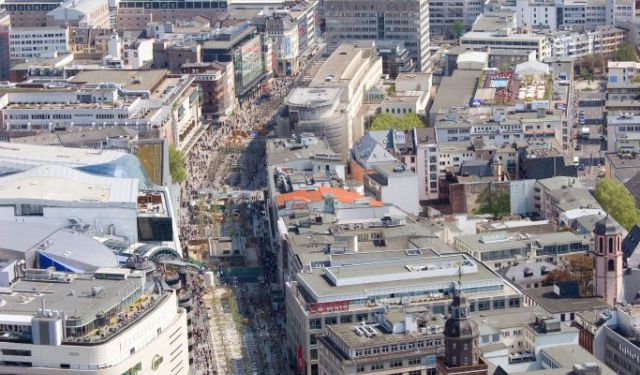
Once the center for large scale cattle trading, this old and busy shopping lane extends from the Konstablerwache Plaza to the Hauptwache Plaza in Frankfurt. The Zeil is a shoppers’ paradise where visitors with varied budgets can find a range of products from mid priced supermarket fare to high end brands.
The Zeil has been Frankfurt’s retail hub since the 14th century. The name Zeil is from the German Zeile that means row. At first it meant a row of residential houses that later became the city’s popular marketplace. Before World War II the street had many grand buildings that were destroyed and subsequently restored.
Three major buildings located on the Zeil are the Zeilgalerie, a ten storey shopping center with a unique spiral design. There are many music and electronic stores and restaurants in the building. Modern architecture and baroque are blended in another shopping center called the PalaisQuartier. The building has a spectacular vortex like glass façade, glass columns and irregular shaped ramps. The 12 storey Beehive House, a commercial and office building which is also one of the Frankfurt’s early skyscrapers is located on the Zeil.
Visitors will enjoy the unique shopping experience offered by the shops at the Zeil. Products available include luxury items, designer brands, handicrafts, clothes designed by young Frankfurt designers, outlets of all major German retail chains and produce from the Frankfurt area.
Image Courtesy of Wikimedia and Marcel Klinger
Hauptwache
9) Hauptwache
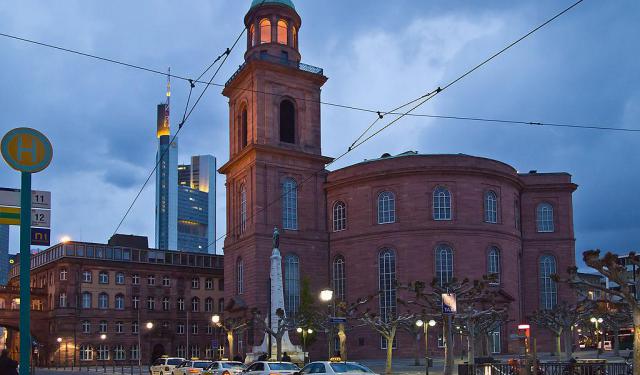
The Hauptwache building lies at one end of the Zeil and adds old world architectural charm to this busy part of Frankfurt. The Haauptwache square on which the building stands is surrounded by high rise modern buildings with the exception of the Hauptwache. The structure lies above the suburban train station and is a major intersection for the S bahn and U bahn trains.
The Hauptwache was designed by German master builder, Johann Samhaimer. The building has a red sandstone baroque style exterior and a hipped Gothic style triangular roof with three chimneys. The original purpose of the structure when it was built in 1729 was to serve as a prison and military headquarters. At the time Frankfurt was an independent city state. The Hauptwache played its role in Frankfurt’s history when it was stormed by student activists in a failed attempt at freeing political prisoners in 1733 called the Frankfurter Wachenstrum. The building then served as a police station. In 1904 it became a café that serves diners till today.
Visitors, commuters and shoppers can enjoy a light refreshing meal at the Hauptwache with its quaint ambience reminiscent of a momentous past. The cafe stays open from Mondays to Saturdays from 10am to 11 pm and on Sundays from 10 am to 8 pm.
Image Courtesy of Wikimedia and dontworry
Commerzbank Tower
10) Commerzbank Tower
The Commerzbank Tower, adjacent to the old offices of Commerzbank in Frankfurt was the tallest building in Europe till 2003. It was also the first successful skyscraper with an eco-friendly design. The tower made of steel has 56 floors, gardens and a design to let in maximum fresh air and natural lighting into the offices within the high rise structure.
The Commerzbank Tower was designed in the early 1990s by the English architectural firm, Norman Foster and partners. The building was the first in Germany to be constructed completely with steel. The elevators were placed at the four corners of the tower to make space for green gardens in the middle of the building. The gardens are in fact a ventilation system and make up the outer shell of the façade of the building where natural light and fresh air reaches the interior glass shell of the building. The windows of the offices can open and close when required.
The lobby has three large lifelike human sculptures by American sculptor J Seward Johnson. At night the building is illuminated with changing golden colors designed by artist Thomas Emde. The Commerzbank Tower does not have an observation deck but visitors are welcome to view the plaza level and the magnificent atrium gardens.
Image Courtesy of Wikimedia and Mylius
Maintower
11) Maintower
Named after the River Main, the Main Tower is one of the tallest skyscrapers in Frankfurt and the fifth highest building in Europe. The tower is the only skyscraper open for public view in the city. The design is of two connected towers, one cubical with a glass façade and the other circular clad with blue colored glass.
Construction of the Main Tower began in 1996 and was completed in 1999. The tower has 55 floors with functioning windows making it an eco friendly modern high rise structure. The Tower was planned by the Hamburg based Schweger and partners and the design won the IMMOBILIEN award 2001 at the CIMMIT congress. The building has the offices of German Banks and several international banks making it the financial center of Frankfurt. The structure also houses a television and radio station.
There is an observation deck at the top floor of the tower and visitors are encouraged to take a map to view Frankfurt’s many landmarks from the top. One floor below is a restaurant and bar with large windows offering panoramic 360 degree views of the city. On clear days visitors to the deck can see as far as the Mainz, Wiesbaden, Hanau and Taunus Mountains.
Image Courtesy of Wikimedia and dontworry
Frankfurt Opera House (Oper Frankfurt)
12) Frankfurt Opera House (Oper Frankfurt)
Overlooking a beautiful plaza with a cascading fountain is this modern opera house with a renaissance façade. It is also called the old opera house because it was erected on the site of an earlier building that existed from 1880 to 1944.
The first Frankfurt opera house, designed by Berlin based architect, Richard Lucae was opened in 1880. The guest of honor at the opening was Kaiser Wilhelm I. The architectural style had the renaissance grandeur required of an opera house that royals frequented. During World War II, the building was completely destroyed. After years of deliberation by the citizens of Frankfurt, a new structure was erected similar in design to the old opera house. The lobby and façade has a renaissance architectural style while the rest of the building is a multipurpose modern complex with banquet halls, concert halls and a congress center. The opera house serves as a cultural center and as a meeting hall for the citizens of Frankfurt.
Visitors can enjoy concerts of classical and popular music at the opera house. The building is particularly beautiful, lighted up at night with magnificent statues of Goethe and Mozart looking down on the plaza below.
Image Courtesy of Wikimedia and Sunilgkoshy
Attractions Map
Visitor's Comments (0)
Visitor's Gallery (0)