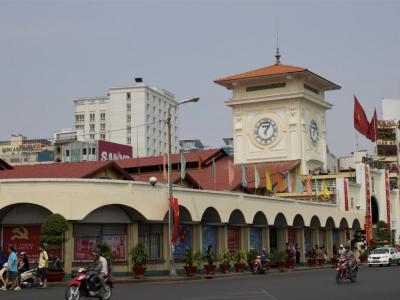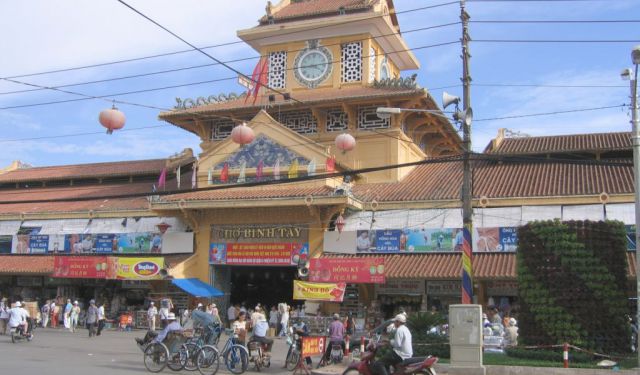


Ho Chi Minh City, also known as Saigon, is the largest, busiest and most vibrant city of Vietnam. You will find the streets filled with locals riding bikes and lined with visitors admiring sites all over the city. Museums, palaces, and skyscrapers are among its most visited sights, as they feature interesting Asian or French Colonial architecture. This next tour will lead you through some of Ho Chi Minh City's most-visited attractions.
1) War Crime Museum
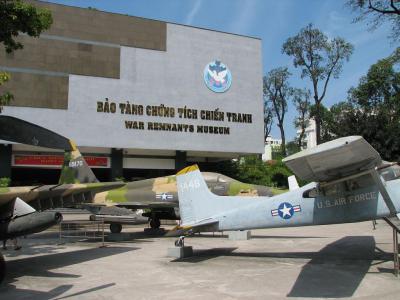
The War Crimes Museum tells the story of the war between the North and American supported South Vietnam in graphic detail. Most of the exhibits relate to the American phase of the war.
The War Crimes Museum is housed in a series of warehouses, although a new museum building is currently under construction. When inaugurated in 1975, the museum was called The House for Displaying War Crimes of American Imperialism and the Puppet Government. It was later renamed the Museum of American War Crimes. The present name emerged in 1993 after the thaw in relations between Vietnam and the United States.
The War Crimes Museum has a large collection of photographs of the brutal massacres of innocent civilians during the Vietnam War. There are displays of the effects of chemical warfare on the people, including Agent Orange, chemical defoliant sprays and the lethal Napalm and phosphorous bombs. Photographs of other atrocities committed, such as the Mai Lai massacres, and demonstrations against the war around the world, including in the US, are on display. Visitors can view Tiger Cages used by the South Vietnamese government to house political prisoners and a guillotine used to execute their political opponents. One section is devoted to captured US weaponry and ammunition. The museum has hosted over six million Vietnamese and international visitors from the date of its inauguration.
Image Courtesy of Wikimedia and Jeremy Burgin
2) Reunification Palace
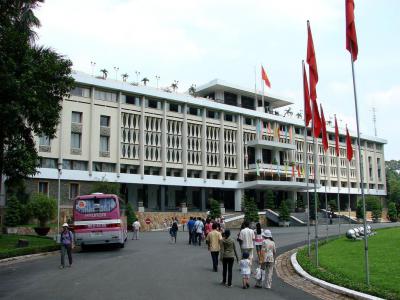
The Reunification Palace is a historic landmark in Ho Chi Minh City. It was here that North Vietnamese tanks breached the gates and were declared victorious in the Vietnam War resulting in the reunification of the country.
The Reunification Palace was built on the site of the former Norodom Palace. The Palace was the former residence of the French Governor of Cochin China and was also called the Governor’s Palace at the time. It was occupied by Japanese colonists during World War II. After the independence of Vietnam, it became the residence and office of the president of South Vietnam. The building was bombed by two rebellious pilots in 1962. The present building was designed by architect Ngo Viet Thu and opened its doors in 1966.
Visitors to the Reunification Palace are welcomed in the front lawn by the tank that breached its gates and signaled the end of the Vietnam War. The rooms of the building are preserved as they were during the war. The recreation room has many pieces of period furniture. The War command room is the most interesting part of the museum displaying early communication equipment and maps used during the war. There are also a series of underground tunnels leading to the Gia Long Palace including a basement wartime communications room. Visitors can also view a video about the Vietnam War in English at the Reunification Palace.
Image Courtesy of Wikimedia and Eustaquio Santimano
3) Notre Dame Basilica de Saigon
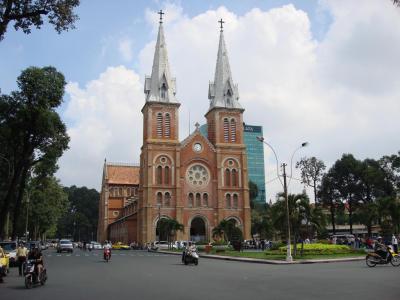
This Roman Catholic cathedral constructed by the French colonists is the seat of the Archbishop of Saigon. The red building with two pointed bell towers is a distinctive landmark of Ho Chi Minh City.
The French Bishop Isidore de Colombert laid the foundation stone of the Saigon Notre Dame Basilica in 1877. The building was designed in France and built under the supervision of a well known French engineer named Bourad. It was consecrated on Easter Day, 1880 in the presence of the then Governor of Cochin China, Charles Le Myre de Vilers. The church became a basilica in 1959 after receiving approval from the Vatican.
The Notre Dame Basilica is made from construction material imported directly from France. The bricks were made in Marseilles and the stained glass that once adorned the windows came from Chartres. It has a neo Romanesque design with three arched façade. The two bell towers are 57.6 meters high and hold six bronze bells. Each tower is topped by a 3.5 meter high cross. In 1959, Bishop Joseph Pham Van Thien of the Saigon parish installed a statue of the Holy Mother in front of the church. In 2005, a story that the statue had shed tears circulated and thousands of visitors came to view the phenomenon. The clergy later denied the occurrence of the incident.
Image Courtesy of Wikimedia and Andre Lettau
4) Central Post Office
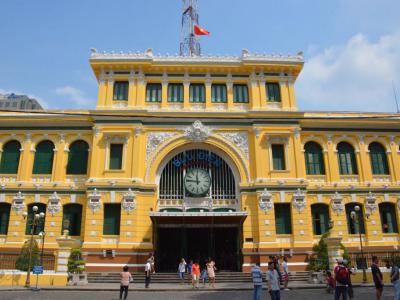
The Central Post Office is an elegant colonial style building in the heart of Ho Chi Minh City. It is located beside the Notre Dame Basilica at the Paris Commune Square.
The Central Post Office building has a gothic architectural style and was designed by the world famous French architect, Gustave Eiffel. It was constructed between 1886 and 1891 and resembles a European railway station. It was and is a working post office where visitors can send postcards and purchase stamps.
The Central Post Office Building is the biggest post office structure in Vietnam. There are ornate wrought iron gates in the main entrance. The central hall has a large clock and two similar extensions on both sides covered by a large skylight. The arched windows have decorated capstones and green shutters that are a typical feature of French colonial buildings. The interior of the main chamber has two large maps of Vietnam and Saigon that date back to the 18th century. At the far end of the chamber hangs a giant portrait of the Vietnamese revolutionary leader, Ho Chi Minh. Besides postal mail services, the post office offers public phone and fax facilities. The specialty stamp counter sells some unusual philately sets.
Image Courtesy of Wikimedia and Eustaquio Santimano
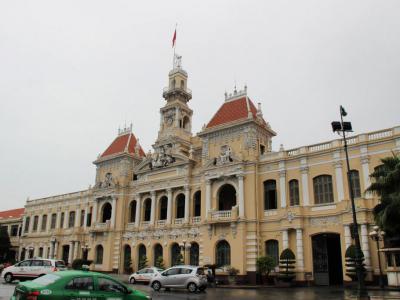
5) Ho Chi Minh City Hall
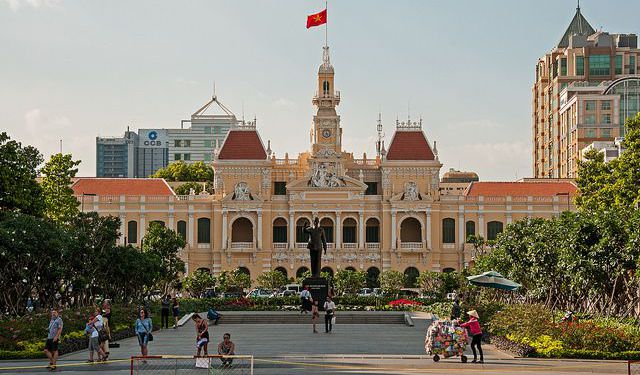
The Ho Chi Minh City Hall is the present name of the former Hotel De Ville or City Hall of Saigon. The ornate yellow French style building is located on the Le Thanh Ton Street at the end of the Nguyen Hue Boulevard.
The Ho Chi Minh City hall was designed by the French architect P. Gardes and built between 1898 and 1908. It was called the Hotel de Ville until 1954. Between 1954 and 1975, it was called the City Hall of Saigon under the then South Vietnam Government. After the reunification of the country in 1975, it was given its present name, the Ho Chi Minh City People’s Committee Building.
Visitors to the building are greeted by a statue of Ho Chi Minh teaching a child. It is a popular spot where locals and tourists get their photographs taken. The Ho Chi Minh City Hall has a renaissance style that was inspired by the design of town halls in France. It has a main hall and rectangular wings. A notable feature of the building is the bell tower that stands on a pyramid shaped pedestal. The Ho Chi Minh Hall is spectacular when lighted up at night. It consists of working government offices and is not open to visitors.
Image Courtesy of Wikimedia and Brian Snelson
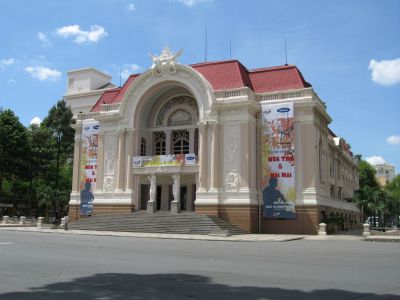
6) Municipal Theater
The Municipal Theater also called the Saigon Opera House is one of the finest examples of 19th century French colonial architecture in Ho Chi Minh City. It was built to stage plays and operas for the entertainment of French troops stationed in the city.
The Municipal Theater was designed by architect Felix Olivier and its construction was supervised by architects, Ernest Guichard and Eugene Ferret. It was built between 1898 and 1900. The theater was damaged by the allied bombs of World War II. After the victory of the forces of the Viet Minh in Dien Bien Phu, it became the temporary shelter for French families fleeing North Vietnam. The theater was renovated to house the lower house of parliament of South Vietnam in 1955. Its function as a performing arts venue was restored after the fall of Saigon in 1975. Extensive restorations were carried out in1998 by the Municipal Government as part of the celebrations of the 300th anniversary of Saigon.
Visitors are greeted by two white female statues at the gate. The stairs are lined with ornate chandeliers and bronze statues. There is a main seating floor with two upper floors. The theater can seat an audience of 1800 people. Today, the Municipal Theater is the venue for Jazz concerts, operas, traditional Vietnamese dances and ballet performances.
Image Courtesy of Wikimedia and Kham Tran - www.khamtran.com
7) Saigon Trade Center
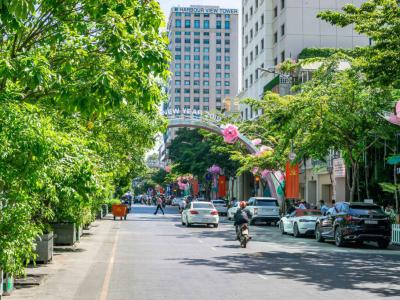
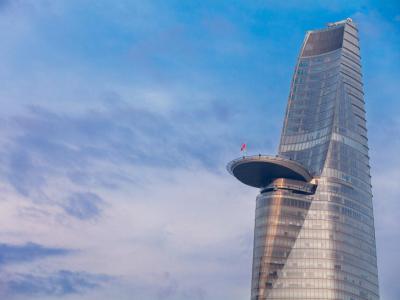
Saidon Trade Center is the tallest skyscraper in all of Ho Chi Minh City, standing at 145 m tall. The skyscraper is surrounded by the embassies and consulates of the city. There are plenty of shops inside the building and, as every other major skyscraper, it offers a gorgeous panoramic view of the city. The bar and restaurant at the top provide a pleasurable dining experience.
Image Courtesy of Flickr and hienmtd
8) Saigon Zoo and Botanical Garden
The Saigon Zoo and Botanical Garden offers a peaceful getaway from the bustle of the city. It is one of the oldest zoos in the world and the adjacent botanical garden has some rare, native Vietnamese species of orchids.
The Saigon Zoo was founded by a French Veterinarian, named Louis Germain, and covered an area of 12 hectares in 1864. Later, eminent botanist Louis Pierre, who designed the botanical gardens of Kolkata in India, was invited to design the landscape for a garden, covering an additional area of 13 hectares, adjacent to the zoo, in 1869. A bridge across the Nghe Channel, built in 1927, connected the botanical gardens and the zoo. It is the biggest biological garden in Vietnam.
The Saigon Zoo and Botanical Gardens are home to over a 100 animals, ornamental plants and rare orchids. The zoo has several species of mammals, reptiles and birds. Visitors can view the deer enclosure from an elevated walkway and there is a petting area with domesticated animals. The botanical garden has plant species from across Asia, Africa and the Americas. There are 20 species of rare orchids, many unique cacti species and 34 Bonzai tree varieties. In 1927, the Japanese government donated to the garden over 900 rare plants.
Image Courtesy of Wikimedia and Steve Jurvetson
9) Vietnam History Museum
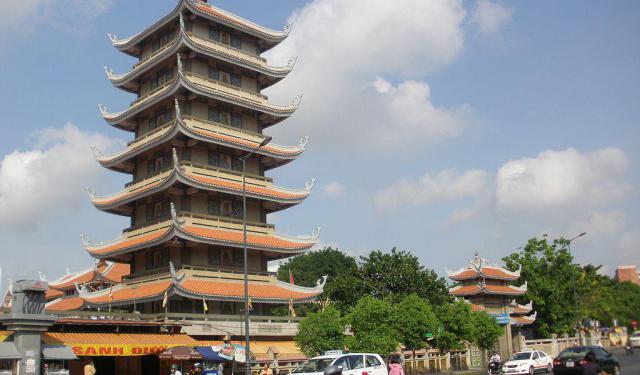
The Vietnam History Museum is a repository of objects dating from prehistoric times to the formation of the communist party in 1930. The building housing the museum is a unique pagoda like structure designed in Neo Vietnamese style during the colonial era.
The Vietnamese History museum was constructed in 1929. At the time, it was called the Blanchard de la Brosse Museum. Between 1929 and 1956, the museum displayed objects from all parts of French Indochina. It was renamed, Saigon National Museum between 1956 and 1975 and got its present name after the unification of the country in 1975.
The Vietnamese History Museum is divided into two parts. The first part consists of halls with exhibits from each period in Vietnam’s history. Exhibits in these halls are dedicated to the pre historic period, the reign of King Hung, the Ly dynasty, the Tran Dynasty, the Le Dynasty, the Tay Son and the Nguyen Dynasty. The second part is dedicated to the cultures of Southern Vietnam like the Oc Eo culture, the cultures of the Mekong River, Cham art, ceramics and pottery, ancient weaponry and the crafts, costumes, utensils and of ethnic minority groups in the country. There is also a small theater within the museum where traditional Vietnamese water puppet shows are held.
Image Courtesy of Wikimedia and DoktorMax
10) Emperor Jade Pagoda
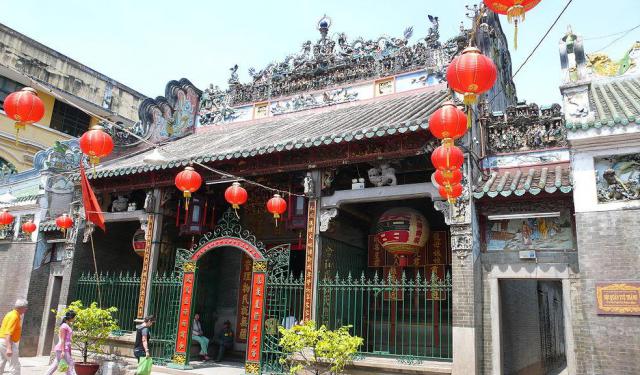
The Emperor Jade Pagoda is located north of the intersection of Mai Thi Luu Street and Dien Bien Phu Street in Ho Chi Minh City. It is also called the Tortoise Pagoda.
The Emperor Jade Pagoda is an ancient temple built by the Cantonese Chinese community of the city. A statue of the Taoist God of the heavens made of jade is the main object of worship. It was built in the year 1909.
Visitors enter the temple from a crowded street filled with shops and houses through a traditional Chinese temple gate. The Jade statue at the center is dedicated to the Taoist God of the heavens. The deity is said to decide who will enter the heavens and whose entry will be rejected. The statue of Kim Hua, the Goddess of fertility is in the room to the left of the central hall and another room has the statue of the King of Hell surrounded by his minions. The interiors are filled with paintings portraying Taoist and Buddhist mythical stories and sculpture depicting the ten levels of hell and the apocalypse from Chinese mythology. The temple is an active one and the smell of burning incense hangs heavily in the atmosphere. There is a large concrete pond in front of the temple filled with large turtles.
Image Courtesy of Flickr and Original Nomad