It's not difficult to dive into Cape Town history, since the most notable museums are almost all located in or close to the city center. Take this tour and immerse yourself in Cape Town's history and culture.
1) Bo-Kaap Museum
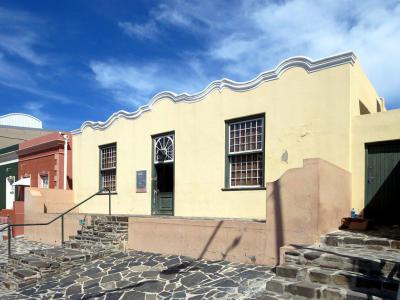
Cape Town has been the home of different ethnic groups, many of them brought here as slaves who either bought or earned their freedom. The Bo-Kaap Museum stands on Wale Street and is dedicated to early Muslims who settled here after they had been freed.
The house museum is situated in an area of brightly painted houses typical of Cape Dutch architecture. It is the oldest house in this part of the town, built in 1763. The Muslims who lived in the Bo-Kaap district on the slopes of Signal Hill, were, in the main part, skilled craftsmen – carpenters, tailors and builders.
The museum is decorated with 19th century furniture that would have been used by a typical Muslim family. A large collection of black and white photos in a room on the first floor depict colonial life.
The museum isn’t very big, but it is very interesting and you will learn about Muslim life, about their customs and beliefs and how they were affected by the apartheid system. Under apartheid many of the locals wanted the Muslims to move away from the area, but they had their mosque here and they refused to move. The museum stands today as a reminder of the tenacity and determination of this minority group.
Image Courtesy of Wikimedia and n1s / Eric Lin
2) The Slave Lodge
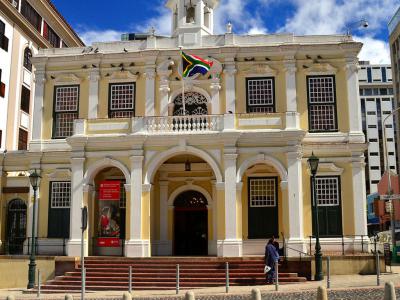
The Slave Lodge is located on the corner of Wale and Adderley Streets and is an interesting museum to visit as it pays tribute to the thousands of slaves brought to Cape Town between the 17th and 19th centuries.
The lodge was built in 1679 and it was here that the Dutch East India Company housed up to a thousand slaves in insanitary, cramped conditions. The original lodge had no windows and was built of unadorned brick, but today it is a smart, white-washed building that tells the story of the African and Asian slaves who lived and worked in the city.
Through interactive displays you will learn about slave family roots, their way of life and how some of them settled in the city after winning their freedom.
The museum has a small but excellent collection of Egyptian artefacts that date back to 3050BC, including silver items, textiles, toys and tools. You can admire a superb collection of Greek vases and ceramics, pottery and cuneiform tablets from the Roman occupation of the Near East.
Between 1811 and 1911 the lodge changed hands several times: it was a post office, a public library, a small prison and the Supreme Court. In the courtyard you will see the tombstones (but not the graves) of Cape Town’s founder, Jan Van Riebeeck and his wife Maria.
Image Courtesy of Flickr and I love beachhuts
3) District Six Museum
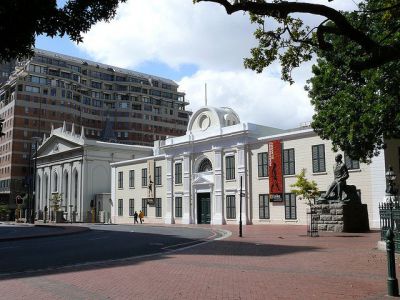
District Six is the name of a former inner-city residential area in Cape Town, South Africa. It is best known for the forced removal of over 60,000 of its inhabitants during the 1970s by the apartheid regime. On 11 February 1966, the government declared District Six a whites-only area under the Group Areas Act, with removals starting in 1968. The old houses were bulldozed. In 1989 the District Six Museum Foundation was established, and in 1994 the District Six Museum came into being. It serves as a remembrance to the events of the apartheid era as well as the culture and history of the area before the removals. The ground floor is covered by a large street map of District Six, with handwritten notes from former residents indicating where their homes had been; other features of the museum include street signs from the old district, displays of the histories and lives of District Six families, and historical explanations of the life of the District and its destruction.
Image Courtesy of Flickr and thomas_sly
Sight description based on wikipedia
4) Rust-en-Vreugd House
Rust-en-Vreugd House is a fascinating museum to visit, not only for its fine collections of paintings, furniture and objets d’art, but also because of the building’s interesting history.
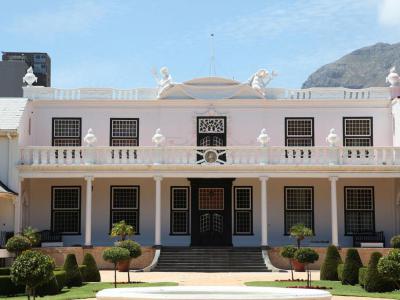
The house, located on Bultenkant Street, was built in 1777 and is a typical flat-roofed, two-storey townhouse, only on a much larger scale than most townhouses in the area. It was commissioned by Willem Cornelis Boers, who was an official in the Dutch East India Company, and was considered a ruthless, unscrupulous man.
He was suspected of using government funds to construct the house, which is an elegant affair, its balcony supported by 4 Corinthian pillars and a decorative fanlight over the front door. It has many splendid rooms and a vast cellar.
In 1878 the building was bought by the Dutch Reformed Church and turned into a teachers’ training college. Between 1925 and 1957 it was the Cape Town High School. In the early nineteen sixties it was bought by the town council and refurbished as a gallery.
Today, it houses William Fehr’s beautiful collection of watercolours, prints and drawings, as well as a comprehensive collection of 16th to 19th century Africana paintings. You will also be able to admire a series of paintings featuring early scenes of Cape Town by John Thomas Baines and architectural sketches by Alys Fane Trotter.
Image Courtesy of Flickr and John Steedman
5) Jewish Museum
A visit to the Jewish Museum should be on everyone’s “must” list, as it is an exciting and successful mixture of the old and the new.
The entrance to the museum is in the Old Synagogue which was founded in 1863, making it one of the oldest in South Africa. You cross a bridge from the synagogue and into the ultra-modern high-tech museum and it is just like stepping forward in time.
The museum was founded in the nineteen fifties, but has been extensively renovated and the new model was opened by Nelson Mandela in 1999. Various videos are shown throughout the day, the most important one being a documentary entitled “Nelson Mandela – A Righteous Man”.
The interactive displays take you through the history of South Africa and the history of Jewish life, with a heavy emphasis and the moral and political side of being a Jew living under the apartheid reign.
There is a wonderful scale model of a “shtetl”, or small village mainly populated by Jews. There were many of these in Eastern Europe before the Second World War and the one you will see in the museum is based on a village in Lithuania, where most of the Jews in South Africa came from originally.
In the Discovery Centre you will find family trees with information about over 15000 families who can trace their origins back to Eastern Europe before settling in South Africa between 1880 and 1930.
Image Courtesy of Flickr and Lorraine van der Merwe
6) South African National Gallery
The South African National Gallery is to be found in Company Gardens on Government Avenue and is a popular venue for tourists and locals alike.
The gallery houses one of the most important collections of African, British, Dutch and Flemish art in South Africa from the colonial period to contemporary and indigenous art.
The collection of architectural designs and sketches, paintings, photographs, sculpture and textiles is so large that the permanent exhibitions are rotated so that nothing is missed out.
The gallery was founded in 1871 and the first works were those donated by the estate of Thomas Butterworth – a total of 45 paintings. Today the gallery holds thousands. You can admire the works of Anton Van Wouw, Marc Chagall, Neville Lewis, Irma Stern and William Kentridge among many other artists.
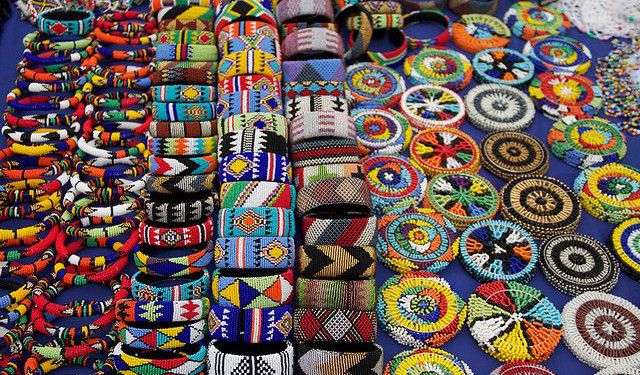
Bead work plays an important role in the lives of the women in many tribes and in 1999 the Bead Society of South Africa was integrated into the gallery and you can learn about the meaning behind some of the magnificent head-dresses, vests and jewellery you will see on display.
The gallery has a very good gift shop where you can buy prints and reproductions, books about colonial and contemporary art, books about bead work and other souvenirs.
Image Courtesy of Wikimedia and PhilippN
7) South African Museum and Planetarium
A good way to spend an interesting afternoon, especially if you are looking for something to do with the kids, is at the South African Museum and Planetarium in Company Gardens.
There is something for everyone in the museum from rock paintings to stuffed animals and skeletons. There are nine permanent exhibitions that trace the Earth from its earliest beginnings into the future and to the stars themselves.
In the Planetarium high-tech light and sound displays recreate the night sky inside a domed auditorium. You will learn about our galaxy and our place in the universe. There is also an impressive collection of meteorites.
In Virtual Earth you can take part in interactive displays about the planet and how the Earth is changing, not only through man’s clumsy approach to environmental protection, but also through the natural shifting of the continental plaques and the upheavals within the Earth’s core.
Darwin and the Cape, African Dinosaurs and Boonstra Dioramas are different sections dealing with life on Earth back to over 300 million years ago, with dinosaur and reptile fossils and artefacts from the earliest human emergence on the continent.
In the Wonders of Nature section you will find over 20 items, including ammonites, a turtle carapace, some amazing clusters of various quartz and an iron meteorite that is as old as time.
The best part of the museum is undoubtedly the section dedicated to marine life and the Whale Well, where you will be amazed by the skeleton of a huge whale, sharks and the reconstruction of a giant squid.
Image Courtesy of Flickr and Nuno Boggiss