Home City Search Cape Town Self-Guided Tour of Cape Town's Garden District
Self-Guided Tour of Cape Town's Garden District, Cape Town
Download iPhone Walking Tours Application for Cape Town
iPhone Walking Tours Application for Cape Town
Bookmark and Share
Self-Guided Tour of Cape Town's Garden District
Guide Location: South Africa » Cape Town
Guide Type: Self-guided city tour
# of Attractions: 10
Tour Duration: 1 hour(s)
Transportation Mode: by foot
Travel Distance: 1.8 km
Image Courtesy of Flickr and henribergius
Author: ann
This green inner-city suburb of Cape Town is very popular with tourists. It dates back to 1652 when the first garden was opened. A number of cultural and architectural sights are located within this district. Take this tour to enjoy a picturesque and artsy walk through the gardens of Cape Town.
Tour Stops and Attractions
Bertram House
1) Bertram House
No visit to Cape Town would be complete without visiting Bertram House, which you will find on the corner of Orange Street and Government Avenue Gardens.

Due to the strong Dutch influence in Cape Town, it is easy to forget that the British held the area several times during South Africa’s history, and Bertram House is a house museum which will show you how a wealthy British family lived in a country far from their own.

You should perhaps note that at the time of the British rule in the region, the settlers were, on the most part, military, trading or mining families who came from the British working or middle classes. Finding themselves in a new territory, these families were the nouveau riche and they modelled their homes on the grand houses they had dreamed about owning.

Bertram House was built in the Georgian style and is one of the last surviving buildings of its kind in the Cape area. It was built in 1839 by John Baker and its British owners lived there until 1903. When they left the country, it was bought by the South African College and taken over by the government in 1930.

The house was saved from demolition by the determination of Winifred Ann Lidderdale, a member of the South African Cultural History Museum, who insisted that it should be made into a house museum.

Restored to its former beauty, the house museum is furnished with English Georgian furniture and beautifully decorated in light colours. The 364 pieces of Chinese and English porcelain are from the personal collection of Mrs Lidderdale.
Image Courtesy of Flickr and PROFI-LACK-TISCH
South African National Gallery
2) South African National Gallery
The South African National Gallery is to be found in Company Gardens on Government Avenue and is a popular venue for tourists and locals alike.

The gallery houses one of the most important collections of African, British, Dutch and Flemish art in South Africa from the colonial period to contemporary and indigenous art.

The collection of architectural designs and sketches, paintings, photographs, sculpture and textiles is so large that the permanent exhibitions are rotated so that nothing is missed out.

The gallery was founded in 1871 and the first works were those donated by the estate of Thomas Butterworth – a total of 45 paintings. Today the gallery holds thousands. You can admire the works of Anton Van Wouw, Marc Chagall, Neville Lewis, Irma Stern and William Kentridge among many other artists.

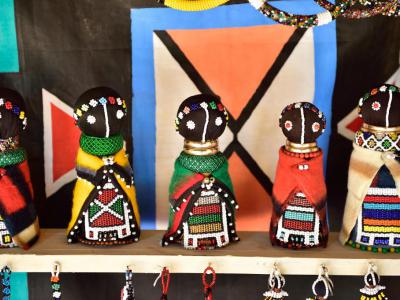
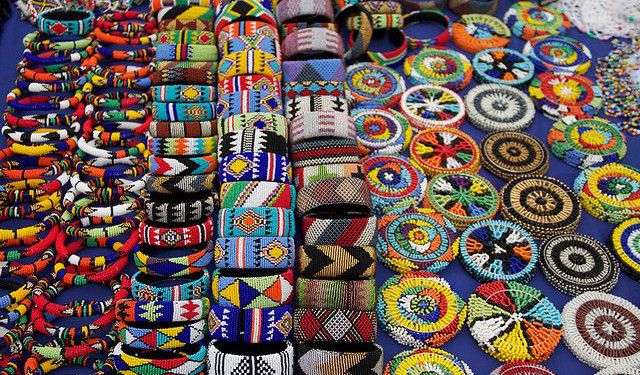
Bead work plays an important role in the lives of the women in many tribes and in 1999 the Bead Society of South Africa was integrated into the gallery and you can learn about the meaning behind some of the magnificent head-dresses, vests and jewellery you will see on display.

The gallery has a very good gift shop where you can buy prints and reproductions, books about colonial and contemporary art, books about bead work and other souvenirs.
Image Courtesy of Wikimedia and PhilippN
Jewish Museum
3) Jewish Museum
A visit to the Jewish Museum should be on everyone’s “must” list, as it is an exciting and successful mixture of the old and the new.

The entrance to the museum is in the Old Synagogue which was founded in 1863, making it one of the oldest in South Africa. You cross a bridge from the synagogue and into the ultra-modern high-tech museum and it is just like stepping forward in time.

The museum was founded in the nineteen fifties, but has been extensively renovated and the new model was opened by Nelson Mandela in 1999. Various videos are shown throughout the day, the most important one being a documentary entitled “Nelson Mandela – A Righteous Man”.

The interactive displays take you through the history of South Africa and the history of Jewish life, with a heavy emphasis and the moral and political side of being a Jew living under the apartheid reign.

There is a wonderful scale model of a “shtetl”, or small village mainly populated by Jews. There were many of these in Eastern Europe before the Second World War and the one you will see in the museum is based on a village in Lithuania, where most of the Jews in South Africa came from originally.

In the Discovery Centre you will find family trees with information about over 15000 families who can trace their origins back to Eastern Europe before settling in South Africa between 1880 and 1930.
Image Courtesy of Flickr and Living Imprint
South African Museum and Planetarium
4) South African Museum and Planetarium
A good way to spend an interesting afternoon, especially if you are looking for something to do with the kids, is at the South African Museum and Planetarium in Company Gardens.

There is something for everyone in the museum from rock paintings to stuffed animals and skeletons. There are nine permanent exhibitions that trace the Earth from its earliest beginnings into the future and to the stars themselves.

In the Planetarium high-tech light and sound displays recreate the night sky inside a domed auditorium. You will learn about our galaxy and our place in the universe. There is also an impressive collection of meteorites.

In Virtual Earth you can take part in interactive displays about the planet and how the Earth is changing, not only through man’s clumsy approach to environmental protection, but also through the natural shifting of the continental plaques and the upheavals within the Earth’s core.

Darwin and the Cape, African Dinosaurs and Boonstra Dioramas are different sections dealing with life on Earth back to over 300 million years ago, with dinosaur and reptile fossils and artefacts from the earliest human emergence on the continent.

In the Wonders of Nature section you will find over 20 items, including ammonites, a turtle carapace, some amazing clusters of various quartz and an iron meteorite that is as old as time.

The best part of the museum is undoubtedly the section dedicated to marine life and the Whale Well, where you will be amazed by the skeleton of a huge whale, sharks and the reconstruction of a giant squid.
Image Courtesy of Flickr and carminenyc
Cecil Rhodes Statue
5) Cecil Rhodes Statue
In the very heart of the Company's Garden, you will find the statue of Cecil Rhodes, an imposing South African political figure and successful businessman. He is known for founding the diamond company De Beers and the state of Rhodesia, which would later divide into the states of Zambia and Zimbabwe. Part of his fortune went to endowing the Rhodes scholarship.
Image Courtesy of Flickr and haxney
Parliament of South Africa
6) Parliament of South Africa
While in Cape Town don’t pass up the opportunity to visit the Parliament of South Africa, which holds guided tours on most weekdays when Parliament isn’t in session, or you can get tickets to sit in the public gallery.

Since 1910 Cape Town has been the Legislative Capital of the Union and the Council of Provinces meet in the Old House of Parliament which was built in 1885. The National Assembly meets in the Tricameral Chamber, which was created when coloured members were admitted to the government.

The building was originally designed by Charles Freeman in 1875, but he made a hash of the foundation planning and got kicked off the project which was then handed to Henry Greaves, who redid the plans and the building was finished in 1884.

There are two entrances to this beautiful building, one on the garden side with six Corinthian columns; the other, the main entrance on Parliament Street, has four groups of two columns. In front of this entrance you will see a grand statue of Queen Victoria.

The guided tours are very interesting: to start off you visit the multimedia room where you will watch a short documentary DVD that explains the history of the National Symbol and the Parliamentary Emblem. The guides are always ready to answer any questions concerning the political history of South Africa.

If you want to sit in the public gallery during a session, you’ll have to present your passport before acquiring tickets.
Image Courtesy of Wikimedia and PhilippN
De Tuynhuys
7) De Tuynhuys
If you are interested in architecture and history but don’t want to visit museums, then you will be happy just to photograph De Tuynhuys from the outside, as it houses the offices of the State President and is not open to the public.

It is rather hard to imagine, but in 1675 this building was a rather shabby tool-shed, owned by the Dutch East India Company. At the time there were few splendid buildings in the Cape Town area, which was a basic supply station for Dutch ships passing through the Cape of Good Hope on their way to the Far East and India.

In 1679, when the state governor decided to visit the growing outpost, there was a bit of a panic about where to lodge him. As the tool shed was the only unoccupied building, it was hastily enlarged into a two-storey house with a flat roof and a large veranda.

By 1751 it had become the summer residence for succeeding governors and had been refurbished in the Neo-classical style with sculptures of Mercury and Poseidon added – the former being the Roman god of trade and the latter the god of the sea – to enhance Dutch prowess at both trade and sailing. The beautiful front door was created by a slave carpenter, Rangton Van Bali, whose excellent work later earned him his freedom.

In 1824 a lovely ballroom was added, but the building was damp and no longer habitable except during the driest months of the year. At the beginning of the 20th century the town council considered demolishing it, but as the house was linked to the city’s history, they couldn’t decide whether to knock it down or not.

In 1968 it was decided to restore the house and Gabriel Fagan was commissioned to carry out the necessary repairs. Using drawings that dated back to 1790, he began the work and during restoration he uncovered the façade’s original stucco garlands, bas reliefs and floral decorations that you can photograph today.
Image Courtesy of Wikimedia and Mahendra13
Queen Victoria Statue
8) Queen Victoria Statue
For many years, Cape Town was a British colony, and British influences can be found in landmarks throughout the city. One such landmark is standing majestically in the Company's Garden directly in front of the House of Parliament. Queen Victoria's Statue was erected in 1887 as part of the celebration of Queen Victoria's Jubilee.
Image Courtesy of Flickr and Simone Meltesen
Jan Smuts' Statue
9) Jan Smuts' Statue
Just before entering the Company's Garden, on the corner of Wale and Adderley Streets, you will find the statue depicting Jan Smuts sitting on a rock. Jan Christiaan Smuts was a well-regarded politician, recognized military leader and philosopher. For many years he held the position of Prime Minister of the Union of South Africa.
Image Courtesy of Wikimedia and Georgio
St. George's Cathedral
10) St. George's Cathedral
St George’s Cathedral on Wale Street is renowned for two things: the first is its beautiful stained glass windows; the second is that even after 106 years, it still isn’t finished!

The cathedral was designed on the site of a former church by Sir Henry Baker in 1901. Building started in 1906, but through lack of funds the North Transept wasn’t finished until 1936. By this time Sir Henry had returned to England, where he died ten years later.

Work dragged on slowly over the years: the Lady Chapel and the south aisle were completed in 1963, the Bell Tower and the Link in 1978. The cathedral is still waiting for the Chapter House to be added onto the end of the Link.

In 1982 the French stained-glass artist Gabriel Loire donated the magnificent window entitled “Christ in Triumph over Darkness and Evil” to the cathedral. This masterpiece is dedicated to the memory of Earl Mountbatten of Burma, the last Viceroy of India. The beautiful rose window is in the South Transept and in the Link is a window dating back to 1866 of the Last Supper.

In the cathedral gardens you can walk the Labyrinth and you can buy souvenirs in the Cathedral Book and Bric-à-Brac Shop opposite the church. This great shop not only sells religious books, but cookbooks, children’s stories and fiction. You can browse through the CD’s or old records, pictures and paintings, antiques and occasionally small items of furniture.
Image Courtesy of Wikimedia and Danie van der Merwe
Attractions Map
Visitor's Comments (0)
Visitor's Gallery (0)