

Titian's Paintings Walk (Self Guided), Venice
One of the greatest painters of all time, Tiziano Vecelli – better known as Titian – was a pioneering figure of the Venetian school of Italian Renaissance painting. His career was successful from the start, and he became sought after by patrons, initially from Venice and its possessions, then joined by the north Italian princes, and finally the Habsburgs and papacy.
Equally adept with portraits, landscape backgrounds, and mythological and religious subjects, his methods – particularly in the application and use of colour – exercised a profound influence not only on painters of the late Italian Renaissance, but on future generations of Western art. This self-guided walking tour will guide you through the most important places that have benefited from Titian’s amazing skills.
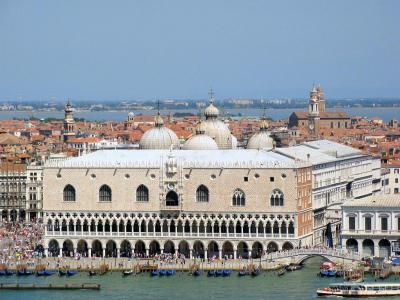
Because of a devastating fire in the late 16th century, the Doge’s Palace had to be reconstructed – fortunately during the peak of both Venetian wealth and its talents. The result was a massive collaboration among stars like Titian, Veronese, Tintoretto and Tiepolo, who filled every room with paintings and sculptures – some of which are so beautiful that each of them could easily be a headliner piece in any major art museum!
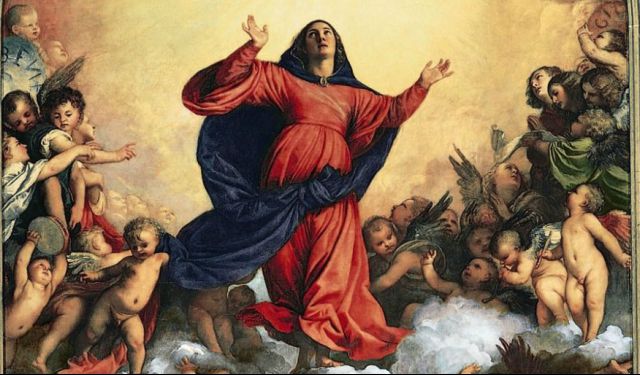
Another veritable treasure-chest of exceptional works of art, Santa Maria Gloriosa dei Frari houses perhaps the most famous masterpiece of Titian's early maturity, “Assumption of the Virgin” (1516-18), as well as the painter's tomb. What’s not to be forgotten is also “Pesaro Madonna” (1526), which some critics thought to be the artist’s best work in Venice.
Other precious works by Titian can be admired in the Gallerie dell'Accademia (“Presentation of the Virgin”), the Santa Maria della Salute (“St. Mark Enthroned”, the altarpiece of the sacristy, as well as ceiling paintings of David and Goliath, Abraham and Isaac and Cain and Abel), and the San Giovanni Elemosinario (“St. John the Almsgiver”).
Take our self-guided walk to admire Titian’s artistic mastership in Venice as well as the beautiful church where he was laid to rest.
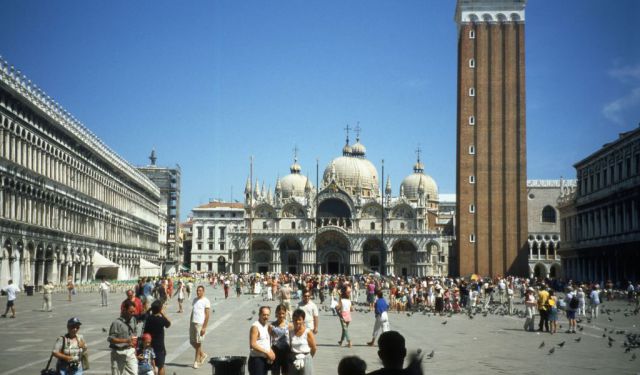
Getting to Sight #1. The first tour stop (Palazzo Ducale (Doge's Palace)) is on San Marco Square or can be reached by: Alilaguna Water Taxi: Blue (B), Rosa (R); Water Bus: 1, 2, 4.1, 10, 7, 4.2, 5.2, 2, 20 + N (Night line).
Equally adept with portraits, landscape backgrounds, and mythological and religious subjects, his methods – particularly in the application and use of colour – exercised a profound influence not only on painters of the late Italian Renaissance, but on future generations of Western art. This self-guided walking tour will guide you through the most important places that have benefited from Titian’s amazing skills.
Because of a devastating fire in the late 16th century, the Doge’s Palace had to be reconstructed – fortunately during the peak of both Venetian wealth and its talents. The result was a massive collaboration among stars like Titian, Veronese, Tintoretto and Tiepolo, who filled every room with paintings and sculptures – some of which are so beautiful that each of them could easily be a headliner piece in any major art museum!
Another veritable treasure-chest of exceptional works of art, Santa Maria Gloriosa dei Frari houses perhaps the most famous masterpiece of Titian's early maturity, “Assumption of the Virgin” (1516-18), as well as the painter's tomb. What’s not to be forgotten is also “Pesaro Madonna” (1526), which some critics thought to be the artist’s best work in Venice.
Other precious works by Titian can be admired in the Gallerie dell'Accademia (“Presentation of the Virgin”), the Santa Maria della Salute (“St. Mark Enthroned”, the altarpiece of the sacristy, as well as ceiling paintings of David and Goliath, Abraham and Isaac and Cain and Abel), and the San Giovanni Elemosinario (“St. John the Almsgiver”).
Take our self-guided walk to admire Titian’s artistic mastership in Venice as well as the beautiful church where he was laid to rest.
Getting to Sight #1. The first tour stop (Palazzo Ducale (Doge's Palace)) is on San Marco Square or can be reached by: Alilaguna Water Taxi: Blue (B), Rosa (R); Water Bus: 1, 2, 4.1, 10, 7, 4.2, 5.2, 2, 20 + N (Night line).
How it works: Download the app "GPSmyCity: Walks in 1K+ Cities" from Apple App Store or Google Play Store to your mobile phone or tablet. The app turns your mobile device into a personal tour guide and its built-in GPS navigation functions guide you from one tour stop to next. The app works offline, so no data plan is needed when traveling abroad.
Titian's Paintings Walk Map
Guide Name: Titian's Paintings Walk
Guide Location: Italy » Venice (See other walking tours in Venice)
Guide Type: Self-guided Walking Tour (Sightseeing)
# of Attractions: 5
Tour Duration: 2 Hour(s)
Travel Distance: 3.6 Km or 2.2 Miles
Author: DanaOffice
Sight(s) Featured in This Guide:
Guide Location: Italy » Venice (See other walking tours in Venice)
Guide Type: Self-guided Walking Tour (Sightseeing)
# of Attractions: 5
Tour Duration: 2 Hour(s)
Travel Distance: 3.6 Km or 2.2 Miles
Author: DanaOffice
Sight(s) Featured in This Guide:
- Palazzo Ducale (Doge's Palace)
- Chiesa di San Giovanni Elemosinario (Church of St. John the Almsgiver)
- Basilica di Santa Maria Gloriosa dei Frari (Basilica of Glorious St. Mary of the Friars)
- Gallerie dell'Accademia (Gallery of the Academy)
- Basilica di Santa Maria della Salute (Basilica of Our Lady of Good Health)
1) Palazzo Ducale (Doge's Palace) (must see)
Built on the remains of a 9th-century fortress, this palace didn’t just host power—it defined it. For its time, it was arguably the finest secular building in Europe, serving as the Doge's residence, headquarters of the Venetian government, court of law, civil administration, and, when things went badly, a prison, too. Indeed, back in the day, in Venice, politics, justice, and daily life all shared the same address...
The first version of the palace took shape in the 14th century. Sadly, two centuries later, its major sections went up in flames, taking with them countless artworks. To this, Venice responded the only way it knew how—by calling in the best. Tintoretto, Veronese, Titian, Bellini, and Tiepolo all contributed to rebuilding the palace’s visual identity, covering it once again with gilded stucco, sculpture, frescoes, and monumental paintings. What you see today is not a simple restoration, but a carefully staged comeback.
From the outside, the palace blends Byzantine elegance with Gothic rhythm. Inside, the mood shifts toward classical order and theatrical scale. Art critic John Ruskin once famously called it “the central building of the world,” and being inside, it’s easy to see why. The Grand Council Chamber stops most visitors mid-sentence, dominated by Tintoretto’s Paradise, generally accepted as the largest oil painting ever made. Nearby, the Voting Hall wraps Venice’s political ambitions in paintings celebrating its victories and naval dominance.
Then comes the contrast. Cross to the other side of the canal, and the tone darkens quickly. The prison cells tell a harsher story of justice in medieval Venice. They are linked to the palace by the Bridge of Sighs, named for the sounds the prisoners reportedly made as they caught their last glimpse of freedom before facing interrogation, torture, or worse...
If you want the full picture, the infrared audio guide at the entrance is worth your time. It adds context, political drama, and human detail to a building that governed a maritime empire for over a thousand years.
And finally, a footnote that reads like fiction—but is not. In 1755, Giacomo Casanova himself was imprisoned here, accused of offending religion and public morals. Locked beneath the lead roof, enduring crushing heat and relentless fleas, he spent 15 long months plotting his escape. Eventually, he succeeded—lowering himself through a hole in the ceiling and vanishing into the night. Casanova thus remains the only person ever to escape this prison.
One last tip: book ahead for the “Secret Itinerary” tour. It opens doors that are normally closed—private chambers, interrogation rooms, hidden corridors, and the very cells once occupied by Casanova...
The first version of the palace took shape in the 14th century. Sadly, two centuries later, its major sections went up in flames, taking with them countless artworks. To this, Venice responded the only way it knew how—by calling in the best. Tintoretto, Veronese, Titian, Bellini, and Tiepolo all contributed to rebuilding the palace’s visual identity, covering it once again with gilded stucco, sculpture, frescoes, and monumental paintings. What you see today is not a simple restoration, but a carefully staged comeback.
From the outside, the palace blends Byzantine elegance with Gothic rhythm. Inside, the mood shifts toward classical order and theatrical scale. Art critic John Ruskin once famously called it “the central building of the world,” and being inside, it’s easy to see why. The Grand Council Chamber stops most visitors mid-sentence, dominated by Tintoretto’s Paradise, generally accepted as the largest oil painting ever made. Nearby, the Voting Hall wraps Venice’s political ambitions in paintings celebrating its victories and naval dominance.
Then comes the contrast. Cross to the other side of the canal, and the tone darkens quickly. The prison cells tell a harsher story of justice in medieval Venice. They are linked to the palace by the Bridge of Sighs, named for the sounds the prisoners reportedly made as they caught their last glimpse of freedom before facing interrogation, torture, or worse...
If you want the full picture, the infrared audio guide at the entrance is worth your time. It adds context, political drama, and human detail to a building that governed a maritime empire for over a thousand years.
And finally, a footnote that reads like fiction—but is not. In 1755, Giacomo Casanova himself was imprisoned here, accused of offending religion and public morals. Locked beneath the lead roof, enduring crushing heat and relentless fleas, he spent 15 long months plotting his escape. Eventually, he succeeded—lowering himself through a hole in the ceiling and vanishing into the night. Casanova thus remains the only person ever to escape this prison.
One last tip: book ahead for the “Secret Itinerary” tour. It opens doors that are normally closed—private chambers, interrogation rooms, hidden corridors, and the very cells once occupied by Casanova...
2) Chiesa di San Giovanni Elemosinario (Church of St. John the Almsgiver)
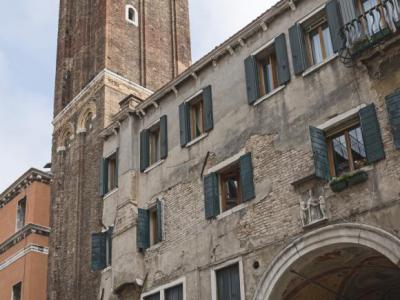
The Church of Saint John the Almsgiver is easy to miss—and that’s part of the story. Wedged tightly between neighboring buildings, it keeps a low profile, with only its 15th-century bell tower rising above the rooftops to announce that a church is even here.
Founded in the 11th century, it nearly vanished in the devastating fire of 1514 that tore through the Rialto area. The blaze spared just the bell tower. When the church was rebuilt between 1527 and 1529, under designs by Antonio Abbondi (generally known as Scarpagnino), the tower gained a new civic role: each evening, its bell rang to signal that all fires in the district were to be put out—an early form of urban fire control in a neighborhood that had learned its lesson the hard way...
Once inside, the mood pivots from everyday utility to painted spectacle. Most of what you see dates from the decades after the reconstruction, when the church became a showcase for Venetian art. Several works by Palma il Giovane line the interior, alongside paintings by Leonardo Corona. The visual anchor, however, is the high altarpiece by Titian, Saint John the Almsgiver, depicting the 7th-century Patriarch of Alexandria as a figure of authority tempered by charity.
Nearby, Italian Mannerist painter Pordenone delivers a very different kind of energy in Saints Catherine, Sebastian, and Roch: a powerfully built Sebastian, almost defiantly exposed; a focused Saint Catherine, eyes lifted skyward; and Saint Roch casually revealing a healed leg—a quiet nod to survival after the plague. Look up to the cupola, and you’ll find Pordenone again, this time filling the space with sturdy, muscular cherubs that feel more physical than ethereal.
Indeed, for a church that hides so well on the outside, it leaves a strong impression once you’re in.
Founded in the 11th century, it nearly vanished in the devastating fire of 1514 that tore through the Rialto area. The blaze spared just the bell tower. When the church was rebuilt between 1527 and 1529, under designs by Antonio Abbondi (generally known as Scarpagnino), the tower gained a new civic role: each evening, its bell rang to signal that all fires in the district were to be put out—an early form of urban fire control in a neighborhood that had learned its lesson the hard way...
Once inside, the mood pivots from everyday utility to painted spectacle. Most of what you see dates from the decades after the reconstruction, when the church became a showcase for Venetian art. Several works by Palma il Giovane line the interior, alongside paintings by Leonardo Corona. The visual anchor, however, is the high altarpiece by Titian, Saint John the Almsgiver, depicting the 7th-century Patriarch of Alexandria as a figure of authority tempered by charity.
Nearby, Italian Mannerist painter Pordenone delivers a very different kind of energy in Saints Catherine, Sebastian, and Roch: a powerfully built Sebastian, almost defiantly exposed; a focused Saint Catherine, eyes lifted skyward; and Saint Roch casually revealing a healed leg—a quiet nod to survival after the plague. Look up to the cupola, and you’ll find Pordenone again, this time filling the space with sturdy, muscular cherubs that feel more physical than ethereal.
Indeed, for a church that hides so well on the outside, it leaves a strong impression once you’re in.
3) Basilica di Santa Maria Gloriosa dei Frari (Basilica of Glorious St. Mary of the Friars) (must see)
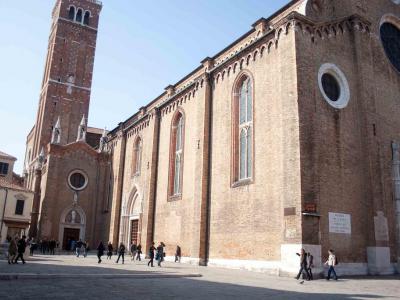
The Friars' Basilica, usually shortened by locals to just the “Frari,” sits a little away from the main tourist flow—and that already tells you something about Venice. The city’s second most important church, after St. Mark’s Basilica, is not on the main stage, but quietly holding its ground in a lived-in neighborhood. It doesn’t shout for attention, and it’s rarely swarmed. That restraint is misleading, because once inside, the Frari delivers one of the strongest artistic punches in the city.
The church was founded by the Franciscans in the late 13th century, and size was clearly not a concern. This is one of the largest churches in Venice, crowned by a brick bell tower that rises higher than all but St. Mark’s. Architecturally, it remains one of the few Venetian churches to keep a Gothic look—simple, sober, and almost blunt on the outside. A kind of vast brick container... What’s inside, however, is anything but restrained.
Indeed, the Frari is one of the best places in Venice to understand why Titian mattered. His Assumption of the Virgin dominates the high altar, and it still feels radical: dramatic movement, bold color, and a vertical energy that pulls your eyes upward. Nearby hangs the Madonna di Ca’ Pesaro, another break from tradition, with the Virgin shifted off center, and the composition tilted in a way that once caused raised eyebrows. Add works by Bellini and Vivarini, and you start to see how Venetian painting evolved within these walls.
And art here is not limited to just paintings, either. Donatello’s wooden Saint John the Baptist stands with unsettling intensity. A finely carved 15th-century choir fills the space with quiet craftsmanship. Then there are the tombs—many of them extravagant, some deliberately unsettling. On one side of the nave lies Titian himself, who died of plague in 1576 and was granted a church burial when others were not. Opposite, the marble pyramid mausoleum of sculptor Antonio Canova contrasts sharply with the theatrical monument to Doge Giovanni Pesaro, held up by massive sculpted figures and filled with symbols of decay and power.
If you want to catch the details, a small guide or leaflet helps. And yes—make sure to cover your shoulders here, because even masterpieces have dress codes...
The church was founded by the Franciscans in the late 13th century, and size was clearly not a concern. This is one of the largest churches in Venice, crowned by a brick bell tower that rises higher than all but St. Mark’s. Architecturally, it remains one of the few Venetian churches to keep a Gothic look—simple, sober, and almost blunt on the outside. A kind of vast brick container... What’s inside, however, is anything but restrained.
Indeed, the Frari is one of the best places in Venice to understand why Titian mattered. His Assumption of the Virgin dominates the high altar, and it still feels radical: dramatic movement, bold color, and a vertical energy that pulls your eyes upward. Nearby hangs the Madonna di Ca’ Pesaro, another break from tradition, with the Virgin shifted off center, and the composition tilted in a way that once caused raised eyebrows. Add works by Bellini and Vivarini, and you start to see how Venetian painting evolved within these walls.
And art here is not limited to just paintings, either. Donatello’s wooden Saint John the Baptist stands with unsettling intensity. A finely carved 15th-century choir fills the space with quiet craftsmanship. Then there are the tombs—many of them extravagant, some deliberately unsettling. On one side of the nave lies Titian himself, who died of plague in 1576 and was granted a church burial when others were not. Opposite, the marble pyramid mausoleum of sculptor Antonio Canova contrasts sharply with the theatrical monument to Doge Giovanni Pesaro, held up by massive sculpted figures and filled with symbols of decay and power.
If you want to catch the details, a small guide or leaflet helps. And yes—make sure to cover your shoulders here, because even masterpieces have dress codes...
4) Gallerie dell'Accademia (Gallery of the Academy)
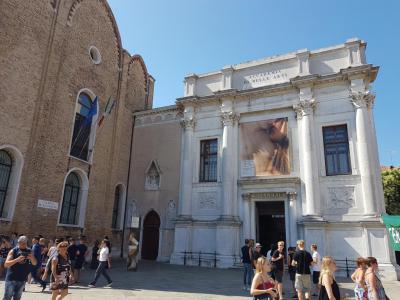
Step inside the Gallery of the Academy, and Venice’s painting tradition starts speaking in full color. This is where the city keeps its visual memory, from the Middle Ages through the Renaissance, all under one roof. Venetian painting was never shy, and the Academy makes that clear right away—rich pigments, dramatic light, and scenes that feel firmly rooted in real life. Here, familiar names like Veronese, Titian, and Tintoretto don’t just appear; they take over entire walls.
The journey begins earlier than you might expect. Fourteenth-century painters Paolo and Lorenzo Veneziano ease you from Byzantine stiffness toward Gothic expression, acting as visual translators between worlds. Then comes Giovanni Bellini, whose calm Madonnas and intimate religious scenes slow the pace and invite closer looking. Vittore Carpaccio shifts the mood again, filling his canvases with storytelling detail—city streets, interiors, fabrics, and architecture that quietly document how Venice actually lived in the late 1400s. And then there’s Giorgione’s The Tempest: a soldier, a nursing mother, and a stormy sky that refuses to explain itself, still puzzling viewers centuries later.
Rooms 6 to 8 mark the arrival of the heavyweights. Tintoretto, Titian, Veronese, and Lotto appear in quick succession, each pushing Venetian painting further—bigger compositions, stronger movement, more confidence. These rooms alone would justify the visit. But the Academy saves its theatrical moment for later.
Room 10 is where everything pauses. One enormous painting—Paolo Veronese’s Christ in the House of Levi—covers an entire wall. It’s not subtle, and it’s not meant to be. The scale, the crowd of figures, and the sheer ambition of the canvas make it impossible to ignore. This is Venice at its most self-assured.
Before you leave, take a final look at Titian’s Presentation of the Virgin. It’s a fitting closing note—measured, luminous, and quietly powerful...
Practical note: the gallery is spacious, well laid out, and surprisingly easy to navigate. Tickets are reasonably priced, and during major local festivals, entry can sometimes be free. Keep your ticket, too—it also grants access to the nearby Grimani Palace, recently renovated and well worth the short walk.
The journey begins earlier than you might expect. Fourteenth-century painters Paolo and Lorenzo Veneziano ease you from Byzantine stiffness toward Gothic expression, acting as visual translators between worlds. Then comes Giovanni Bellini, whose calm Madonnas and intimate religious scenes slow the pace and invite closer looking. Vittore Carpaccio shifts the mood again, filling his canvases with storytelling detail—city streets, interiors, fabrics, and architecture that quietly document how Venice actually lived in the late 1400s. And then there’s Giorgione’s The Tempest: a soldier, a nursing mother, and a stormy sky that refuses to explain itself, still puzzling viewers centuries later.
Rooms 6 to 8 mark the arrival of the heavyweights. Tintoretto, Titian, Veronese, and Lotto appear in quick succession, each pushing Venetian painting further—bigger compositions, stronger movement, more confidence. These rooms alone would justify the visit. But the Academy saves its theatrical moment for later.
Room 10 is where everything pauses. One enormous painting—Paolo Veronese’s Christ in the House of Levi—covers an entire wall. It’s not subtle, and it’s not meant to be. The scale, the crowd of figures, and the sheer ambition of the canvas make it impossible to ignore. This is Venice at its most self-assured.
Before you leave, take a final look at Titian’s Presentation of the Virgin. It’s a fitting closing note—measured, luminous, and quietly powerful...
Practical note: the gallery is spacious, well laid out, and surprisingly easy to navigate. Tickets are reasonably priced, and during major local festivals, entry can sometimes be free. Keep your ticket, too—it also grants access to the nearby Grimani Palace, recently renovated and well worth the short walk.
5) Basilica di Santa Maria della Salute (Basilica of Our Lady of Good Health) (must see)
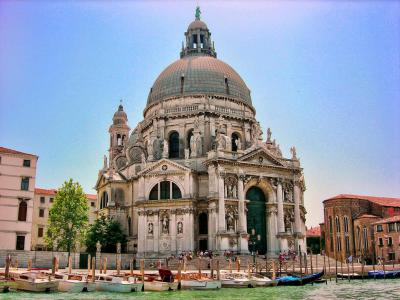
San Marco may dominate postcards by reputation, but when it comes to Venice’s most recognizable outline, the real scene-stealer is the Basilica of Our Lady of Good Health. Known locally as La Salute, this sweeping white church commands the entrance to the Grand Canal with a dome that feels less like a roof and more like a statement. It stands as the clearest expression of Venetian Baroque ambition—bold, theatrical, and impossible to ignore...
Its origins are tied to crisis rather than confidence. In the early 1630s, a devastating plague swept through Venice, killing nearly a third of the city’s population. In response, the Venetian Republic made a vow: if deliverance came, a church would rise in honor of Our Lady of Good Health. The promise held, and construction followed.
Designed by Baldassare Longhena, then just in his early thirties, the project would define his career. Built on more than 100,000 wooden piles driven into the lagoon floor, La Salute took around fifty years to complete. Longhena devoted most of his life to it and lived just long enough to see the final result in 1681.
Once finished, the basilica's dome quickly became part of Venice’s visual identity. Painters took note. Canaletto and Francesco Guardi returned to it again and again, while artists visiting from abroad—Turner, Monet, and John Singer Sargent among them—used it as a focal point for light, reflection, and atmosphere. The silhouette you see today is not just architecture; it is centuries of artistic attention layered onto stone.
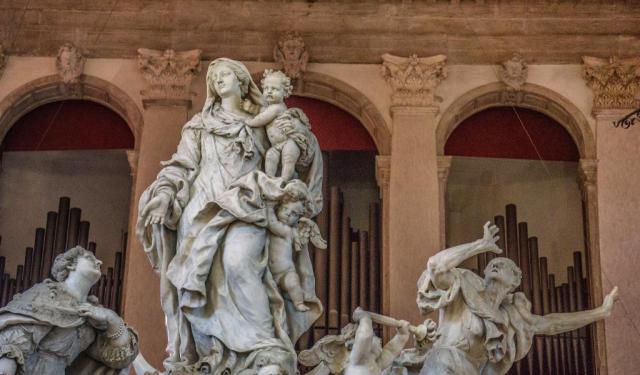
Inside, the basilica continues to surprise. The sacristy doubles as a compact art gallery, featuring works by Titian and Tintoretto. Ceiling paintings such as David and Goliath, Cain and Abel, and Abraham and Isaac unfold overhead, while The Marriage Feast of Cana anchors the space with dramatic intensity. At the high altar, a sculptural group by Josse de Corte delivers pure Baroque theater: the Virgin and Child banish the plague itself, imagined as a defeated old woman retreating from Venice.
Entry to the church is free during opening hours, though the sacristy requires a ticket. From the balcony, views spill back onto the square, and on certain days, a short organ recital follows the service—an unexpected reward for those who linger. Check the schedule in advance, and plan ahead.
Cafés are scarce nearby, so bringing a drink isn’t a bad idea. La Salute rewards patience, timing, and a willingness to look up...
Its origins are tied to crisis rather than confidence. In the early 1630s, a devastating plague swept through Venice, killing nearly a third of the city’s population. In response, the Venetian Republic made a vow: if deliverance came, a church would rise in honor of Our Lady of Good Health. The promise held, and construction followed.
Designed by Baldassare Longhena, then just in his early thirties, the project would define his career. Built on more than 100,000 wooden piles driven into the lagoon floor, La Salute took around fifty years to complete. Longhena devoted most of his life to it and lived just long enough to see the final result in 1681.
Once finished, the basilica's dome quickly became part of Venice’s visual identity. Painters took note. Canaletto and Francesco Guardi returned to it again and again, while artists visiting from abroad—Turner, Monet, and John Singer Sargent among them—used it as a focal point for light, reflection, and atmosphere. The silhouette you see today is not just architecture; it is centuries of artistic attention layered onto stone.
Inside, the basilica continues to surprise. The sacristy doubles as a compact art gallery, featuring works by Titian and Tintoretto. Ceiling paintings such as David and Goliath, Cain and Abel, and Abraham and Isaac unfold overhead, while The Marriage Feast of Cana anchors the space with dramatic intensity. At the high altar, a sculptural group by Josse de Corte delivers pure Baroque theater: the Virgin and Child banish the plague itself, imagined as a defeated old woman retreating from Venice.
Entry to the church is free during opening hours, though the sacristy requires a ticket. From the balcony, views spill back onto the square, and on certain days, a short organ recital follows the service—an unexpected reward for those who linger. Check the schedule in advance, and plan ahead.
Cafés are scarce nearby, so bringing a drink isn’t a bad idea. La Salute rewards patience, timing, and a willingness to look up...
Walking Tours in Venice, Italy
Create Your Own Walk in Venice
Creating your own self-guided walk in Venice is easy and fun. Choose the city attractions that you want to see and a walk route map will be created just for you. You can even set your hotel as the start point of the walk.
Venice Introduction Walking Tour
Venice is a city that learned early how to live with water—and, ultimately, how to profit from it. Built across hundreds of small islands in a shallow lagoon in the northern Adriatic, it runs without roads, relying solely on canals and bridges. Although the lagoon itself formed thousands of years ago, it was inhabited mainly by fishermen up until the 5th century AD, when waves of barbarian... view more
Tour Duration: 3 Hour(s)
Travel Distance: 4.1 Km or 2.5 Miles
Tour Duration: 3 Hour(s)
Travel Distance: 4.1 Km or 2.5 Miles
Grand Canal Walking Tour
The main waterway in Venice, Grand Canal snakes in an "S" shape through the center of the city, dividing its main districts. On both sides of this thoroughfare are the most beautiful buildings dating from the 12th to the 18th centuries that tell the story of a thousand years of Venetian splendor. While one can view the architectural parade from water buses, our self-guided walking tour... view more
Tour Duration: 3 Hour(s)
Travel Distance: 5.2 Km or 3.2 Miles
Tour Duration: 3 Hour(s)
Travel Distance: 5.2 Km or 3.2 Miles
Venice's Hidden Art Treasures
Among the first things springing to mind when talking about Venice, apart from the canals and gondolas, of course, is Art and Architecture. Indeed, Venice is one of the few cities in the world where Art and Architecture have merged in a stunning multiplicity of forms. The city is even renowned for its unique (Venetian) pictorial school famed by the likes of Tintoretto, Titian, Veronese, Castagno... view more
Tour Duration: 2 Hour(s)
Travel Distance: 3.6 Km or 2.2 Miles
Tour Duration: 2 Hour(s)
Travel Distance: 3.6 Km or 2.2 Miles
Casanova's Venice
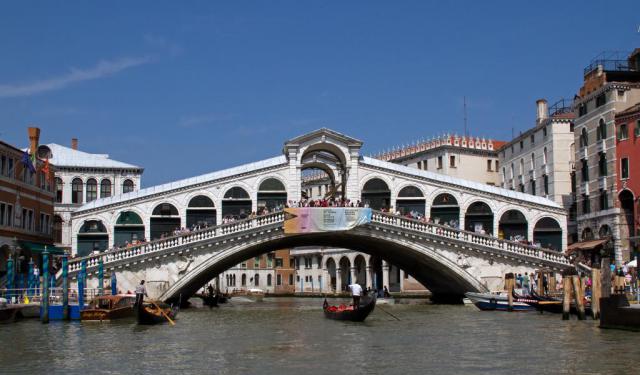
Giacomo Casanova is usually introduced as history’s most famous seducer—but that shorthand misses the point. Casanova didn’t simply charm his way through life, but was shaped by a very particular moment in Venetian history. He came of age in the eighteenth century, when the Republic of Venice was living on its reputation. The great maritime empire was fading, its political and commercial... view more
Tour Duration: 2 Hour(s)
Travel Distance: 4.5 Km or 2.8 Miles
Tour Duration: 2 Hour(s)
Travel Distance: 4.5 Km or 2.8 Miles
Piazza San Marco Walking Tour
Piazza San Marco is where Venice has always put on its best face. This is the city’s ceremonial and political core, shaped over centuries as the grand stage of the Venetian Republic. Its story began in the 9th century, when the relics of Saint Mark arrived in the lagoon and instantly raised the evangelist—much as the square built in his name—to the highest rank. From a simple open space, the... view more
Tour Duration: 1 Hour(s)
Travel Distance: 0.6 Km or 0.4 Miles
Tour Duration: 1 Hour(s)
Travel Distance: 0.6 Km or 0.4 Miles
Jewish Ghetto Tour
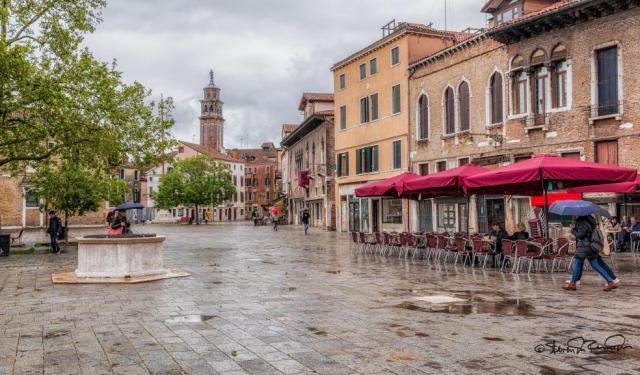
Founded in 1516, the Jewish Ghetto of Venice earns its grim little footnote in European history as the first place officially designated as a “ghetto.” It began as a Venetian compromise with sharp edges: the Papacy urged to expel the Jews, while Venice—never one to waste a useful population—chose to confine them to a small island.
The word “ghetto” comes with competing origin... view more
Tour Duration: 1 Hour(s)
Travel Distance: 0.4 Km or 0.2 Miles
The word “ghetto” comes with competing origin... view more
Tour Duration: 1 Hour(s)
Travel Distance: 0.4 Km or 0.2 Miles
Useful Travel Guides for Planning Your Trip
15 Distinctively Italian Things to Buy in Venice
Venice has been a tourist mecca for over a century now, with millions of visitors flocking in every year to see this unique place on the face of the Earth. Many, if not all, of these people seek to obtain something memorable as a token of their stay in this city. By far, not all of them know which...
The Most Popular Cities
/ view all