


Audio Guide: Madrid Introduction Walking Tour (Self Guided), Madrid
Welcome… to Madrid! A city where regal boulevards unfold like film reels, where iron balconies whisper old gossip, and where history has a flair for the dramatic. The Spanish capital is less a city, more a vast museum with a pulse, cradling centuries of European art, powdered baroque façades, and monuments that speak in old tongues if you listen close enough.
Madrid’s story begins long before streetlamps and tapas. Prehistoric humans once roamed this soil. But the first traceable echo of a real settlement comes from the Muslim era, sometime in the 9th century. A fortification-Mayrit-watching the Manzanares River. By 1085, the Christians had claimed it, folding it into the kingdom of Castile like a page in a manuscript.
Fast forward to the 17th century, Madrid explodes-not with bombs, but with brilliance. Cervantes scribbles. Velázquez paints. Quevedo sharpens his wit. Lope de Vega stages brilliant drama before supper. A city blazing with minds too bright to hold still.
The 1930s brought another period of great vitality-but then came the Civil War. Madrid, fiercely Republican and anti-fascist: bombed, broken, bleeding-yet refusing to fall. November 1936 saw street-to-street resistance, a city as battleground and beacon.
From ashes to acceleration: between 1959 and 1973, the economic boom transforms the city. Glass and steel claw toward the sky. A new middle class struts into being, slick with optimism. Franco dies, the constitution breathes, and in 1978, Madrid is officially, finally, constitutionally crowned the capital of a democratic Spain.
Yet-despite the metro lines, the fiber-optics, the touchscreen timetables-it remains ancient just below. Glass towers wink at medieval alleys. Trendy cafés share walls with haunted taverns. The city doesn’t just preserve its history. It wears it like perfume.
So… ready to walk the walk? This self-guided tour doesn’t just take you to the top landmarks. It invites you to slip between centuries, to eavesdrop on time itself, and to find out why Madrid isn’t just a place worth visiting-it’s a place worth feeling.
Let’s begin.
Madrid’s story begins long before streetlamps and tapas. Prehistoric humans once roamed this soil. But the first traceable echo of a real settlement comes from the Muslim era, sometime in the 9th century. A fortification-Mayrit-watching the Manzanares River. By 1085, the Christians had claimed it, folding it into the kingdom of Castile like a page in a manuscript.
Fast forward to the 17th century, Madrid explodes-not with bombs, but with brilliance. Cervantes scribbles. Velázquez paints. Quevedo sharpens his wit. Lope de Vega stages brilliant drama before supper. A city blazing with minds too bright to hold still.
The 1930s brought another period of great vitality-but then came the Civil War. Madrid, fiercely Republican and anti-fascist: bombed, broken, bleeding-yet refusing to fall. November 1936 saw street-to-street resistance, a city as battleground and beacon.
From ashes to acceleration: between 1959 and 1973, the economic boom transforms the city. Glass and steel claw toward the sky. A new middle class struts into being, slick with optimism. Franco dies, the constitution breathes, and in 1978, Madrid is officially, finally, constitutionally crowned the capital of a democratic Spain.
Yet-despite the metro lines, the fiber-optics, the touchscreen timetables-it remains ancient just below. Glass towers wink at medieval alleys. Trendy cafés share walls with haunted taverns. The city doesn’t just preserve its history. It wears it like perfume.
So… ready to walk the walk? This self-guided tour doesn’t just take you to the top landmarks. It invites you to slip between centuries, to eavesdrop on time itself, and to find out why Madrid isn’t just a place worth visiting-it’s a place worth feeling.
Let’s begin.
How it works: Download the app "GPSmyCity: Walks in 1K+ Cities" from Apple App Store or Google Play Store to your mobile phone or tablet. The app turns your mobile device into a personal tour guide. For US$14.99 per year, you get access to walking tours in 630+ cities worldwide. In comparison, a guided tour often costs dozens of dollars per person for a single tour. The app works offline, so no data plan is needed when traveling abroad.
Download The GPSmyCity App



Madrid Introduction Walking Tour Map
Guide Name: Madrid Introduction Walking Tour
Guide Location: Spain » Madrid (See other walking tours in Madrid)
Guide Type: Self-guided Walking Tour (Sightseeing)
Tour Duration: 2 Hour(s)
Travel Distance: 3.8 Km or 2.4 Miles
Guide Location: Spain » Madrid (See other walking tours in Madrid)
Guide Type: Self-guided Walking Tour (Sightseeing)
Tour Duration: 2 Hour(s)
Travel Distance: 3.8 Km or 2.4 Miles
Sights Featured in This Walk
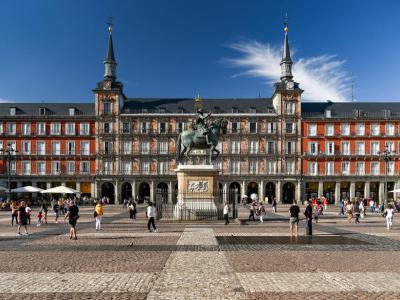
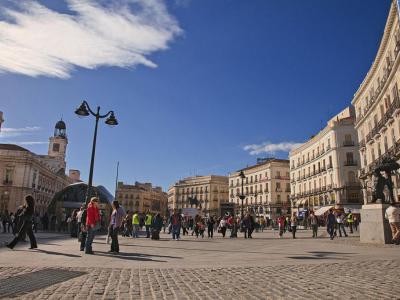
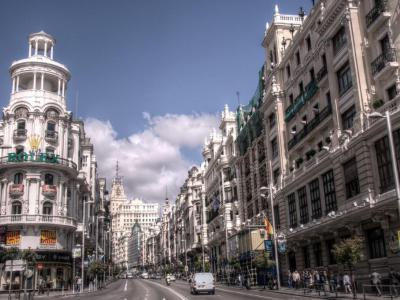
Walking Tours in Madrid, Spain

Create Your Own Walk in Madrid
Creating your own self-guided walk in Madrid is easy and fun. Choose the city attractions that you want to see and a walk route map will be created just for you. You can even set your hotel as the start point of the walk.

Madrid Food Tour
Spain is internationally reputed as a major gastronomic power and its capital city Madrid attests to this claim, being home to vibrant food markets and multiple establishments serving traditional Spanish food in a soul-warming atmosphere.
One of the iconic food destinations is Plaza Mayor, a bustling town square where you can savor traditional Spanish dishes. The square is home to numerous... view more
Tour Duration: 1 Hour(s)
Travel Distance: 1.8 Km or 1.1 Miles
One of the iconic food destinations is Plaza Mayor, a bustling town square where you can savor traditional Spanish dishes. The square is home to numerous... view more
Tour Duration: 1 Hour(s)
Travel Distance: 1.8 Km or 1.1 Miles

Miguel de Cervantes' Madrid Walking Tour
The name of the iconic Spanish writer Miguel de Cervantes is closely associated with Madrid. The author is known for a number of works, but his 1605 novel Don Quixote de la Mancha is often held as the first modern novel.
Despite being regarded as one of the fathers of modern literature, very little is known about Cervantes' early life. Born in 1547, he had spent some of his young years in... view more
Tour Duration: 1 Hour(s)
Travel Distance: 1.2 Km or 0.7 Miles
Despite being regarded as one of the fathers of modern literature, very little is known about Cervantes' early life. Born in 1547, he had spent some of his young years in... view more
Tour Duration: 1 Hour(s)
Travel Distance: 1.2 Km or 0.7 Miles

Souvenirs Shopping Tour
Shopping for souvenirs in Madrid is an exciting and delightful experience for anyone visiting the vibrant Spanish capital. Indeed, it would be a pity to leave Madrid without having explored its specialty shops and bringing home something truly original. With this in mind, we've compiled a list of must-visit locations where you can find souvenirs, which are unique to Madrid and make for... view more
Tour Duration: 1 Hour(s)
Travel Distance: 1.0 Km or 0.6 Miles
Tour Duration: 1 Hour(s)
Travel Distance: 1.0 Km or 0.6 Miles

Buen Retiro Park Walking Tour
Buen Retiro-meaning “Pleasant Retreat”-is one of Madrid’s most beloved landmarks. Much like Central Park in New York or Hyde Park in London, this former royal escape has become the city’s most iconic green space, a peaceful oasis right in the heart of the Spanish capital.
Among its standout attractions is the Crystal Palace, a stunning 19th-century glass and iron structure that now... view more
Tour Duration: 2 Hour(s)
Travel Distance: 3.9 Km or 2.4 Miles
Among its standout attractions is the Crystal Palace, a stunning 19th-century glass and iron structure that now... view more
Tour Duration: 2 Hour(s)
Travel Distance: 3.9 Km or 2.4 Miles

Ernest Hemingway's Madrid Walking Tour
Among the many writers who’ve spoken fondly of Madrid, few did so as passionately-or as famously-as Ernest Hemingway. A giant of 20th-century literature, Hemingway penned classics like “The Sun Also Rises”, “Death in the Afternoon”, “The Fifth Column”, “For Whom the Bell Tolls”, and “The Old Man and the Sea”. But beyond his books, he had a deep, lasting connection with the... view more
Tour Duration: 1 Hour(s)
Travel Distance: 2.5 Km or 1.6 Miles
Tour Duration: 1 Hour(s)
Travel Distance: 2.5 Km or 1.6 Miles

Golden Mile Walking Tour
Similarly to 5th Avenue in New York City, Champs Elysee in Paris, or Bond Street in London, the Golden Mile is one of the wealthiest and most expensive neighborhoods of the Spanish capital. Forming part of Madrid's Salamanca district, this posh area is known for its upscale shopping, cultural attractions, and gastronomic delights.
One of the prominent local landmarks is Columbus Square... view more
Tour Duration: 1 Hour(s)
Travel Distance: 2.5 Km or 1.6 Miles
One of the prominent local landmarks is Columbus Square... view more
Tour Duration: 1 Hour(s)
Travel Distance: 2.5 Km or 1.6 Miles
Useful Travel Guides for Planning Your Trip

Top 12 Bars in Madrid
Madrid, the third largest city in Western Europe, is packed with an eclectic mix of bars that offer a scene for every style. In Spain’s Capital city, alcohol flows without end. Just take a walk down the streets of this vibrant city, and it seems as if every other building is a café or bar...

Madrid Souvenir Shopping Guide: Top 15 Spanish Products
They call Spain "magnificent" for a reason, as there're loads of fascinating stuff a visitor to the country might want to take home and share with family and friends. Luckily, in Madrid one can find nearly all that Spain is famous for - wine, food, fashion, arts, sports, etc. Good...

A Self-Guided Food Walk in Madrid
The reputation of Spain as a major gastronomic power to reckon with goes a long way. The capital city of Madrid has a lot to offer visitors in terms of soul warming food experience. On this walk you will visit some of the city's most vibrant and lively food markets and other places serving...

10 Uniquely Madrid Foods to Try in Spanish Capital
There’s no better way to fall in love with a city than through its traditional cuisine. Complete meals, appetizers, beverages and sweets: all of them draw a path to a tourist heart. Madrid, the Spanish capital, has its very own unique and original dishes that can make a stay in this city a...

Madrid´s Latin Quarter Tapas
This app is a description of bars and cafeterias of tapas and pinchos in the Latin Quarter of Madrid. Tapas and pinchos are generally bar snacks and finger foods, with pinchos generally originating from the Basque Country. The custom of tapas and pinchos-eating refers to eating at the bar, sometime...
The Most Popular Cities
/ view all