

Western Ho Chi Minh City is largely influenced by Chinatown. There are many Chinese temples, or pagodas, and the main market in this area of Ho Chi Minh sells many Chinese items, including food. This self-guided tour will lead you through the districts of Western Ho Chi Minh City, showing you its most popular attractions:
1) Thien Hau Temple
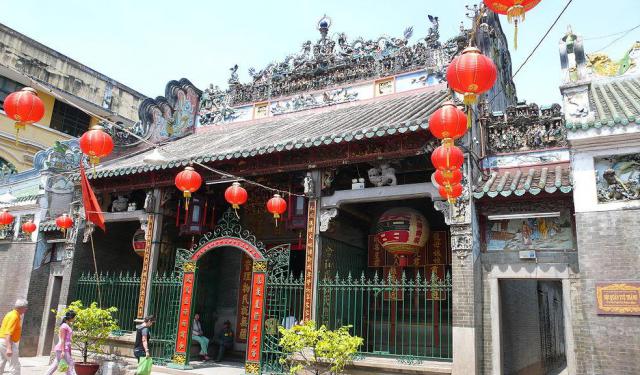
Located in the Cho Lon or Chinatown area of Ho Chi Minh City, this temple is dedicated to Thien Hau, the Goddess of the Sea. Members of the Chinese community and the Vietnamese come here to pray for happiness and prosperity.
Thien Hau or Mazu, the Goddess of the Sea is worshipped by the seafaring communities of Southern China and by Chinese communities around the world who depend on the sea for their livelihood. She is not a Taoist or a Buddhist Deity but has been assimilated by both religions. The Thien Hau temple was first built in the year 940. It has been destroyed and rebuilt many times and the present building dates back to 1900. It is believed that she left two giant turtles to look after the people and ascended to the heavens.
The interior of the Thien Hau Temple is a large covered courtyard and the statue of chief deity and two other Goddesses are located at one end. Urns to place incense sticks are placed in the open spaces around the courtyard. The ceiling is covered with intricate porcelain reliefs depicting a 19th century Chinese city and tales from Chinese history and legends. A festival is held in honor of the birthday of Thien Hau on the 23rd day of the 3rd Lunar Month. Two effigies of demons are burned and the lion dance is performed as part of the festivities.
Image Courtesy of Wikimedia and DoktorMax
2) Quan Am Temple
The Quan Am Temple is located in the predominantly Chinese, Cho Lon area of Ho Chi Minh City. It is dedicated to Quan Am the Chinese Goddess of mercy.
Chinese traders and Vietnamese merchants raised funds and constructed the Quan Am Temple in 1816. It was expanded by funds raised by a congregation from the Chinese Fujian province. From the date of construction, it has remained one of the most frequented temples by Chinese and Vietnamese worshippers and contains both Taoist and Buddhist objects of worship.
Visitors and worshippers enter the pagoda through a red traditional gate. There is a small courtyard between the gate and the temple complex. There are relief panels at both ends depicting Buddhist motifs. The central altar is dedicated to Ngoc Huang or the Jade Emperor. Other altars are of the Amitabha Buddha and three Bodhisattvas. Inside the Pagoda, the main altar is that of the Goddess of the sea, Thien Hau. Beyond the altar the main deity is located in a partially covered courtyard. The Chinese Quan Am statue is flanked by two smaller figures. There are many other altars dedicated to figures from Buddhist and Taoist legends and wooden figures of Arhats or Buddhist holy men. On the other side of the street is a garden that forms part of the temple complex with an artificial pond surrounded by relief panels depicting Taoist motifs.
Image Courtesy of Wikimedia and DoktorMax
3) Cha Tam Church
The Cha Tam Church is a Roman Catholic parish Church in Ho Chi Minh City. It has a distinctive colonial façade and is painted in pastel yellow and white.
The Cha Tam Church was founded due to the efforts of a Chinese Catholic Priest, Francis Xavier Tam Assou in 1900. On December the 3rd 1900 which coincided with the feast of St. Francis Xavier, Bishop Bossard laid the foundation stone of the church. It was consecrated in 1902 and Francis Xavier Tam Assou was its first priest. It was here that the Roman Catholic president of South Vietnam Ngo Dinh Diem and his brother Ngo Dinh Nu hid during an attempted coup. When their attempts to contact loyal military officers failed, they were discovered and shot dead after being taken into custody by the leaders of the coup.
The Cha Tam Church has been an active church from its foundation till date. The tower holds the statue of Francis Xavier Tam Assou. He was a Chinese born vicar apostolate or representative of the Pope. He was sent to look after the affairs of the Chinese Catholics in the Cho Lon neighborhood of Saigon. A daily mass is held and the congregation consists of 3000 Vietnamese and 2000 ethnic Chinese parishioners. It is the only Catholic Church in Saigon with horizontal lacquered boards similar to a Chinese temple in the interiors.
Image Courtesy of Wikimedia and Thuydaonguyen
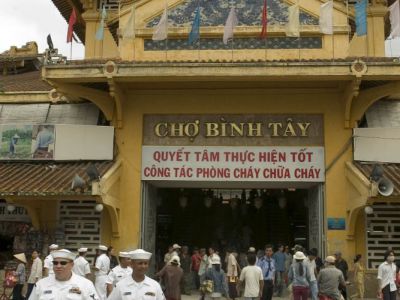
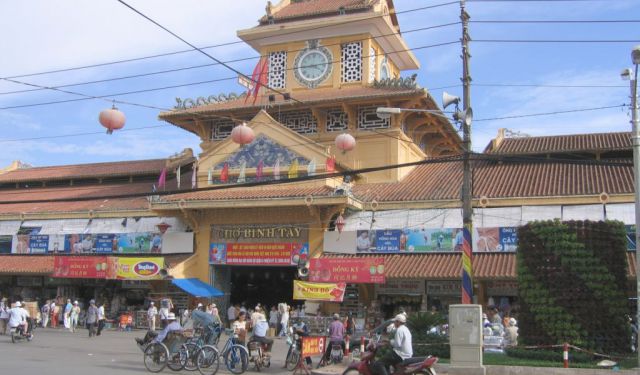
4) Binh Tay Market
The Binh Tay Market located in the Cho Lon area of Ho Ch Minh City draws tourists looking for bargains. It is also famous because of its unique Chinese architecture. It is a large wholesale market with a green central courtyard.
The Binh Tay market was funded by a wealthy Chinese trader, Quach Dam who came from Chiu Chow in China and made his fortune in Saigon. His trade name was Thong Heip and was nicknamed handicapped Thong by the local Chinese. He came to the city as a poor man who started recycling garbage. He soon diversified and became one of the most successful businessmen in the city.
At the center of Binh Tay Market is a courtyard. A statue of its founder once stood at the center surrounded by four bronze lions. The original statue was removed and a glass altar was placed at the location between 1976 and 1980. One can find the original statue in the Museum of Fine Arts. Shops selling international branded cosmetics are located on the second floor of the market. An array of bowls pots and pans for homes and restaurants are also on sale. It is known to the locals as a wholesale market where retailers come to buy products in bulk. Tourists can find interesting souvenirs here at bargain prices.
Image Courtesy of Wikimedia and John L. Beeman
5) Phung Son Pagoda
The Phung Son Pagoda also called the Go Pagoda is located in District 11, Ho Chi Minh City. It has been declared a national Historical and Cultural Vestige by the Government.
The Phung Son Pagoda was built by a Bonze or monk named Lieu Thong between 1802 and 1820. Archeological excavations have revealed that there were structures from the Funan civilization at the site before the construction of the temple. According to legend, it was at one time decided to move the location of the temple. All artifacts were loaded on an elephant for transportation to the new site. On the way the elephant tripped and many relics fell into a nearby pond. Local people saw this as a sign that the temple should stay in its original location. It has been renovated twice, once between 1904 and 1915 by the Bonze, Tue Minh and later in 1960.
The Phung Son Pagoda has many notable artifacts. There are over 40 gilded wooden statues. Other valuable objects are the Di Da Tam Ton statue, the gilded stone statue of the Buddha called the Ngu Hien Thuong Ky Thu and a statue of Tieu Dien made of ceramic. Archeological excavations around the temple have unearthed objects made of baked earth and ceramics belonging to the Funan Oc Eo civilization.
Image Courtesy of Wikimedia and Bùi Thụy Đào Nguyên
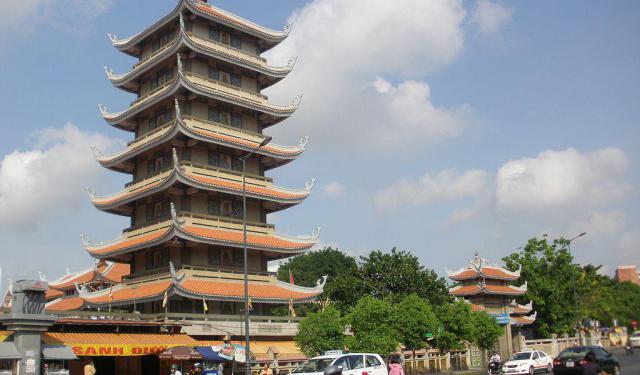
6) Giac Vien Pagoda and Tower Tomb
The Giac Vien Pagoda is located within a recreation Park called the Dam Sen Park. The nearby Tower tomb is famous for its unique architecture. It is the finest example of pagodas designed during the Nguyen Dynasty.
The Giac Vien Pagoda was built by a Buddhist monk in 1789 as a small pavilion for his daily prayers. In 1850, during the reign of King Du Tuc, it was rebuilt and called the Giac Vien Pagoda. The builders of the modern tourist park, the Dam Sen or Lotus Pond Park, recognized the historical and cultural value of the pagoda and left it intact, having designed the landscape around it.
The Giac Vien Pagoda has a main shrine where the Buddha is worshipped. To the east and west are corridors and a vestry. The corridors are flanked by small altars and pillars where parallel sentences are engraved. There are 153 gilded statues made of jack wood within the temple, as well as 40 gilded jack wood plates engraved on both sides. The largest among them is carved with 18 smiling faces of Arhats or Buddhist saints. The other plates are engraved with figures of native fruit that grow in Vietnam. It has been declared a Cultural Relic and a Museum of Wood Engravings of Historical and Artistic value by the Government.
Image Courtesy of Flickr and Ayelie
7) Dam Sen Water Park
The Dam Sen Water Park is a popular recreational area within Ho Chi Minh City. It offers a range of enjoyable activities for visitors of all ages.
The Dam Sen Water Park was opened in 1999. It covers an area of more than 50 hectares, located between Lac Long Quan and Hoa Binh Street. Since its inauguration the park has been a popular venue where local families come with their children, especially on weekends.
The Dam Sen Water Park offers many activities for adults and children. There are water fountains and water slides for children, the most popular of which is the Space Bowl. The well known Vietnamese water puppet theater shows also take place here. Besides water games, there is an indoor fun house and many electronic games for the enjoyment of young visitors. A landscaped garden with walking paths helps adults take a break from the bustle of the city. There is a separate rose garden and a flower garden. The complex also has a Co-op Mart, a bowling center and a sports center with a gymnasium. The Dam Sen Water Park stays open all week: Mondays to Saturdays from 8.30 am to 6.00 pm, and from 8.00 am to 7.00 pm on Sundays.
Image Courtesy of Wikimedia and Lưu Ly