

Home City Search Hong Kong Wan Chai and Causeway Bay Walking Tour
Wan Chai and Causeway Bay Walking Tour, Hong Kong
Download iPhone Walking Tours Application for Hong Kong
iPhone Walking Tours Application for Hong Kong
Bookmark and Share
Wan Chai and Causeway Bay Walking Tour
Guide Location: Hong Kong » Hong Kong
Guide Type: Self-guided city tour
# of Attractions: 9
Tour Duration: 2 hour(s)
Transportation Mode: by foot
Travel Distance: 4.9 km
Image Courtesy of Wikimedia and Baycrest
Author: emma
Wan Chai District is well known for its shopping places and skyscrapers that lie adjacent to its rustic streets and picturesque corners. It is adjacent to the Causeway Bay region that has many shopping complexes and is a popular destination among tourists. Pay attention to the next list, where the most accessible attractions are compiled in an interesting walking tour.
Tour Stops and Attractions
Noon Day Gun
1) Noon Day Gun
The Noon Day Gun is a former naval artillery gun, mounted on an enclosed site located near the Causeway Bay Typhoon Shelter in Hong Kong. The gun is owned by Jardine Matheson and fired at noon every day. The Noonday gun is a popular tourist attraction.
Originally known as East Point, the Noon Day Gun is now located on a part of Causeway Bay. In 1841, East point was sold by the British colonial government in Hong Kong by public auction. This was the first plot of land to ever be sold in this way by the colonial government and it was purchased by Jardine Matheson. The name, East Point has now been disused, due to a drastic change in the geographical profile of the area caused by land reclamation.
During the 1860s, the private militia of Jardine Matheson used to fire a gun salute in order to welcome Jardine’s arrival by sea. This annoyed a senior British naval officer who declared that such a salute is reserved for government officials and the senior officers of the armed forces only. He ordered Jardine Matheson to fire the gun everyday at noon for perpetuity. This launched the tradition of the Noon Day Gun, firing at noon every day, even today.
Image Courtesy of Wikimedia and Baycrest
Sogo Department Store
2) Sogo Department Store
Sogo is a Japanese of departmental store chain, having also branches in Hong Kong, of which the one in Causeway Bay is the most famous. It is actually a 13 storey mall, covering a wide variety of stores and dining places. It is a very popular hang-out place for residents and tourists.
Image Courtesy of Wikimedia and Terence Ong
Times Square
3) Times Square
Times Square in Causeway bay is a famous shopping complex, accessible through MTR and public transport. It features a mall, some nice restaurants and a cinema. The open square in front is a popular place where people gather to celebrate New Year's Eve.
Image Courtesy of Wikimedia and Terence
Po Leung Kuk Museum
4) Po Leung Kuk Museum
The Po Leung Kuk Museum, also known as the Po Leung Kuk Archives, is located at 66 Leighton Road, in Hong Kong. The museum is located in the Main Building of the Po Leung Kuk's Head quarters. The Museum consists of the three sectioned Exhibition Hall, The Old Hall, the Archives Office, the Research Room and two Archival Conservation Rooms. Out of all the rooms only the Exhibition Hall and the Old Hall and are open to public. The museum displays and houses the famous historic documents of Po Leung Kuk.

During the late 19th Century, Hong Kong was plagued by the increasing abduction and trafficking of women and children. These crimes were increasing in frequency and becoming a serious problem for the people of Hong Kong. On the 8th of November in the year 1878, a group of local Chinese people presented a petition to Sir John Pope Hennessy, the Governor of Hong Kong to set up the Po Leung Kuk in order to rescue the kidnapped victims.

“Po Leung”, translates to “protection of the young and the innocent” from the Chinese language. The organization has protected destitute women and children, prevented and resolved kidnappings, and also assisted the Secretary for Chinese Affairs (under British rule) in many matters.
Image Courtesy of Wikimedia and Chong Fat
Khalsa Diwan Sikh Temple
5) Khalsa Diwan Sikh Temple
The Khalsa Diwan Sikh Temple was the first Gurudwara (place of Sikh worship) in Hong Kong. It was also called Sri Guru Singh Sabha and was built in the year 1901. The temple was built by the Indian Sikh members of the British Army, stationed in Hong Kong.

During the 1930s the Sikh population of Hong Kong continued to grow, and the Gurudwara was too small to accommodate them all. The temple was thus rebuilt in order to accommodate a larger Sangat (Sikh community). During the Second World War, the temple was bombed twice and sustained extensive damage. Many people, Sikh and non-Sikh alike, had sought refuge in the temple. These people had sustained minor injuries, but were left with their lives. The damaged parts of the temple were rebuilt by the Sikh and non-Sikh people of the area after the war was over.

During the 1980s the Gurudwara was once gain renovated and extended and its main hall is now linked with Queens' Road East by a covered bridge. This bridge provides an easier access to the temple for Sikh worshippers. In the year 1999, the Gurudwara needed further expansion, and the expansion process has been going on ever since.
Image Courtesy of Wikimedia and Chong Fat
Old Wan Chai Post Office
6) Old Wan Chai Post Office
The Old Post Office, famous as the oldest surviving post office building in Hong Kong, is situated at the junction between Wan Chai Gap Road and Queen's Road East. It was declared a national monument, since it is very old and nobody knows for what purpose the building was originally built.
Image Courtesy of Wikimedia and WiNG
Hopewell Centre
7) Hopewell Centre
The Hopewell Centre is a sky scraper located in Wan Chai, at 183 Queen's Road East, on Hong Kong Island. The sky scraper is the first of its kind in Hong Kong and named after the Hopewell Holdings company Limited, which had constructed the building. The Hopewell Centre is a circular skyscraper and the Hopewell Holdings company Limited is head quartered in the building. The top floor is occupied by the offices of the CEO of Hopewell Holdings, Gordon Wu.
The building has 64-storeys and is 216 meters tall. The construction of the Hopewell Centre started in 1977 and it was completed in the year1980. This was the tallest building of Hong Kong at the time it was completed.
The building has a circular floor plan and the roof of the building also consists of a circular private swimming pool. The 62nd floor has a revolving restaurant named “Revolving 66”. The restaurant completes a 360 degree rotation every hour. There are several groups of elevators present in the building that transport passengers to its many floors. The hotel lobbies are present on the 3rd and also on the 17th floors. The 56th floor has a mini-sky lobby for diners as well.
Image Courtesy of Wikimedia and Deadkid dk
Central Plaza
8) Central Plaza
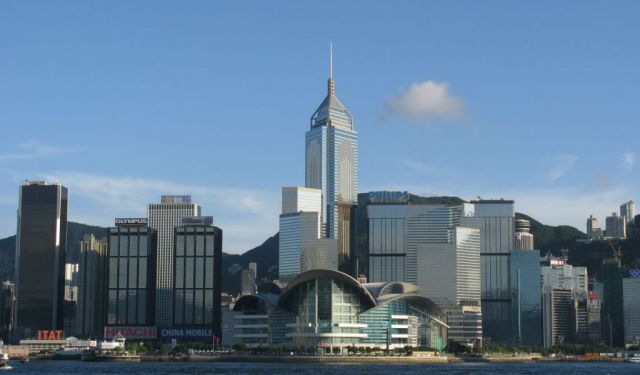
The Central Plaza is the 3rd tallest skyscraper on Hong Kong Island. It is 374 meters tall and located at 18 Harbor Road, in Wan Chai, Hong Kong. From 1992 to 1996 the Central Plaza was the tallest building in Hong Kong. The building has 78-storeys, and it was built in August 1995.
The Central Plaza building uses a triangular floor plan. A neon clock is present on top of the building, which indicates the time by displaying different colors at fifteen minute intervals. The Sky City Church, which is the world's highest church inside a skyscraper, is also present in the Central Plaza.
Two components make up the Central Plaza; these are a free standing office tower and a podium block which is attached to it. The tall tower contains 57 office floors, 5 mechanical plant floors and a sky lobby. The top of the tower also consists of 6 mechanical plant floors and a tower mast that is 102 meters tall.
On the ground level, a public area is present with beautiful, landscaped gardens, a fountain and artificial stone paving. The shape of the building is almost triangular, with three corners that have been cut off in order to provide better internal office space.
Image Courtesy of Wikimedia and Baycrest
Hong Kong Convention and Exhibition Center
9) Hong Kong Convention and Exhibition Center
The Hong Kong Convention and Exhibition Centre is a major convention and exhibition venue in Hong Kong. The center is located in Wan Chai North on Hong Kong Island. The center has been built along the Victoria Harbor, and it is linked to nearby commercial buildings and hotels by covered walkways. The center was designed by Larry Oltmanns, who used to be a former Design Partner with Skidmore, Owings & Merrill LLP a renowned design firm.
The building was originally built on reclaimed land off the Gloucester Road in the year 1988. The glass curtain present inside the structure was the world’s largest at the time that it was built. The curtain overlooks the Victoria Harbor on 3 sides. During the 1990s the second phase of the centre was constructed, on an artificial island. It features a bird-like (or turtle like) roof-top. A sky bridge was originally connecting phase two with phase one but today an expanded exhibition hall connects the two phases.
The complex was built by the combined efforts and finances of New World Development, Grand Hyatt Hong Kong, Harbor View Hotel and Harbor View Apartments. The later are all present on top of the complex.
Image Courtesy of Wikimedia and Baycrest
Attractions Map
Visitor's Comments (0)
Visitor's Gallery (0)