Custom Walk in Mykonos, Greece by mommaffei_befbf created on 2025-02-09
Guide Location: Greece » Mykonos
Guide Type: Custom Walk
# of Sights: 6
Tour Duration: 1 Hour(s)
Travel Distance: 1.1 Km or 0.7 Miles
Share Key: 467BK
Guide Type: Custom Walk
# of Sights: 6
Tour Duration: 1 Hour(s)
Travel Distance: 1.1 Km or 0.7 Miles
Share Key: 467BK
How It Works
Please retrieve this walk in the GPSmyCity app. Once done, the app will guide you from one tour stop to the next as if you had a personal tour guide. If you created the walk on this website or come to the page via a link, please follow the instructions below to retrieve the walk in the app.
Retrieve This Walk in App
Step 1. Download the app "GPSmyCity: Walks in 1K+ Cities" on Apple App Store or Google Play Store.



Step 2. In the GPSmyCity app, download(or launch) the guide "Mykonos Map and Walking Tours".
Step 3. Tap the menu button located at upper right corner of the "Walks" screen and select "Retrieve custom walk". Enter the share key: 467BK
1) Old Port (must see)
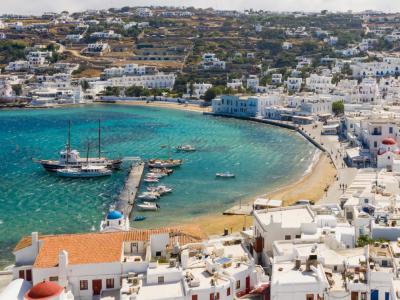
Long before Mykonos became a magnet for yachts and selfie sticks, its Old Port-also known as the Venetian Port-was the island’s lifeline to the rest of the world. Back in the 18th and 19th centuries, this crescent-shaped harbor was one of the busiest stops in the Mediterranean, hosting merchant ships sailing between Europe, Asia, and the Middle East. If crates could talk, they'd have stories in at least five languages.
The port itself dates to the 16th century, built under Venetian rule with some strategic thinking. Set into the island’s western side, it stayed protected from Mykonos’s famously unruly winds-a practical feature when your cargo includes silk, spices, and maybe a barrel or two of wine. The semi-circular layout made docking and unloading a breeze, and the place quickly earned its reputation as a merchant’s paradise.
These days, the Old Port has swapped goods for good vibes. The heavy maritime traffic has moved to the New Port, leaving this historic harbor in a much calmer state-more sailboats and strolling than shipping and shouting. It’s an ideal place to wander, with the Aegean on one side and whitewashed buildings on the other. The waterfront is lined with small shops, cozy restaurants, and boutique hotels-each with just enough charm to make you think about canceling tomorrow’s plans.
The area isn’t just for admiring the view. Scattered around the neighborhood are a few gems, like the Church of Saint Nicholas, the Church of Saint Basil, and the beautifully named Holy Temple of the Unwithering Rose. For a deep dive into Mykonos’s past, the Archaeological Museum of Mykonos offers a fascinating collection of ancient Cycladic artifacts, some dating all the way back to the 25th century BCE.
Step just beyond the pier, and you’ll find narrow alleys winding quietly through the old quarter. It’s here that the island slows down-less buzz, more breeze. Locals go about their day, cats sunbathe with purpose, and visitors get a glimpse of Mykonos before the beach clubs and champagne buckets.
The Old Port isn’t flashy. That’s exactly the point. It’s a slice of Mykonos that still breathes in time with the tides.
The port itself dates to the 16th century, built under Venetian rule with some strategic thinking. Set into the island’s western side, it stayed protected from Mykonos’s famously unruly winds-a practical feature when your cargo includes silk, spices, and maybe a barrel or two of wine. The semi-circular layout made docking and unloading a breeze, and the place quickly earned its reputation as a merchant’s paradise.
These days, the Old Port has swapped goods for good vibes. The heavy maritime traffic has moved to the New Port, leaving this historic harbor in a much calmer state-more sailboats and strolling than shipping and shouting. It’s an ideal place to wander, with the Aegean on one side and whitewashed buildings on the other. The waterfront is lined with small shops, cozy restaurants, and boutique hotels-each with just enough charm to make you think about canceling tomorrow’s plans.
The area isn’t just for admiring the view. Scattered around the neighborhood are a few gems, like the Church of Saint Nicholas, the Church of Saint Basil, and the beautifully named Holy Temple of the Unwithering Rose. For a deep dive into Mykonos’s past, the Archaeological Museum of Mykonos offers a fascinating collection of ancient Cycladic artifacts, some dating all the way back to the 25th century BCE.
Step just beyond the pier, and you’ll find narrow alleys winding quietly through the old quarter. It’s here that the island slows down-less buzz, more breeze. Locals go about their day, cats sunbathe with purpose, and visitors get a glimpse of Mykonos before the beach clubs and champagne buckets.
The Old Port isn’t flashy. That’s exactly the point. It’s a slice of Mykonos that still breathes in time with the tides.
2) Saint Nicholas Church
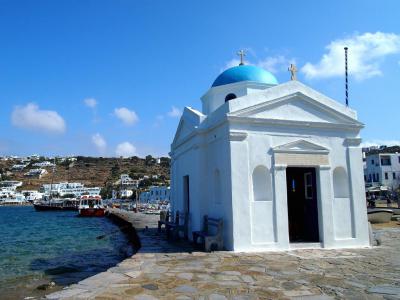
Placed near the edge of the Old Port, Saint Nicholas Church might be small in size, but it carries centuries of maritime faith on its blue-domed shoulders. Also known as the Chapel of Saint Nicholas, or Agios Nikolaos if you want to impress the locals, this modest Greek Orthodox church is dedicated to the beloved patron saint of sailors, fishermen, and travelers-the kind of company Mykonos has always kept close.
Legend has it that Saint Nicholas first visited the island around 500 AD to celebrate his name day, and according to local belief, he’s never really stopped returning. Every December 6th, the faithful carry his icon along the coastline in a solemn litany, followed by a celebration that’s anything but quiet-think feasting, music, and a community gathering that stretches long after sunset. Sailors still share stories of feeling his protection on rough seas, and for an island like Mykonos, that kind of guardian is worth honoring year after year.
The church itself dates to the 4th century and checks all the boxes for classic Cycladic architecture-bright whitewashed walls, a sky-blue dome, matching blue doors and shutters, and a few weathered benches to complete the postcard. It fits seamlessly into the surrounding landscape, which may be why so many visitors pause here-some to pray, others to snap a photo, and many just to enjoy the calm.
Step inside, and you’ll find a quiet, candle-lit interior with simple icons of the Virgin Mary and the Apostles. There’s no grand altar, no gilded ceiling-just a place of reflection, where people have come for generations to light a candle, say a prayer, or seek a moment of peace before heading back into the bustle outside.
While Saint Nicholas Church might not draw crowds like the beaches or windmills, it speaks to a different rhythm of Mykonos-one rooted in faith, tradition, and the deep relationship between islanders and the sea. If you're wandering the Old Port, it's well worth a pause. Light a candle, take in the view, and-who knows-maybe Saint Nicholas is still keeping an eye out.
Legend has it that Saint Nicholas first visited the island around 500 AD to celebrate his name day, and according to local belief, he’s never really stopped returning. Every December 6th, the faithful carry his icon along the coastline in a solemn litany, followed by a celebration that’s anything but quiet-think feasting, music, and a community gathering that stretches long after sunset. Sailors still share stories of feeling his protection on rough seas, and for an island like Mykonos, that kind of guardian is worth honoring year after year.
The church itself dates to the 4th century and checks all the boxes for classic Cycladic architecture-bright whitewashed walls, a sky-blue dome, matching blue doors and shutters, and a few weathered benches to complete the postcard. It fits seamlessly into the surrounding landscape, which may be why so many visitors pause here-some to pray, others to snap a photo, and many just to enjoy the calm.
Step inside, and you’ll find a quiet, candle-lit interior with simple icons of the Virgin Mary and the Apostles. There’s no grand altar, no gilded ceiling-just a place of reflection, where people have come for generations to light a candle, say a prayer, or seek a moment of peace before heading back into the bustle outside.
While Saint Nicholas Church might not draw crowds like the beaches or windmills, it speaks to a different rhythm of Mykonos-one rooted in faith, tradition, and the deep relationship between islanders and the sea. If you're wandering the Old Port, it's well worth a pause. Light a candle, take in the view, and-who knows-maybe Saint Nicholas is still keeping an eye out.
3) Church of Panagia Paraportiani (must see)
Standing watch over the Aegean in the old Kastro neighborhood-the Church of Panagia Paraportiani is one of the island’s most iconic sights. It’s not flashy, but it doesn’t need to be. With its stark white curves, sea views, and time-worn edges, this structure quietly steals the show.
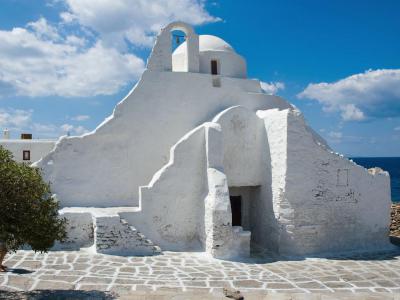
The name Panagia Paraportiani translates to “Our Lady of the Side Gate,” and yes, that’s exactly where you'll find it- near the old entrance to the neighborhood. But what really sets this church apart is its structure. At first glance, it might look like one building with some architectural personality. In truth, it’s five churches in one-four built at ground level over different centuries, forming the base for a fifth that crowns the entire cluster like a sculpted hat.
The earliest part, dedicated to Saint Anargyros, likely dates to around 1425-though some say even earlier. Over time, more chapels were added: Saint Efstathios, Saint Sozon, and Saint Anastasia all took their place in this holy puzzle. The finishing touch, the upper church dedicated to the Virgin Mary, was completed sometime in the 17th century. It took centuries to come together-but somehow, the result looks effortless.
Architecturally, Panagia Paraportiani is a pure expression of Cycladic style-whitewashed, weather-smoothed, and strikingly asymmetrical. There are no decorative frills, no carved facades-just clean lines, rounded corners, and a dome that blends into the sky. It’s bold in its simplicity and famous precisely because it doesn’t try too hard.
Today, the church is more than a place of worship-it’s a national monument and a favorite subject of artists, photographers, and postcard designers. Visit at golden hour, and you’ll likely find a small crowd gazing up, cameras in hand, trying to capture its quiet power.
Part holy site, part accidental sculpture, Panagia Paraportiani is proof that sometimes the best designs come together slowly-and look like they were always meant to stand by the waves.
The name Panagia Paraportiani translates to “Our Lady of the Side Gate,” and yes, that’s exactly where you'll find it- near the old entrance to the neighborhood. But what really sets this church apart is its structure. At first glance, it might look like one building with some architectural personality. In truth, it’s five churches in one-four built at ground level over different centuries, forming the base for a fifth that crowns the entire cluster like a sculpted hat.
The earliest part, dedicated to Saint Anargyros, likely dates to around 1425-though some say even earlier. Over time, more chapels were added: Saint Efstathios, Saint Sozon, and Saint Anastasia all took their place in this holy puzzle. The finishing touch, the upper church dedicated to the Virgin Mary, was completed sometime in the 17th century. It took centuries to come together-but somehow, the result looks effortless.
Architecturally, Panagia Paraportiani is a pure expression of Cycladic style-whitewashed, weather-smoothed, and strikingly asymmetrical. There are no decorative frills, no carved facades-just clean lines, rounded corners, and a dome that blends into the sky. It’s bold in its simplicity and famous precisely because it doesn’t try too hard.
Today, the church is more than a place of worship-it’s a national monument and a favorite subject of artists, photographers, and postcard designers. Visit at golden hour, and you’ll likely find a small crowd gazing up, cameras in hand, trying to capture its quiet power.
Part holy site, part accidental sculpture, Panagia Paraportiani is proof that sometimes the best designs come together slowly-and look like they were always meant to stand by the waves.
4) Little Venice (must see)
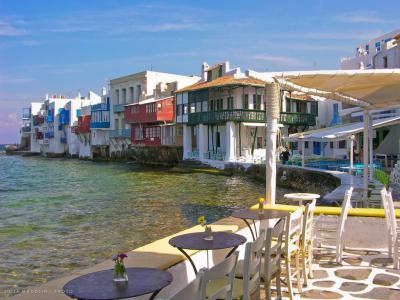
Little Venice isn’t just a nickname-it’s one of Mykonos’s most photogenic corners and one of the island’s top draws. Perched right on the edge of the Aegean in Chora, this waterfront neighborhood has waves lapping at its foundations and balconies that lean just far enough to flirt with the sea breeze.
Originally called Alefkandra, after the nearby beach, the area earned its current name thanks to its colorful houses and distinctive architecture-more Venetian flair than Cycladic minimalism. Think wooden balconies, arched windows, and bold colors that break from the island’s usual white-and-blue palette. This style didn’t appear by accident: back in the 13th century, Mykonos sat on a major Venetian trade route, and for centuries, this spot was a popular pit stop for sailors looking for food, rest, and likely a bit of fun.
Rolling a few hundred years, and Little Venice still knows how to welcome a crowd. By day, the cafés and boutique shops hum with energy, and by night, the area transforms into a lively stretch of bars and clubs-complete with music, cocktails, and a glow that bounces right off the sea. If you're here for the party, you’ve found your place.
Prefer a quieter visit? Come in the morning, when the sun’s low and the crowds are still recovering. It’s the perfect time to explore the area’s history. You’ll find landmarks like the Church of Panagia Paraportiani, Saint Nicholas Church, the Folklore Museum, and what remains of Mykonos Castle resting among the narrow lanes.
Before you leave, head just north of the Mykonos Windmills for a picture-perfect view looking back at Little Venice.
Be it for the colors, the history, or the hum of daily life, this is a shoreline that leaves its mark without saying a word.
Originally called Alefkandra, after the nearby beach, the area earned its current name thanks to its colorful houses and distinctive architecture-more Venetian flair than Cycladic minimalism. Think wooden balconies, arched windows, and bold colors that break from the island’s usual white-and-blue palette. This style didn’t appear by accident: back in the 13th century, Mykonos sat on a major Venetian trade route, and for centuries, this spot was a popular pit stop for sailors looking for food, rest, and likely a bit of fun.
Rolling a few hundred years, and Little Venice still knows how to welcome a crowd. By day, the cafés and boutique shops hum with energy, and by night, the area transforms into a lively stretch of bars and clubs-complete with music, cocktails, and a glow that bounces right off the sea. If you're here for the party, you’ve found your place.
Prefer a quieter visit? Come in the morning, when the sun’s low and the crowds are still recovering. It’s the perfect time to explore the area’s history. You’ll find landmarks like the Church of Panagia Paraportiani, Saint Nicholas Church, the Folklore Museum, and what remains of Mykonos Castle resting among the narrow lanes.
Before you leave, head just north of the Mykonos Windmills for a picture-perfect view looking back at Little Venice.
Be it for the colors, the history, or the hum of daily life, this is a shoreline that leaves its mark without saying a word.
5) Mykonos Windmills (must see)
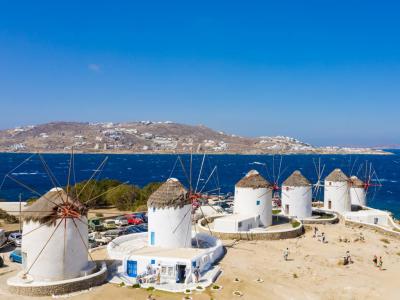
The Mykonos Windmills, or Kato Mili, aren’t just part of the skyline-they are the skyline. Perched on a breezy hill above Alefkandra Harbor, these whitewashed towers have been keeping an eye on Chora for centuries. Their round shapes, tiny windows, and pointed wooden roofs make them look like something out of a Cycladic fairytale-minus the dragons, plus a lot of wind.
Back in the day, Mykonos had 28 windmills scattered across the island. Today, only 16 remain, and seven of those stand proudly on this iconic hill overlooking the sea. You’ll spot them from just about anywhere in town. And no, that’s not your camera lens playing tricks-most of them really do face north to catch the island’s famously strong winds.
The Venetians kicked off windmill construction in the 16th century, using them to grind wheat and keep the local economy spinning-literally. These three-story stone structures were workhorses of island life until the mid-20th century, when electricity made flour-making a whole lot less impressive.
These days, the windmills have traded wheat for nostalgia. Some have been transformed into cozy homes, others into storage, and a couple have taken on new lives as museums. But all of them remain powerful symbols of Mykonos’s past-proof that function and beauty can, in fact, coexist.
If you’re up for a closer look, two of the windmills near the harbor are open to visitors. Geronymos Mill is the oldest of the bunch, with original grinding gear still intact-and still impressive. Then there’s Bonis Mill, which is part of the Mykonos Agricultural Museum. It opens from 4 to 8 PM during summer and hosts a lively festival each September, complete with dancing, storytelling, food, and local wine. Think of it as a love letter to simpler times-with better snacks.
So if you’re wandering Mykonos and see white towers catching the wind, don’t just snap a photo and move on. Climb the hill, take in the view, and let these gentle giants remind you of the island’s quieter, wheatier past.
Back in the day, Mykonos had 28 windmills scattered across the island. Today, only 16 remain, and seven of those stand proudly on this iconic hill overlooking the sea. You’ll spot them from just about anywhere in town. And no, that’s not your camera lens playing tricks-most of them really do face north to catch the island’s famously strong winds.
The Venetians kicked off windmill construction in the 16th century, using them to grind wheat and keep the local economy spinning-literally. These three-story stone structures were workhorses of island life until the mid-20th century, when electricity made flour-making a whole lot less impressive.
These days, the windmills have traded wheat for nostalgia. Some have been transformed into cozy homes, others into storage, and a couple have taken on new lives as museums. But all of them remain powerful symbols of Mykonos’s past-proof that function and beauty can, in fact, coexist.
If you’re up for a closer look, two of the windmills near the harbor are open to visitors. Geronymos Mill is the oldest of the bunch, with original grinding gear still intact-and still impressive. Then there’s Bonis Mill, which is part of the Mykonos Agricultural Museum. It opens from 4 to 8 PM during summer and hosts a lively festival each September, complete with dancing, storytelling, food, and local wine. Think of it as a love letter to simpler times-with better snacks.
So if you’re wandering Mykonos and see white towers catching the wind, don’t just snap a photo and move on. Climb the hill, take in the view, and let these gentle giants remind you of the island’s quieter, wheatier past.
6) Matoyianni Street (must see)
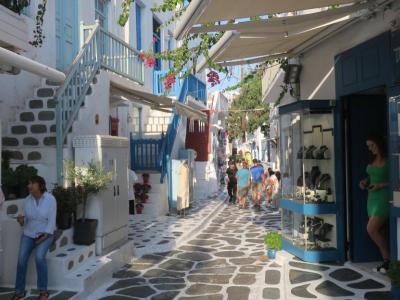
If Mykonos had a runway, it would be Matoyianni Street. Nestled right in the heart of town, this narrow little thoroughfare knows how to make a scene-with cobblestones underfoot, stylish windows at every turn, and a crowd that mixes sun-kissed tourists with locals on a mission.
Often called a shopper’s paradise, Matoyianni is where credit cards and curiosity go hand in hand. Think designer boutiques next to souvenir stalls, high fashion next to handcrafted sandals, and a steady stream of browsers until midnight during the summer months. If you’ve ever wanted to buy a replica of Byzantine-style jewelry, neon beachwear, and olive soap in one stroll-this is your place.
The street itself is short, winding its way between Kalogera Street and Enoplon Dinameon Street, but what it lacks in length it makes up for in personality. Along the way, you’ll pass cafés, craft shops, and perhaps even a few cats acting like they own the place. Don’t miss Pantopoleion, a 300-year-old gem of a store that’s part grocery, part apothecary, and part time machine. It stocks everything from Greek organic foods to natural cosmetics and handmade local goods-ideal for souvenirs that don’t scream “airport gift shop.”
Foodies, fear not-Matoyianni doesn’t disappoint. Ice cream spots and restaurants serving up fresh local dishes keep the energy high and the bellies full. Skaropoulos Bakery, a favorite with locals, has been firing up fresh bread and pastries for over a century. It’s the kind of place where even the crumbs taste like history.
When the sun goes down, Matoyianni flips the switch. Cocktail bars and nightclubs take over, spilling music and laughter into the street. Whether you’re chasing a quiet drink or dancing into the early hours, you’ll find a spot that suits your mood-just follow the beat.
Matoyianni Street condenses the best of Mykonos into one stylish stretch-shops, bites, and nightlife all packed into a lane that never really sleeps.
Often called a shopper’s paradise, Matoyianni is where credit cards and curiosity go hand in hand. Think designer boutiques next to souvenir stalls, high fashion next to handcrafted sandals, and a steady stream of browsers until midnight during the summer months. If you’ve ever wanted to buy a replica of Byzantine-style jewelry, neon beachwear, and olive soap in one stroll-this is your place.
The street itself is short, winding its way between Kalogera Street and Enoplon Dinameon Street, but what it lacks in length it makes up for in personality. Along the way, you’ll pass cafés, craft shops, and perhaps even a few cats acting like they own the place. Don’t miss Pantopoleion, a 300-year-old gem of a store that’s part grocery, part apothecary, and part time machine. It stocks everything from Greek organic foods to natural cosmetics and handmade local goods-ideal for souvenirs that don’t scream “airport gift shop.”
Foodies, fear not-Matoyianni doesn’t disappoint. Ice cream spots and restaurants serving up fresh local dishes keep the energy high and the bellies full. Skaropoulos Bakery, a favorite with locals, has been firing up fresh bread and pastries for over a century. It’s the kind of place where even the crumbs taste like history.
When the sun goes down, Matoyianni flips the switch. Cocktail bars and nightclubs take over, spilling music and laughter into the street. Whether you’re chasing a quiet drink or dancing into the early hours, you’ll find a spot that suits your mood-just follow the beat.
Matoyianni Street condenses the best of Mykonos into one stylish stretch-shops, bites, and nightlife all packed into a lane that never really sleeps.
