Custom Walk in Atlanta, Georgia by chavetino_844e34 created on 2026-02-19
Guide Location: USA » Atlanta
Guide Type: Custom Walk
# of Sights: 7
Tour Duration: 3 Hour(s)
Travel Distance: 6 Km or 3.7 Miles
Share Key: DSK4K
Guide Type: Custom Walk
# of Sights: 7
Tour Duration: 3 Hour(s)
Travel Distance: 6 Km or 3.7 Miles
Share Key: DSK4K
How It Works
Please retrieve this walk in the GPSmyCity app. Once done, the app will guide you from one tour stop to the next as if you had a personal tour guide. If you created the walk on this website or come to the page via a link, please follow the instructions below to retrieve the walk in the app.
Retrieve This Walk in App
Step 1. Download the app "GPSmyCity: Walks in 1K+ Cities" on Apple App Store or Google Play Store.



Step 2. In the GPSmyCity app, download(or launch) the guide "Atlanta Map and Walking Tours".
Step 3. Tap the menu button located at upper right corner of the "Walks" screen and select "Retrieve custom walk". Enter the share key: DSK4K
1) King Center for Nonviolent Social Change
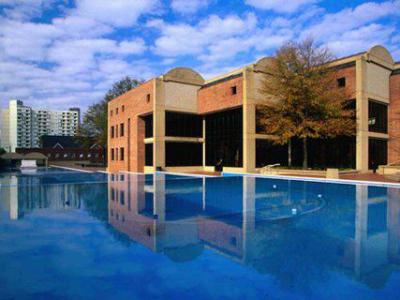
The King Center serves as a memorial and educational institution dedicated to the life, values, and philosophy of Martin Luther King Jr.. Founded in 1968, the Center occupies a key position within the Martin Luther King Jr. National Historical Park. As you approach the campus from Auburn Avenue, you’ll enter an open, landscaped space that immediately sets a reflective tone before you step inside any buildings.
From the main entrance, walk straight ahead toward the long Reflecting Pool, which runs east–west through the heart of the grounds. At the west end of the pool, you’ll see the Eternal Flame, positioned slightly forward and framed by low stone walls. Just beyond the flame, centered along the pool, stands the crypt where Dr. King and his wife, Coretta Scott King, are laid to rest. This outdoor sequence, pool, flame, and crypt, is designed to be experienced in order, encouraging visitors to move slowly and pause along the way.
After taking in the memorial area, turn north and head toward Freedom Hall, the main exhibition building on the campus. Inside, galleries present art, photographs, and historical material tracing the lives and work of Dr. and Mrs. King, while also drawing connections to global figures such as Mahatma Gandhi and Rosa Parks, whose ideas and actions intersected with the philosophy of nonviolent resistance. The exhibitions are arranged to guide you chronologically and thematically through the development of the nonviolent movement.
Adjacent to the exhibition spaces, within the same complex, are the library and archives, which house extensive collections of speeches, correspondence, and primary documents related to Dr. King and the broader civil rights movement. These areas are primarily used for research and educational programs, but their presence underscores the Center’s role as both a memorial and a working institution.
From the main entrance, walk straight ahead toward the long Reflecting Pool, which runs east–west through the heart of the grounds. At the west end of the pool, you’ll see the Eternal Flame, positioned slightly forward and framed by low stone walls. Just beyond the flame, centered along the pool, stands the crypt where Dr. King and his wife, Coretta Scott King, are laid to rest. This outdoor sequence, pool, flame, and crypt, is designed to be experienced in order, encouraging visitors to move slowly and pause along the way.
After taking in the memorial area, turn north and head toward Freedom Hall, the main exhibition building on the campus. Inside, galleries present art, photographs, and historical material tracing the lives and work of Dr. and Mrs. King, while also drawing connections to global figures such as Mahatma Gandhi and Rosa Parks, whose ideas and actions intersected with the philosophy of nonviolent resistance. The exhibitions are arranged to guide you chronologically and thematically through the development of the nonviolent movement.
Adjacent to the exhibition spaces, within the same complex, are the library and archives, which house extensive collections of speeches, correspondence, and primary documents related to Dr. King and the broader civil rights movement. These areas are primarily used for research and educational programs, but their presence underscores the Center’s role as both a memorial and a working institution.
2) Martin Luther King Park Visitor Center
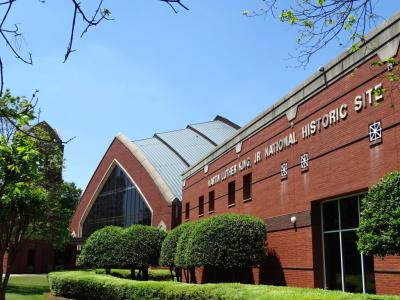
The Martin Luther King, Jr. National Historical Park Visitor Center is the point for understanding both Dr. King’s life and the wider Civil Rights Movement story rooted in Sweet Auburn district. Inside, a staffed information desk helps visitors orient themselves, pick up maps, and plan an efficient route through the surrounding historic area.
The main museum experience is designed to be chronological and easy to follow. Its signature exhibition, “Courage To Lead”, traces Dr. King’s path alongside key events of the movement, using artifacts, photographs, and multimedia to connect personal biography with national change. The experience continues along “Freedom Road”, which places visitors in the cadence of marches, mass meetings, and turning-point moments.
A dedicated D.R.E.A.M. Gallery hosting rotating displays that focus on contemporary civil rights themes and ongoing struggles for social justice. Video programs run in the visitor center theater throughout the day, giving a clear, compact overview before you step back outside to see the nearby sites in person.
The main museum experience is designed to be chronological and easy to follow. Its signature exhibition, “Courage To Lead”, traces Dr. King’s path alongside key events of the movement, using artifacts, photographs, and multimedia to connect personal biography with national change. The experience continues along “Freedom Road”, which places visitors in the cadence of marches, mass meetings, and turning-point moments.
A dedicated D.R.E.A.M. Gallery hosting rotating displays that focus on contemporary civil rights themes and ongoing struggles for social justice. Video programs run in the visitor center theater throughout the day, giving a clear, compact overview before you step back outside to see the nearby sites in person.
3) Ebenezer Baptist Church: New Horizon Sanctuary
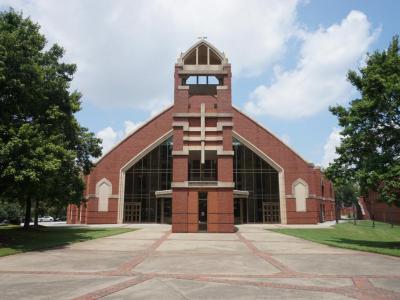
The New Horizon Sanctuary was completed in 1999 and seats approximately 1,600 people. Its construction reflected the congregation’s deliberate decision to remain rooted in downtown Atlanta at a time when many churches were relocating to suburban areas. Today, the building forms an integral part of the Martin Luther King Jr. National Historical Park, continuing Ebenezer’s long-standing role as a living place of worship rather than solely a historic site.
Ebenezer has two main worship spaces facing each other across Auburn Avenue. The Historic Sanctuary is the older brick church on the south side of Auburn Avenue, preserved as the 1960s-era setting most associated with Martin Luther King Jr.’s ministry and the Civil Rights Movement. Directly across Auburn Avenue on the north side is the New Horizon Sanctuary, the larger, modern building used for regular worship and major gatherings.
If you’re standing on the north side of Auburn Avenue with the New Horizon Sanctuary in front of you, the open forecourt called Peace Plaza is the outdoor space that sits between the sanctuary and the National Park Service visitor facilities nearby. The bell tower rises as a vertical marker at the edge of this plaza, close to the street line. The educational building sits immediately alongside the sanctuary, functioning like the campus’s classroom and program wing. The prayer garden is set off from the street-facing plaza in a quieter pocket beside the complex.
Architecturally, the building draws inspiration from African communal meeting structures. Its interior roof ribbing evokes the texture and rhythm of traditional thatch construction, while the freestanding bell tower takes the form of a patterned obelisk, incorporating woven and symbolic motifs. The result is a modern sacred space that consciously references African heritage while serving the practical needs of a contemporary congregation.
Ebenezer has two main worship spaces facing each other across Auburn Avenue. The Historic Sanctuary is the older brick church on the south side of Auburn Avenue, preserved as the 1960s-era setting most associated with Martin Luther King Jr.’s ministry and the Civil Rights Movement. Directly across Auburn Avenue on the north side is the New Horizon Sanctuary, the larger, modern building used for regular worship and major gatherings.
If you’re standing on the north side of Auburn Avenue with the New Horizon Sanctuary in front of you, the open forecourt called Peace Plaza is the outdoor space that sits between the sanctuary and the National Park Service visitor facilities nearby. The bell tower rises as a vertical marker at the edge of this plaza, close to the street line. The educational building sits immediately alongside the sanctuary, functioning like the campus’s classroom and program wing. The prayer garden is set off from the street-facing plaza in a quieter pocket beside the complex.
Architecturally, the building draws inspiration from African communal meeting structures. Its interior roof ribbing evokes the texture and rhythm of traditional thatch construction, while the freestanding bell tower takes the form of a patterned obelisk, incorporating woven and symbolic motifs. The result is a modern sacred space that consciously references African heritage while serving the practical needs of a contemporary congregation.
4) Dr. King's Tomb
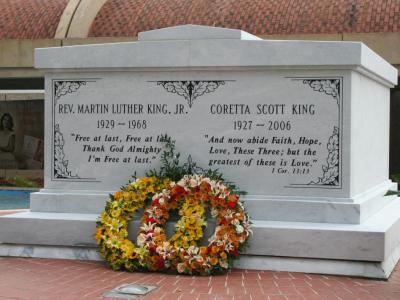
Serving as both a memorial site and the institutional heart of the King Center, the tomb of Martin Luther King Jr. is the final resting place of both Dr. King and his wife, Coretta Scott King. Following Mrs. King’s death in 2006, the tomb was redesigned to accommodate her remains, making it a shared memorial.
The crypt sits at the center of a long, rectangular reflecting pool finished in blue tile and designed with a tiered, cascading form. An inscription on Dr. King’s side of the tomb reads: “Free at Last. Free at Last. Thank God Almighty I’m Free at Last”. On the side dedicated to Coretta Scott King, a separate biblical inscription from First Corinthians reads: “And now abide Faith, Hope, Love, These Three; but the greatest of these is Love.”
In front of the tomb, a small circular pavilion holds the Eternal Flame, which burns continuously. Nearby, the Chapel of All Faiths, positioned at the beginning of the Freedom Walkway, reflects the ecumenical dimension of Dr. King’s work.
The crypt sits at the center of a long, rectangular reflecting pool finished in blue tile and designed with a tiered, cascading form. An inscription on Dr. King’s side of the tomb reads: “Free at Last. Free at Last. Thank God Almighty I’m Free at Last”. On the side dedicated to Coretta Scott King, a separate biblical inscription from First Corinthians reads: “And now abide Faith, Hope, Love, These Three; but the greatest of these is Love.”
In front of the tomb, a small circular pavilion holds the Eternal Flame, which burns continuously. Nearby, the Chapel of All Faiths, positioned at the beginning of the Freedom Walkway, reflects the ecumenical dimension of Dr. King’s work.
5) Martin Luther King, Jr. National Historic Site (must see)
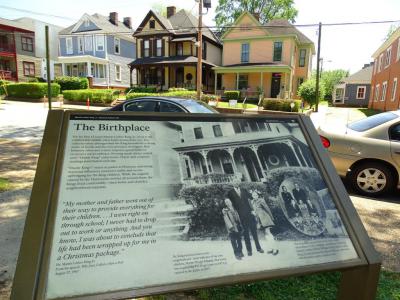
Dedicated to preserving and interpreting the legacy of Dr. Martin Luther King Jr., one of the most influential civil rights leaders in American history, this national historic site is located in the Sweet Auburn neighborhood, where Dr. King was born and raised, and features a variety of exhibits, memorials, and historic landmarks.
Visitors can tour Dr. King's birth home, which has been restored to its original condition and is furnished with period pieces to reflect the time when Dr. King lived there. The site also includes the historic Ebenezer Baptist Church, where Dr. King and his father served as pastors, and where many of his most famous speeches were delivered. The church has been restored to its 1960s appearance, and visitors can attend Sunday services or take guided tours.
The Visitor Center features a museum with a variety of interactive exhibits, artifacts, and multimedia presentations that provide an in-depth look at Dr. King's life and work. Exhibits cover his childhood, education, activism, and leadership in the civil rights movement. There are also exhibits on the history of African Americans in the United States and the struggle for civil rights.
The site includes several other historic landmarks, including Dr. King's grave and tomb, the International Civil Rights Walk of Fame, and the King Center for Nonviolent Social Change, which was founded by Dr. King's wife, Coretta Scott King. The King Center includes a library, archives, and museum, as well as the tomb of Dr. King and his wife.
Why You Should Visit:
To gain a deeper understanding of Dr. King's life, legacy, and contributions to American history.
Tip:
If you want to tour MLK's birth home, arrive early (9 am/11am) to get a ticket at the visitor center.
All of the historical displays and programming are free of charge, but you can spend money in the various gifts shops.
Visitors can tour Dr. King's birth home, which has been restored to its original condition and is furnished with period pieces to reflect the time when Dr. King lived there. The site also includes the historic Ebenezer Baptist Church, where Dr. King and his father served as pastors, and where many of his most famous speeches were delivered. The church has been restored to its 1960s appearance, and visitors can attend Sunday services or take guided tours.
The Visitor Center features a museum with a variety of interactive exhibits, artifacts, and multimedia presentations that provide an in-depth look at Dr. King's life and work. Exhibits cover his childhood, education, activism, and leadership in the civil rights movement. There are also exhibits on the history of African Americans in the United States and the struggle for civil rights.
The site includes several other historic landmarks, including Dr. King's grave and tomb, the International Civil Rights Walk of Fame, and the King Center for Nonviolent Social Change, which was founded by Dr. King's wife, Coretta Scott King. The King Center includes a library, archives, and museum, as well as the tomb of Dr. King and his wife.
Why You Should Visit:
To gain a deeper understanding of Dr. King's life, legacy, and contributions to American history.
Tip:
If you want to tour MLK's birth home, arrive early (9 am/11am) to get a ticket at the visitor center.
All of the historical displays and programming are free of charge, but you can spend money in the various gifts shops.
6) SkyView Atlanta
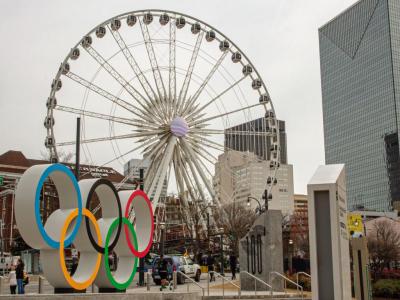
If you want a sweeping overview of Atlanta in a single experience, SkyView Atlanta offers a clear and memorable perspective. Rising 200 feet above the city, this observation wheel provides panoramic views across downtown and the surrounding metropolitan area—an especially appealing option if you don’t have access to Atlanta’s taller buildings or observation decks.
Located beside Centennial Olympic Park and within easy reach of major attractions such as the Georgia Aquarium, World of Coca-Cola, and the Tabernacle, SkyView Atlanta features 42 enclosed, climate-controlled gondolas, each accommodating up to six passengers. The ride is smooth and unhurried, giving you time to take in the skyline, parklands, and nearby venues. For visitors looking for something more exclusive, a VIP gondola can be reserved, offering upgraded seating, tinted windows, a glass floor, and an extended ride duration.
SkyView Atlanta is well suited to families, couples, and first-time visitors, with reasonable wait times and a relaxed pace that makes the experience approachable even for those only mildly cautious about heights. At night, the wheel itself becomes part of the spectacle, illuminated by changing light displays that add color and movement to the downtown skyline.
Located beside Centennial Olympic Park and within easy reach of major attractions such as the Georgia Aquarium, World of Coca-Cola, and the Tabernacle, SkyView Atlanta features 42 enclosed, climate-controlled gondolas, each accommodating up to six passengers. The ride is smooth and unhurried, giving you time to take in the skyline, parklands, and nearby venues. For visitors looking for something more exclusive, a VIP gondola can be reserved, offering upgraded seating, tinted windows, a glass floor, and an extended ride duration.
SkyView Atlanta is well suited to families, couples, and first-time visitors, with reasonable wait times and a relaxed pace that makes the experience approachable even for those only mildly cautious about heights. At night, the wheel itself becomes part of the spectacle, illuminated by changing light displays that add color and movement to the downtown skyline.
7) Ponce City Market
Atlanta's Ponce City Market is a mixed-use development that offers a range of activities and attractions for visitors, including:
- Shopping: Ponce City Market is home to a variety of shops, ranging from high-end boutiques to more affordable options.
- Dining: With dozens of restaurants, cafes, and food stalls, Ponce City Market is a foodie paradise. Visitors can find everything from gourmet burgers to artisanal pastries.
- Rooftop Amusements: Ponce City Market boasts a rooftop amusement park with a variety of rides, games, and activities.
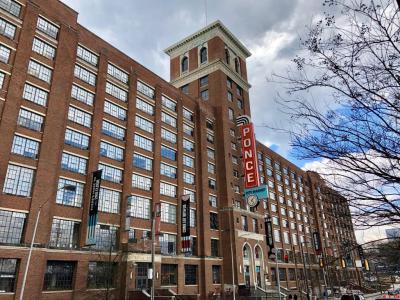
- History: The building that houses Ponce City Market was once a Sears, Roebuck & Co. warehouse and distribution center. The development has preserved much of the building's historic architecture and offers tours that explore the site's history.
- Art: Ponce City Market features a variety of art installations and galleries, showcasing the work of local and regional artists.
- Entertainment: The development hosts regular events, including live music, movie screenings, and pop-up markets.
- Shopping: Ponce City Market is home to a variety of shops, ranging from high-end boutiques to more affordable options.
- Dining: With dozens of restaurants, cafes, and food stalls, Ponce City Market is a foodie paradise. Visitors can find everything from gourmet burgers to artisanal pastries.
- Rooftop Amusements: Ponce City Market boasts a rooftop amusement park with a variety of rides, games, and activities.
- History: The building that houses Ponce City Market was once a Sears, Roebuck & Co. warehouse and distribution center. The development has preserved much of the building's historic architecture and offers tours that explore the site's history.
- Art: Ponce City Market features a variety of art installations and galleries, showcasing the work of local and regional artists.
- Entertainment: The development hosts regular events, including live music, movie screenings, and pop-up markets.
