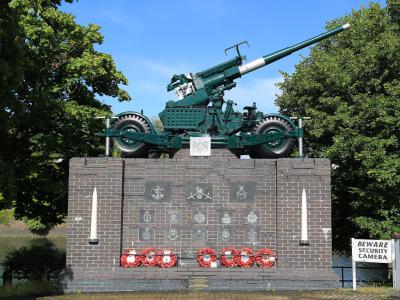


3.7-inch Heavy Anti-Aircraft Gun, Swansea
The 3.7-inch Heavy Anti-Aircraft Gun in Swansea, situated next to the Tawe Bridge, serves as a solemn memorial to commemorate the victims of German air raids during World War II. This particular type of anti-aircraft gun, designed and produced in 1937, was a significant part of Britain’s defense strategy during the war.
The QF 3.7-inch AA Gun was the British Army’s primary heavy anti-aircraft weapon throughout World War II. Comparable to the German Flak 8.8 cm and the American 90 mm gun, it featured a slightly larger caliber of 3.7 inches (94 mm). A brand-new unit of this gun typically weighed 9,317 kg, suggesting that the Swansea memorial’s piece shares a similar weight.
During its operational period, the gun was used across multiple theatres of war, except for the Eastern Front, and remained in service until the advent of guided missiles in 1957. Two versions of the gun were produced-one mobile and the other fixed. The mobile version utilized a wheeled carriage for field operations, while the fixed version was mounted on a pedestal for use in static positions, allowing for more powerful ammunition and enhanced performance.
The 3.7-inch AA gun was developed to replace Britain’s World War I QF 3-inch 20 cwt gun. Improved to counter new aerial threats, it came in various marks and mounts. In static setups like those in Swansea, it was often placed on a concrete platform or temporary structures for quick redeployment, adding versatility to its anti-aircraft capabilities.
The Swansea memorial not only stands as a reminder of the technological advancements in military artillery but also as a tribute to those who lost their lives during the air raids that targeted the city and its surroundings during the war.
The QF 3.7-inch AA Gun was the British Army’s primary heavy anti-aircraft weapon throughout World War II. Comparable to the German Flak 8.8 cm and the American 90 mm gun, it featured a slightly larger caliber of 3.7 inches (94 mm). A brand-new unit of this gun typically weighed 9,317 kg, suggesting that the Swansea memorial’s piece shares a similar weight.
During its operational period, the gun was used across multiple theatres of war, except for the Eastern Front, and remained in service until the advent of guided missiles in 1957. Two versions of the gun were produced-one mobile and the other fixed. The mobile version utilized a wheeled carriage for field operations, while the fixed version was mounted on a pedestal for use in static positions, allowing for more powerful ammunition and enhanced performance.
The 3.7-inch AA gun was developed to replace Britain’s World War I QF 3-inch 20 cwt gun. Improved to counter new aerial threats, it came in various marks and mounts. In static setups like those in Swansea, it was often placed on a concrete platform or temporary structures for quick redeployment, adding versatility to its anti-aircraft capabilities.
The Swansea memorial not only stands as a reminder of the technological advancements in military artillery but also as a tribute to those who lost their lives during the air raids that targeted the city and its surroundings during the war.
Want to visit this sight? Check out these Self-Guided Walking Tours in Swansea. Alternatively, you can download the mobile app "GPSmyCity: Walks in 1K+ Cities" from Apple App Store or Google Play Store. The app turns your mobile device to a personal tour guide and it works offline, so no data plan is needed when traveling abroad.
Download The GPSmyCity App



3.7-inch Heavy Anti-Aircraft Gun on Map
Sight Name: 3.7-inch Heavy Anti-Aircraft Gun
Sight Location: Swansea, Wales (See walking tours in Swansea)
Sight Type: Attraction/Landmark
Sight Location: Swansea, Wales (See walking tours in Swansea)
Sight Type: Attraction/Landmark
Nearby Sights



Walking Tours in Swansea, Wales

Create Your Own Walk in Swansea
Creating your own self-guided walk in Swansea is easy and fun. Choose the city attractions that you want to see and a walk route map will be created just for you. You can even set your hotel as the start point of the walk.
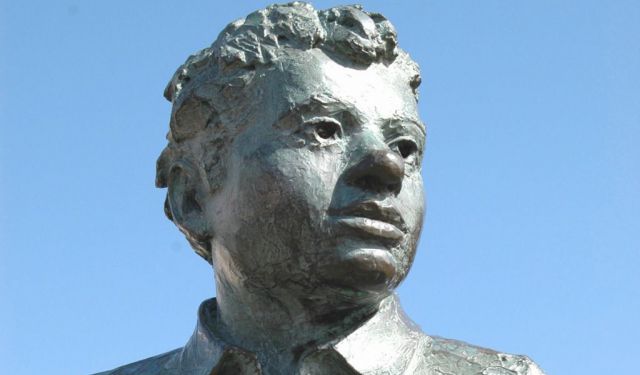
Explore Swansea's Dylan Thomas Sites on Foot
The Dylan Thomas Trail in Swansea is a captivating journey that celebrates the life and works of one of Wales' most famous literary figures. This trail guides visitors through a series of landmarks intimately connected to the poet and writer native of Swansea, providing a deep dive into the environments that influenced his work.
Starting at the Captain Cat Statue, this whimsical sculpture... view more
Tour Duration: 2 Hours
Travel Distance: 4.1 Km or 2.5 Miles
Starting at the Captain Cat Statue, this whimsical sculpture... view more
Tour Duration: 2 Hours
Travel Distance: 4.1 Km or 2.5 Miles
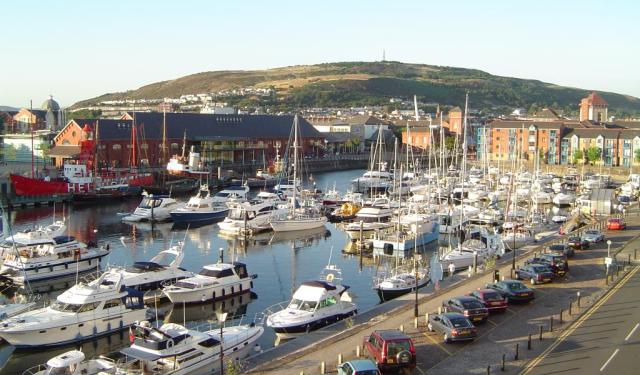
A Walk Through Swansea's Lively Historic City Center
Swansea, the city on the southwest coast of Wales, is the country's second-largest. Its original name in Welsh - Abertawe - means 'mouth of the Tawe' and hints at its geographic location and historical ties to the River Tawe.
The area's history dates back to ancient times when it was contested by early Welsh kingdoms. During the Viking Age, it became a significant trade hub.... view more
Tour Duration: 2 Hours
Travel Distance: 2.7 Km or 1.7 Miles
The area's history dates back to ancient times when it was contested by early Welsh kingdoms. During the Viking Age, it became a significant trade hub.... view more
Tour Duration: 2 Hours
Travel Distance: 2.7 Km or 1.7 Miles
City Walks Overview
