

Agustinas Ermitanas Convento Santa Ursula (Convent of St. Ursula), Toledo
The Convent of Saint Ursula dates back to 1259, when it was founded as a beguinage under the rule of San Agustín. Over the years, the convent acquired its current structure, which features numerous dependencies arranged around two patios. The origins of the church's construction are uncertain, but it is believed that a previous church existed for use as a beguinage before the current one was built in 1360.
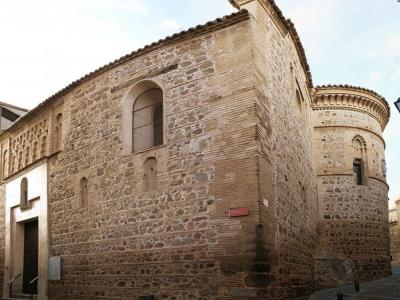
One of the most remarkable features of the convent is the Mudejar apse, which is preserved from the medieval period. The apse departs from the Toledo model because it is built with taped masonry, instead of the well-known brick arches. It features three windows in the upper part that maintain the traditional combination of a pointed horseshoe arch, sheltered by another lobed one. In the intermediate spaces, two shields have been incorporated that correspond to Don Antonio de Ulloa and his wife, Doña Inés de Bazán. They paid for the remodeling of the main chapel for their burial between 1603 and 1625.
The nave of the church was originally a single nave, but two lateral bodies were added with the same taped masonry fabric. They repeat the scheme of the facades of the transept in Santiago del Arrabal, with staggered straight pinion finish and rose window motif between arches, all decorated with lobes. To the right of the apse is a room called the "old choir," which still has remnants of a wooden roof with a frieze around it, under which fragments of an inscription in Gothic characters can be seen.
In the dependencies used as a convent, several reforms have altered the primitive arrangement derived from the grouping of several housing nuclei. The "big cloister" was remodeled in 1623, and two of its canvases had to be demolished and redone. The cloister was almost eliminated when most of the space was incorporated into the church, for the nuns' choir, through a work carried out in 1758 by José Sierra, then architect of the cathedral.
The Agustinas Ermitanas Convento Santa Ursula is a remarkable religious structure that showcases the evolution of its construction over time. Its Mudejar apse, shields, and taped masonry fabric make it unique and worth visiting for those interested in architectural history.
One of the most remarkable features of the convent is the Mudejar apse, which is preserved from the medieval period. The apse departs from the Toledo model because it is built with taped masonry, instead of the well-known brick arches. It features three windows in the upper part that maintain the traditional combination of a pointed horseshoe arch, sheltered by another lobed one. In the intermediate spaces, two shields have been incorporated that correspond to Don Antonio de Ulloa and his wife, Doña Inés de Bazán. They paid for the remodeling of the main chapel for their burial between 1603 and 1625.
The nave of the church was originally a single nave, but two lateral bodies were added with the same taped masonry fabric. They repeat the scheme of the facades of the transept in Santiago del Arrabal, with staggered straight pinion finish and rose window motif between arches, all decorated with lobes. To the right of the apse is a room called the "old choir," which still has remnants of a wooden roof with a frieze around it, under which fragments of an inscription in Gothic characters can be seen.
In the dependencies used as a convent, several reforms have altered the primitive arrangement derived from the grouping of several housing nuclei. The "big cloister" was remodeled in 1623, and two of its canvases had to be demolished and redone. The cloister was almost eliminated when most of the space was incorporated into the church, for the nuns' choir, through a work carried out in 1758 by José Sierra, then architect of the cathedral.
The Agustinas Ermitanas Convento Santa Ursula is a remarkable religious structure that showcases the evolution of its construction over time. Its Mudejar apse, shields, and taped masonry fabric make it unique and worth visiting for those interested in architectural history.
Want to visit this sight? Check out these Self-Guided Walking Tours in Toledo. Alternatively, you can download the mobile app "GPSmyCity: Walks in 1K+ Cities" from Apple App Store or Google Play Store. The app turns your mobile device to a personal tour guide and it works offline, so no data plan is needed when traveling abroad.
Download The GPSmyCity App



Agustinas Ermitanas Convento Santa Ursula (Convent of St. Ursula) on Map
Sight Name: Agustinas Ermitanas Convento Santa Ursula (Convent of St. Ursula)
Sight Location: Toledo, Spain (See walking tours in Toledo)
Sight Type: Religious
Sight Location: Toledo, Spain (See walking tours in Toledo)
Sight Type: Religious
Nearby Sights
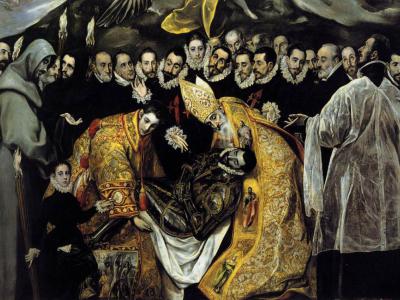
Walking Tours in Toledo, Spain

Create Your Own Walk in Toledo
Creating your own self-guided walk in Toledo is easy and fun. Choose the city attractions that you want to see and a walk route map will be created just for you. You can even set your hotel as the start point of the walk.
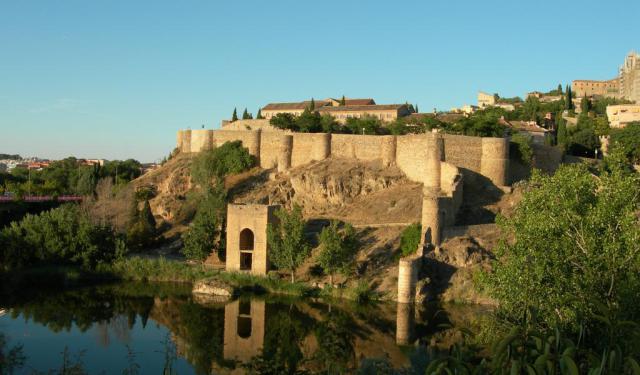
Toledo's Ancient Walls, Gates and Bridges
Other than its signature “Toledo steel”, the Spanish city of Toledo is known for its historic architecture, particularly the ancient mammoth fortifications - a testament to the strength of the city that has maintained its borders for well over a thousand years.
Toledo's soaring walls were first built by the Romans in the 3rd century AD and then further expanded, over the following... view more
Tour Duration: 1 Hour
Travel Distance: 2.1 Km or 1.3 Miles
Toledo's soaring walls were first built by the Romans in the 3rd century AD and then further expanded, over the following... view more
Tour Duration: 1 Hour
Travel Distance: 2.1 Km or 1.3 Miles
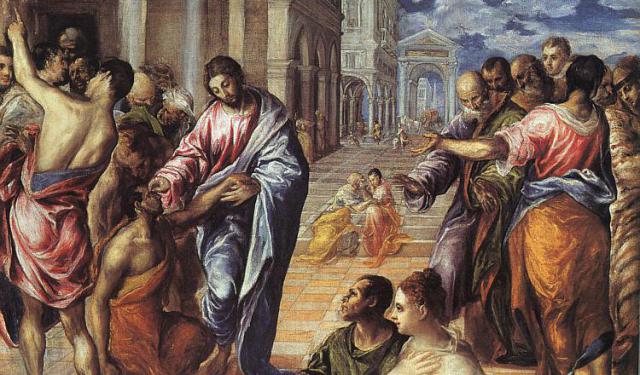
El Greco's Masterpieces
Domnnikos Theotokopoulos, most widely known as El Greco or "The Greek," was a Greek painter, sculptor, and architect of the Spanish Renaissance. El Greco was well ahead of his time. His dramatic and expressionistic style is regarded as a precursor of both Expressionism and Cubism of the 20th century.
El Greco was born in Crete, Greece, and studied painting in Italy. In 1577, he... view more
Tour Duration: 1 Hour
Travel Distance: 2 Km or 1.2 Miles
El Greco was born in Crete, Greece, and studied painting in Italy. In 1577, he... view more
Tour Duration: 1 Hour
Travel Distance: 2 Km or 1.2 Miles
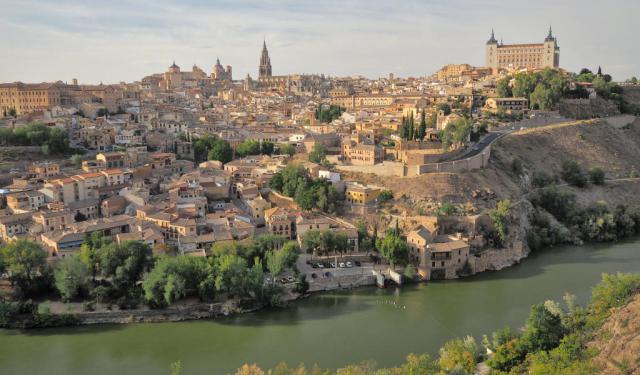
Toledo Introduction Walking Tour
Roman historian Livy didn’t bother with flattery. To him, Toledo was “a small city, but fortified by location”-and he wasn’t wrong. Apart from its governance over the Tagus River, the city has long been known as the “City of the Three Cultures”-a place where Christianity, Islam, and Judaism all left visible marks, even if coexistence was not always peaceful. Its name comes from the... view more
Tour Duration: 2 Hours
Travel Distance: 3.2 Km or 2 Miles
Tour Duration: 2 Hours
Travel Distance: 3.2 Km or 2 Miles
City Walks Overview
