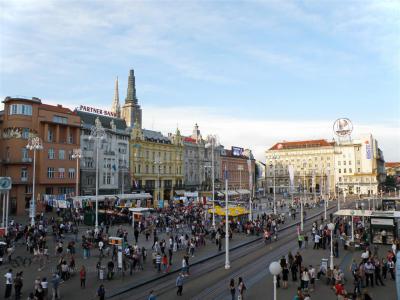


Ban Jelačić Square, Zagreb (must see)
Ban Jelačić Square forms the central gathering point of Zagreb. The square takes its name from Josip Jelačić, a 19th-century governor remembered for his role in resisting Hungarian authority within the Habsburg Monarchy. His equestrian statue, erected in the 19th century, remains the square’s focal point, though it has had a complex history: removed in 1947 by Communist authorities-who renamed the space Republic Square-it was returned in 1990 as Croatia moved toward independence.
The square’s origins date to 1641, when a new marketplace was established outside the medieval cores of Gradec and Kaptol, near the Manduševac spring. Initially known as Manduševac, it later became Harmica which means "thirtieth”. Historically, the square was the place where merchants paid a tax of about 1/30 levied on goods brought into a town In 1848, it was renamed Ban Jelačić Square. Over time, it developed into Zagreb’s main commercial and social hub, framed by buildings that reflect a mix of Classicist, Secessionist, and Modernist styles.
In the late 20th century, the square underwent significant transformation. Ahead of the 1987 World University Games, it was repaved with stone blocks and pedestrianized, while the Manduševac Fountain-whose spring had been buried in 1898-was uncovered and restored.
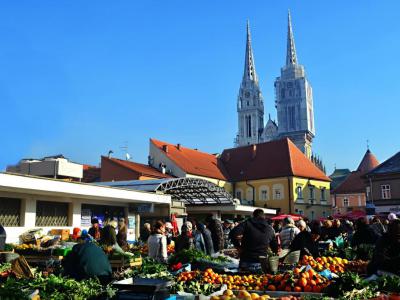
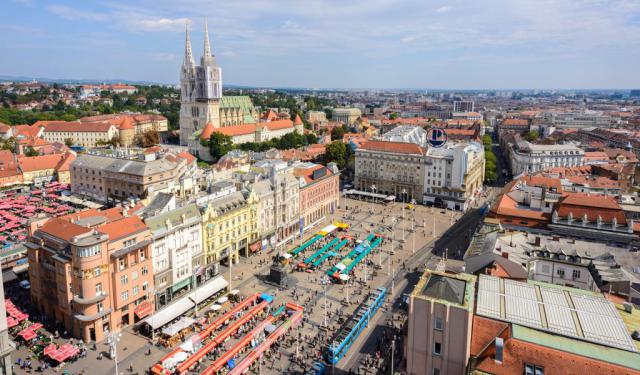
Splavnica Street can be found on the northern side of the square and it leads to Dolac Market. The market is easily recognized by its rows of red umbrellas, where locals shop for fresh produce, cheese, and flowers. Throughout the year, the square functions as a lively urban stage, but in winter it takes on a more festive character, with Christmas trees and lights illuminating the surrounding façades.
The square’s origins date to 1641, when a new marketplace was established outside the medieval cores of Gradec and Kaptol, near the Manduševac spring. Initially known as Manduševac, it later became Harmica which means "thirtieth”. Historically, the square was the place where merchants paid a tax of about 1/30 levied on goods brought into a town In 1848, it was renamed Ban Jelačić Square. Over time, it developed into Zagreb’s main commercial and social hub, framed by buildings that reflect a mix of Classicist, Secessionist, and Modernist styles.
In the late 20th century, the square underwent significant transformation. Ahead of the 1987 World University Games, it was repaved with stone blocks and pedestrianized, while the Manduševac Fountain-whose spring had been buried in 1898-was uncovered and restored.
Splavnica Street can be found on the northern side of the square and it leads to Dolac Market. The market is easily recognized by its rows of red umbrellas, where locals shop for fresh produce, cheese, and flowers. Throughout the year, the square functions as a lively urban stage, but in winter it takes on a more festive character, with Christmas trees and lights illuminating the surrounding façades.
Want to visit this sight? Check out these Self-Guided Walking Tours in Zagreb. Alternatively, you can download the mobile app "GPSmyCity: Walks in 1K+ Cities" from Apple App Store or Google Play Store. The app turns your mobile device to a personal tour guide and it works offline, so no data plan is needed when traveling abroad.
Download The GPSmyCity App



Ban Jelačić Square on Map
Sight Name: Ban Jelačić Square
Sight Location: Zagreb, Croatia (See walking tours in Zagreb)
Sight Type: Attraction/Landmark
Guide(s) Containing This Sight:
Sight Location: Zagreb, Croatia (See walking tours in Zagreb)
Sight Type: Attraction/Landmark
Guide(s) Containing This Sight:
Nearby Sights


Walking Tours in Zagreb, Croatia

Create Your Own Walk in Zagreb
Creating your own self-guided walk in Zagreb is easy and fun. Choose the city attractions that you want to see and a walk route map will be created just for you. You can even set your hotel as the start point of the walk.
Zagreb Upper Town Walking Tour
Zagreb’s Upper Town forms the historic core of the city, rising on a hill above the modern lower districts. The name reflects its elevated position, distinguishing it from Lower Town, which developed later on the plains below. The wider area, however, has much older roots: nearby stood Andautonia, a Roman settlement that points to early habitation in the region. The name “Zagreb” itself... view more
Tour Duration: 1 Hour
Travel Distance: 1.8 Km or 1.1 Miles
Tour Duration: 1 Hour
Travel Distance: 1.8 Km or 1.1 Miles
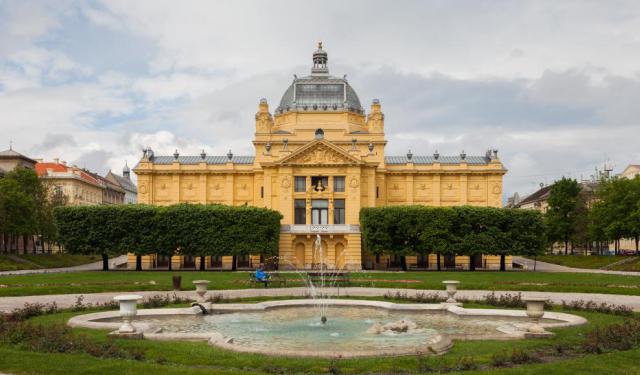
Zagreb Lower Town Walking Tour
Zagreb’s Lower Town forms one of the two main districts in the historic heart of the Croatian capital, alongside the Upper Town. As its name suggests, it lies below the older hilltop settlements of Gradec and Kaptol. While those medieval centers developed organically on elevated ground, the Lower Town is the more modern of the two, shaped through deliberate urban planning during the late 19th... view more
Tour Duration: 2 Hours
Travel Distance: 2.5 Km or 1.6 Miles
Tour Duration: 2 Hours
Travel Distance: 2.5 Km or 1.6 Miles