

Basilica of Fornas de Torelló, Mahon
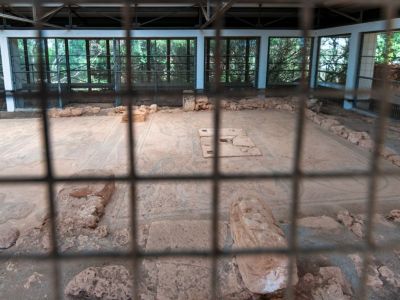
The Basilica des Fornàs de Torelló is one of Menorca’s most remarkable early Christian archaeological treasures. Discovered somewhat by chance in the 20th century, this paleochristian site offers a rare glimpse into religious life on the island during Late Antiquity. The remains preserve not only the layout of an early basilica church but also a spectacular mosaic floor that covers much of its central nave.
Constructed in the 5th–6th centuries AD - a period linked to Byzantine rule and the influence of Emperor Justinian - the basilica is oriented east–west, following the liturgical tradition of the era. Remnants of a semi-spherical baptismal font on the north side of the structure also survive, demonstrating the ritual functions that took place here.
One of the basilica’s most enchanting features is its mosaic pavement, still largely intact today beneath a protective metal shelter. The mosaic includes rich symbolic imagery: grape clusters evoking life, paired peacocks as symbols of resurrection, and a central cratera or wine vessel. At the transition between the nave and apse, two lions flanking a palm tree may reference both triumph over death and older Judaic iconography, a motif sometimes adopted in early Christian visual language. Geometric designs and bird motifs in the nave complete the decorative program, reinforcing a sense of sacred space and divine presence.
Visitors today can walk along a raised walkway that allows close viewing of these relics without damaging them, and informational panels help orient the site’s significance. Because only part of the basilica has been excavated, much remains to be explored beneath the surface.
Constructed in the 5th–6th centuries AD - a period linked to Byzantine rule and the influence of Emperor Justinian - the basilica is oriented east–west, following the liturgical tradition of the era. Remnants of a semi-spherical baptismal font on the north side of the structure also survive, demonstrating the ritual functions that took place here.
One of the basilica’s most enchanting features is its mosaic pavement, still largely intact today beneath a protective metal shelter. The mosaic includes rich symbolic imagery: grape clusters evoking life, paired peacocks as symbols of resurrection, and a central cratera or wine vessel. At the transition between the nave and apse, two lions flanking a palm tree may reference both triumph over death and older Judaic iconography, a motif sometimes adopted in early Christian visual language. Geometric designs and bird motifs in the nave complete the decorative program, reinforcing a sense of sacred space and divine presence.
Visitors today can walk along a raised walkway that allows close viewing of these relics without damaging them, and informational panels help orient the site’s significance. Because only part of the basilica has been excavated, much remains to be explored beneath the surface.
Want to visit this sight? Check out these Self-Guided Walking Tours in Mahon. Alternatively, you can download the mobile app "GPSmyCity: Walks in 1K+ Cities" from Apple App Store or Google Play Store. The app turns your mobile device to a personal tour guide and it works offline, so no data plan is needed when traveling abroad.
Download The GPSmyCity App



Basilica of Fornas de Torelló on Map
Sight Name: Basilica of Fornas de Torelló
Sight Location: Mahon, Spain (See walking tours in Mahon)
Sight Type: Religious
Sight Location: Mahon, Spain (See walking tours in Mahon)
Sight Type: Religious
Nearby Sights
Walking Tours in Mahon, Spain

Create Your Own Walk in Mahon
Creating your own self-guided walk in Mahon is easy and fun. Choose the city attractions that you want to see and a walk route map will be created just for you. You can even set your hotel as the start point of the walk.
Mahon Introduction Walking Tour
Until the first half of the 19th century, the U.S. Navy did not really leave its premises. Only one exception. Mahón became their first naval base overseas.
Mahón is the capital of the island of Menorca in Spain’s Balearic Islands. The etymology of “Mahón” is often linked to Mago Barca, the brother of famous Carthaginian general Hannibal, who is said to have taken refuge there in 205... view more
Tour Duration: 2 Hour(s)
Travel Distance: 1.8 Km or 1.1 Miles
Mahón is the capital of the island of Menorca in Spain’s Balearic Islands. The etymology of “Mahón” is often linked to Mago Barca, the brother of famous Carthaginian general Hannibal, who is said to have taken refuge there in 205... view more
Tour Duration: 2 Hour(s)
Travel Distance: 1.8 Km or 1.1 Miles