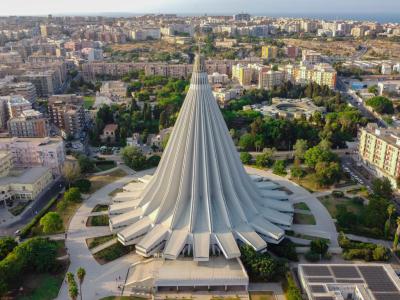


Basilica of Our Lady of the Tears, Syracuse
The Basilica of Our Lady of the Tears is a 20th-century Roman Catholic Marian shrine. This modern and distinctive church, colloquially referred to by some as an "inverted ice-cream cone," stands as a dominant feature on the approach to Ortigia, Syracuse's historic center. The church's design was the result of an international competition, and it was created by the architects Michel Andrault and Pierre Parat, with Riccardo Morandi serving as the chief engineer.
Construction of this unique shrine began in 1966 but was only completed in 1994. During the construction process, an unexpected discovery was made - the foundations contained a crypt, believed to be a paleo-Christian mausoleum. This crypt is now located in the lower levels of the church. The original design envisioned an even taller structure, but it was eventually truncated to its current height of 103 meters.
The Basilica of Our Lady of the Tears is situated adjacent to the Catacombs of San Giovanni and the Basilica of San Marziano. The construction and design of the sanctuary sparked significant controversy. There are various interpretations of the church's unique design, with some suggesting that it resembles a giant teardrop colliding with the Earth. The construction over an archaeological site required special permissions, and many were divided on the decision to erect such an ambitious structure to commemorate the purported miracle.
The miracle in question allegedly took place from August 29 to September 1, 1953, when a plaster icon of the Madonna of the Immaculate Heart was believed to have shed tears in the presence of an impoverished local couple, including a fisherman husband. Crowds of people claimed to have witnessed this event, and even scientific analyses of the fluids were conducted. The icon was subsequently moved from the couple's residence on Via degli Orti to the basilica.
The first stone for the basilica's construction was consecrated in 1954. In 2002, Pope John Paul II elevated the sanctuary to the status of a minor basilica. Furthermore, in 2019, the Episcopal Conference of Sicily granted it the title of a regional sanctuary.
Atop the basilica's dome, a gilded bronze statue of the Madonna, adorned with rings and rays, was created by Francesco Caldarella. The square altar within the basilica features a bronze base with four panels depicting scenes from the apocalyptic visions of the Book of Revelation.
Construction of this unique shrine began in 1966 but was only completed in 1994. During the construction process, an unexpected discovery was made - the foundations contained a crypt, believed to be a paleo-Christian mausoleum. This crypt is now located in the lower levels of the church. The original design envisioned an even taller structure, but it was eventually truncated to its current height of 103 meters.
The Basilica of Our Lady of the Tears is situated adjacent to the Catacombs of San Giovanni and the Basilica of San Marziano. The construction and design of the sanctuary sparked significant controversy. There are various interpretations of the church's unique design, with some suggesting that it resembles a giant teardrop colliding with the Earth. The construction over an archaeological site required special permissions, and many were divided on the decision to erect such an ambitious structure to commemorate the purported miracle.
The miracle in question allegedly took place from August 29 to September 1, 1953, when a plaster icon of the Madonna of the Immaculate Heart was believed to have shed tears in the presence of an impoverished local couple, including a fisherman husband. Crowds of people claimed to have witnessed this event, and even scientific analyses of the fluids were conducted. The icon was subsequently moved from the couple's residence on Via degli Orti to the basilica.
The first stone for the basilica's construction was consecrated in 1954. In 2002, Pope John Paul II elevated the sanctuary to the status of a minor basilica. Furthermore, in 2019, the Episcopal Conference of Sicily granted it the title of a regional sanctuary.
Atop the basilica's dome, a gilded bronze statue of the Madonna, adorned with rings and rays, was created by Francesco Caldarella. The square altar within the basilica features a bronze base with four panels depicting scenes from the apocalyptic visions of the Book of Revelation.
Want to visit this sight? Check out these Self-Guided Walking Tours in Syracuse. Alternatively, you can download the mobile app "GPSmyCity: Walks in 1K+ Cities" from Apple App Store or Google Play Store. The app turns your mobile device to a personal tour guide and it works offline, so no data plan is needed when traveling abroad.
Download The GPSmyCity App



Basilica of Our Lady of the Tears on Map
Sight Name: Basilica of Our Lady of the Tears
Sight Location: Syracuse, Italy (See walking tours in Syracuse)
Sight Type: Religious
Sight Location: Syracuse, Italy (See walking tours in Syracuse)
Sight Type: Religious
Nearby Sights
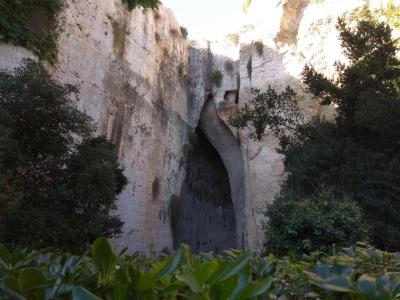
Walking Tours in Syracuse, Italy

Create Your Own Walk in Syracuse
Creating your own self-guided walk in Syracuse is easy and fun. Choose the city attractions that you want to see and a walk route map will be created just for you. You can even set your hotel as the start point of the walk.
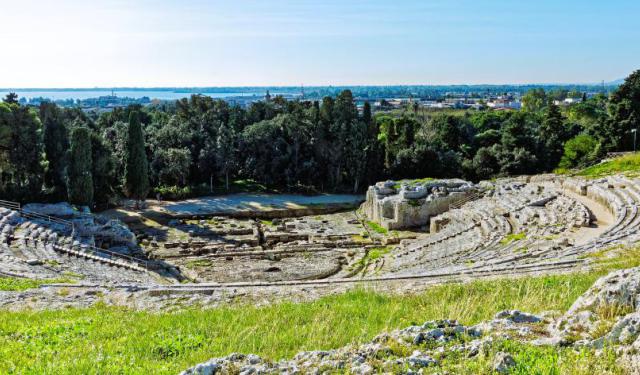
Neapolis Archaeological Park Walk
For those keen on ancient history, Syracuse's main attraction lies within its Neapolis Archaeological Park. Spread across a vast area, this historical site contains a variety of fascinating landmarks, each with its own unique story.
Our first stop on this walk is the Augustan Arch (Arco Augusteo), the majestic archway built during the reign of Emperor Augustus. Nearby, you'll find the... view more
Tour Duration: 2 Hours
Travel Distance: 2.1 Km or 1.3 Miles
Our first stop on this walk is the Augustan Arch (Arco Augusteo), the majestic archway built during the reign of Emperor Augustus. Nearby, you'll find the... view more
Tour Duration: 2 Hours
Travel Distance: 2.1 Km or 1.3 Miles
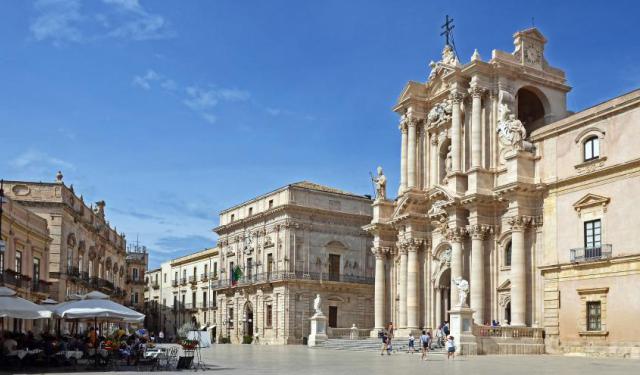
Syracuse Introduction Walking Tour
Syracuse, a city steeped in 2,700 years of Greek and Roman history, boasts a rich cultural heritage, remarkable amphitheaters, and iconic architecture. It was the birthplace of the renowned mathematician and engineer Archimedes and played a pivotal role as a Mediterranean powerhouse in ancient times.
Founded by Ancient Greek Corinthians and Teneans, the city-state formed influential alliances... view more
Tour Duration: 1 Hour
Travel Distance: 1 Km or 0.6 Miles
Founded by Ancient Greek Corinthians and Teneans, the city-state formed influential alliances... view more
Tour Duration: 1 Hour
Travel Distance: 1 Km or 0.6 Miles
City Walks Overview
