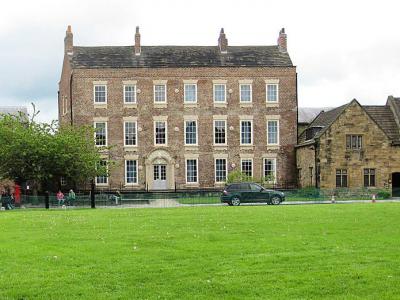


Bishop Cosin's Hall, Durham
Bishop Cosin’s Hall occupies a prominent position near Durham’s Palace Green, housed in a brick-built structure dating to around 1700. Originally constructed as the residence of the Archdeacon of Northumberland, the building reflects early Georgian architectural principles-orderly, symmetrical, and understated. Its design marked a shift in local building practice, standing out as one of the first significant brick constructions in an area historically dominated by stone. Though named after John Cosin, the influential 17th-century Bishop of Durham, the building itself predates his direct involvement and was only later associated with his legacy.
By 1833, the former Archdeacon’s Inn was handed over to the newly established University of Durham and renamed University House. As the university’s reputation grew, so did the need for more affordable educational options. In response, Bishop Cosin’s Hall was formally founded in 1851 to accommodate students who couldn’t afford the higher fees at University College. Its short-lived run ended in 1864 due to financial and enrollment struggles, after which it was absorbed back into the university and later used for administrative offices and staff housing until 2006.
Despite its modest exterior, the Hall holds historical importance. It reflects the university’s early attempts to expand access to education while also standing as a rare example of early 18th-century brickwork in Durham.
In 1952, the building received listed status in recognition of its architectural and historical significance. Today, it contributes to the layered academic and architectural heritage of Palace Green, even if its days as a college hall are long behind it.
By 1833, the former Archdeacon’s Inn was handed over to the newly established University of Durham and renamed University House. As the university’s reputation grew, so did the need for more affordable educational options. In response, Bishop Cosin’s Hall was formally founded in 1851 to accommodate students who couldn’t afford the higher fees at University College. Its short-lived run ended in 1864 due to financial and enrollment struggles, after which it was absorbed back into the university and later used for administrative offices and staff housing until 2006.
Despite its modest exterior, the Hall holds historical importance. It reflects the university’s early attempts to expand access to education while also standing as a rare example of early 18th-century brickwork in Durham.
In 1952, the building received listed status in recognition of its architectural and historical significance. Today, it contributes to the layered academic and architectural heritage of Palace Green, even if its days as a college hall are long behind it.
Want to visit this sight? Check out these Self-Guided Walking Tours in Durham. Alternatively, you can download the mobile app "GPSmyCity: Walks in 1K+ Cities" from Apple App Store or Google Play Store. The app turns your mobile device to a personal tour guide and it works offline, so no data plan is needed when traveling abroad.
Download The GPSmyCity App



Bishop Cosin's Hall on Map
Sight Name: Bishop Cosin's Hall
Sight Location: Durham, England (See walking tours in Durham)
Sight Type: Attraction/Landmark
Sight Location: Durham, England (See walking tours in Durham)
Sight Type: Attraction/Landmark
Nearby Sights
Walking Tours in Durham, England

Create Your Own Walk in Durham
Creating your own self-guided walk in Durham is easy and fun. Choose the city attractions that you want to see and a walk route map will be created just for you. You can even set your hotel as the start point of the walk.
Durham Introduction Walking Tour
According to the legend, it all started with a missing cow. Back in 995, a group of monks fleeing Viking raiders were hauling around the remains of Saint Cuthbert when their saintly cargo decided to stop moving. No matter how hard they tried, the bier wouldn’t budge-until a milkmaid chasing her lost dun cow wandered past. ("Dun" is a dull shade of brownish grey. ) The monks took the... view more
Tour Duration: 2 Hour(s)
Travel Distance: 2.6 Km or 1.6 Miles
Tour Duration: 2 Hour(s)
Travel Distance: 2.6 Km or 1.6 Miles