


Carmelite Monastery in Bamberg, Bamberg
The Carmelite Monastery of Saint Maria and Saint Theodor am Kaulberg has a long and diverse history. Originally a Cistercian abbey, it later became a Carmelite monastery in 1589 and was repurchased by the Carmelite order after a period of secularization.
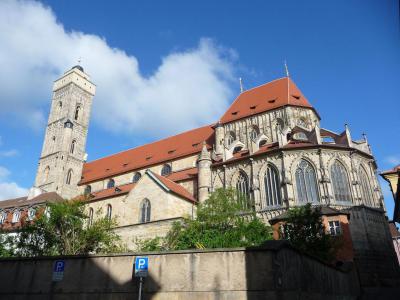
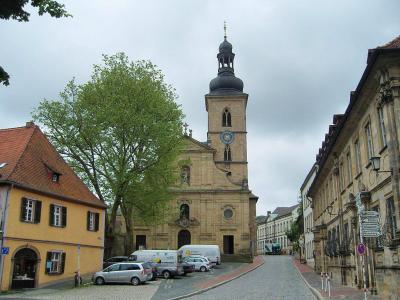
The church displays a mix of architectural styles, with Romanesque elements preserved underground and the remaining lion portal as a visible reminder. Originally planned with two towers, only one was completed, and the second tower remained unfinished until 1808.
Bishop Hermann II, who served in the 12th century, found his final resting place in the church, further emphasizing its spiritual and historical significance.
During the baroque period, the church underwent substantial renovations by architect Leonhard Dientzenhofer. The high altar was relocated from the east to the west, resulting in the lion portal losing its main entrance function.
The east facade, now the entrance side, was artistically adorned by Leonhard Gollwitzer, featuring a sculpture of Maria with child and the scapular. Niches on the facade house statues of Carmelite saints, and the gable end showcases the prophet Elias, symbolizing the order's Old Testament roots.
After the monastery's dissolution, the Carmelite order repurchased the monastery and church a century later. The interior was furnished in a neo-baroque style by Frater Alois Ehrlich, the monastery's carpenter. While most of the current interior dates from after 1902, the Holy Family altar and pulpit were original pieces reacquired and reinstalled.
The church's unfinished tower was completed in 1808 by Bavarian master builder Ferdinand Freiherr von Hohenhausen. The construction debris was used to fill up Altenburger Straße, now a square in front of the Zur Matern restaurant.
In the 1990s, as part of the monastery's revitalization, a crypt was created beneath the church as a new burial place. It became the collective grave for individuals previously buried in the abandoned Bamberg cemetery.
The church displays a mix of architectural styles, with Romanesque elements preserved underground and the remaining lion portal as a visible reminder. Originally planned with two towers, only one was completed, and the second tower remained unfinished until 1808.
Bishop Hermann II, who served in the 12th century, found his final resting place in the church, further emphasizing its spiritual and historical significance.
During the baroque period, the church underwent substantial renovations by architect Leonhard Dientzenhofer. The high altar was relocated from the east to the west, resulting in the lion portal losing its main entrance function.
The east facade, now the entrance side, was artistically adorned by Leonhard Gollwitzer, featuring a sculpture of Maria with child and the scapular. Niches on the facade house statues of Carmelite saints, and the gable end showcases the prophet Elias, symbolizing the order's Old Testament roots.
After the monastery's dissolution, the Carmelite order repurchased the monastery and church a century later. The interior was furnished in a neo-baroque style by Frater Alois Ehrlich, the monastery's carpenter. While most of the current interior dates from after 1902, the Holy Family altar and pulpit were original pieces reacquired and reinstalled.
The church's unfinished tower was completed in 1808 by Bavarian master builder Ferdinand Freiherr von Hohenhausen. The construction debris was used to fill up Altenburger Straße, now a square in front of the Zur Matern restaurant.
In the 1990s, as part of the monastery's revitalization, a crypt was created beneath the church as a new burial place. It became the collective grave for individuals previously buried in the abandoned Bamberg cemetery.
Want to visit this sight? Check out these Self-Guided Walking Tours in Bamberg. Alternatively, you can download the mobile app "GPSmyCity: Walks in 1K+ Cities" from Apple App Store or Google Play Store. The app turns your mobile device to a personal tour guide and it works offline, so no data plan is needed when traveling abroad.
Download The GPSmyCity App



Carmelite Monastery in Bamberg on Map
Sight Name: Carmelite Monastery in Bamberg
Sight Location: Bamberg, Germany (See walking tours in Bamberg)
Sight Type: Religious
Sight Location: Bamberg, Germany (See walking tours in Bamberg)
Sight Type: Religious
Nearby Sights

Walking Tours in Bamberg, Germany

Create Your Own Walk in Bamberg
Creating your own self-guided walk in Bamberg is easy and fun. Choose the city attractions that you want to see and a walk route map will be created just for you. You can even set your hotel as the start point of the walk.
Bamber Introduction Walking Tour
“The happy Bamberg.” This cheerful phrase is often attributed to the renowned writer and thinker Johann Wolfgang von Goethe, who visited the city and expressed deep admiration for its charm. Whether or not he coined the exact words, the sentiment perfectly captures the sense of delight that Bamberg continues to inspire in its visitors.
Bamberg was founded in the 9th century and became a... view more
Tour Duration: 2 Hour(s)
Travel Distance: 2.8 Km or 1.7 Miles
Bamberg was founded in the 9th century and became a... view more
Tour Duration: 2 Hour(s)
Travel Distance: 2.8 Km or 1.7 Miles
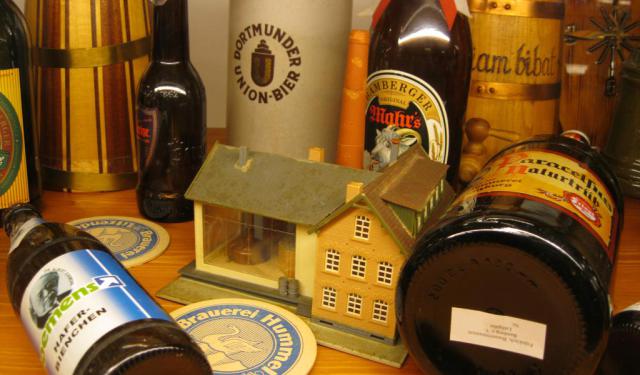
Best Brewpubs In Bamberg Walk
"Brewer's Paradise". Speaking of Bamberg, the town that is regarded as one of the beer capitals of Germany, this expression encapsulates the image of a true haven for beer lovers and brewers alike. Bamberg's "liquid history" goes back over 900 years. The first documented mention of brewing in Bamberg dates to 1122 and the city has been closely associated with beer... view more
Tour Duration: 1 Hour(s)
Travel Distance: 2.7 Km or 1.7 Miles
Tour Duration: 1 Hour(s)
Travel Distance: 2.7 Km or 1.7 Miles