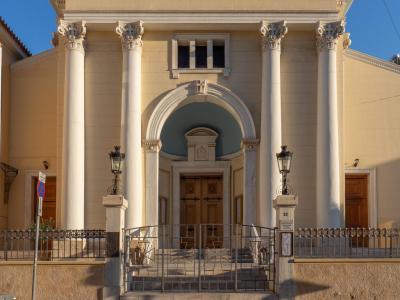


Catholic Church of St. Paul, Piraeus
The harbour of Piraeus has undergone a swift growth after 1834. The few Catholics also grew in number. The Freiderikos Markettis, rich tradesman and naval agent, solicitous for spiritual welfare of his fellow-citizens, constructed in his palace a chapel where on Sundays and feastdays, a priest from Athens celebrated the Mass for them. In 1837, however, the above real estate was sold, thus the Peiraiotes were forced to seek some other place of worship. Rev. Comnstantine Sargologos, Vicar General of the Parish of Athens, informed the Association of Greek Industrialists. Vlangki, who was then in Syros, received a letter from the Vicar on 11 January 1837 which states: "The palace where the Mass has been customarily celebrated, was sold to the State to install the Faculty of Aegina. For this, I should go down in Piraeus to look for some other place. I thought, therefore, of constructing a church; since Piraeus in a little while will develope into the largest harbour of Greece...". Then, a house was rented which is later transformed into a chapel. Information on the foundation of that first temple, is found in the manuscript report entitled: "Historical notes: History of the Foundation of the Catholic Temple of the Apostle Paul in Piraeus " written by Rev. Marinos Danube, first Vicar of the Parish of Piraeus. The idea, therefore, of Rev. Sargologou, to construct a church in the harbour of Piraeus, was appreciated particularly by the Prokesch Osten, ambassador of Austria in Athens. The proposal made by the Vicar of Athens was immediately accepted, and proposed in the Administrative Council, in the meeting of 5 March 1837. Prokesch Osten set himself for the task of raising funds among his Austrian compatriots. The first important sum collected came from "Austrian Fate of Mediterranean". With this sum a suitable plot was bought. Jakovos Tountas, resident Athens, householder of a plot 1600 yards, offered 200 yards for the construction of temple. The rest of his plot had been demarcated by the State for the construction of a public building. The Council asked Tountas to yield his rights to the plot in question, in exchange of compensation. The State in exchange of the plot would grant him another of equal value. The tract of land, however, that the State offered, north of Zeas (Pasalimani) was judged inadequate. At this point, the plot at Filonos road was judged most suitable, in which the present Church of Saint Paul has been constructed. After the acquisition of the plot, the Council asked the architect Eduardo Schaubert, technical adviser of Government, to submit a study of the edifice, proportional to the space available and within its economic possibilities.
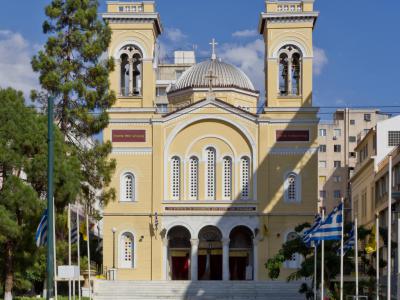
It has a striking profile of a quartet of Corinthian columns supporting a pediment and crowned with a pair of bell towers. Pleasantly adorned in light hues, a semi-dome at the entrance is ornate in pale blue. It dates from the 1840s.
The church of Saint Paul was designed by the German architect Eduard Schaubert in 1838, while modifications to the original design were made by Theofil Hansen and C. Lorenzen, who supervised the building. It was built on a plot of land granted by the donations of believers and the help of the Austrian consul Prokesch von Osten in Greece. The building has a rectangular plan, with dimensions 19.35 m. X 9.20 m. It has a wooden roof, built in 1896, when the front of the church was extended. The facade, on Filonos Street, has a pediment with two belfries and pilasters of Corinthian order. ***PH***
It has a striking profile of a quartet of Corinthian columns supporting a pediment and crowned with a pair of bell towers. Pleasantly adorned in light hues, a semi-dome at the entrance is ornate in pale blue. It dates from the 1840s.
The church of Saint Paul was designed by the German architect Eduard Schaubert in 1838, while modifications to the original design were made by Theofil Hansen and C. Lorenzen, who supervised the building. It was built on a plot of land granted by the donations of believers and the help of the Austrian consul Prokesch von Osten in Greece. The building has a rectangular plan, with dimensions 19.35 m. X 9.20 m. It has a wooden roof, built in 1896, when the front of the church was extended. The facade, on Filonos Street, has a pediment with two belfries and pilasters of Corinthian order. ***PH***
Want to visit this sight? Check out these Self-Guided Walking Tours in Piraeus. Alternatively, you can download the mobile app "GPSmyCity: Walks in 1K+ Cities" from Apple App Store or Google Play Store. The app turns your mobile device to a personal tour guide and it works offline, so no data plan is needed when traveling abroad.
Download The GPSmyCity App



Catholic Church of St. Paul on Map
Sight Name: Catholic Church of St. Paul
Sight Location: Piraeus, Greece (See walking tours in Piraeus)
Sight Type: Religious
Sight Location: Piraeus, Greece (See walking tours in Piraeus)
Sight Type: Religious
Nearby Sights

Walking Tours in Piraeus, Greece

Create Your Own Walk in Piraeus
Creating your own self-guided walk in Piraeus is easy and fun. Choose the city attractions that you want to see and a walk route map will be created just for you. You can even set your hotel as the start point of the walk.
Piraeus Introduction Walking Tour
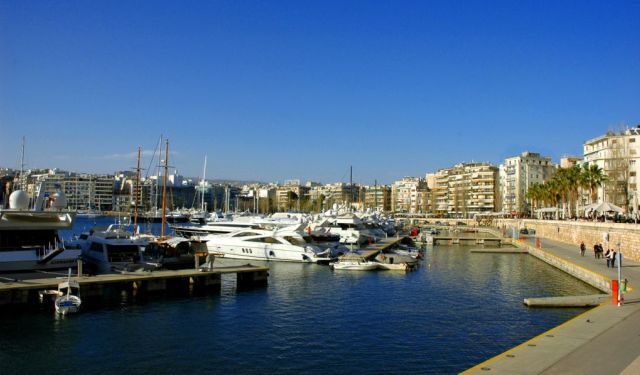
When most people hear “Piraeus,” they picture the buzzing ferry terminals, the gateway to Greece’s famous islands. But for the locals, it’s so much more than a jumping-off point. This port-Greece’s largest-has been at the center of maritime life for centuries. Its name traces back to a phrase meaning “place over the passage” or “ferryman.” It’s the place where Athens and the... view more
Tour Duration: 2 Hour(s)
Travel Distance: 3.5 Km or 2.2 Miles
Tour Duration: 2 Hour(s)
Travel Distance: 3.5 Km or 2.2 Miles