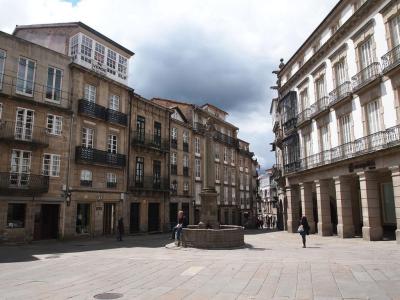


Cervantes Square (Plaza de Cervantes), Santiago de Compostela
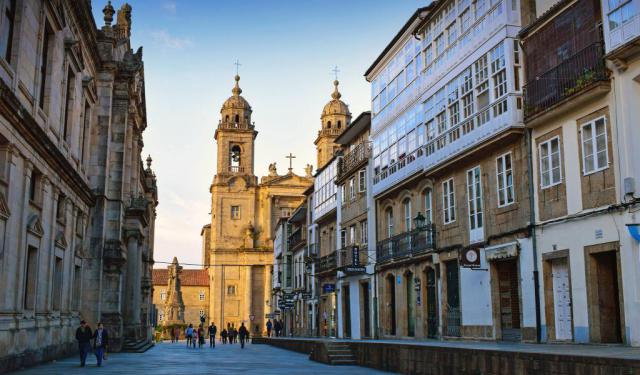
Cervantes Square, located in the heart of the city, holds a rich history that dates back to the 12th century. Originally known as the "Forum," it served as a bustling meeting place where the town crier would gather to read out municipal agreements and the archbishop's regulations.
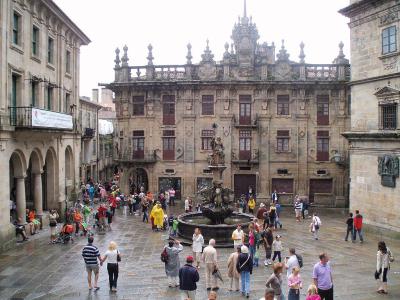
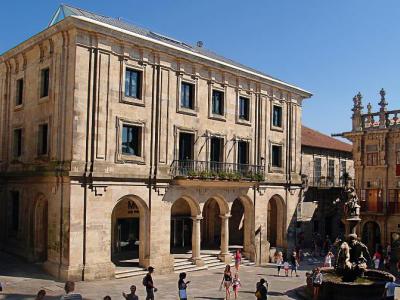
One of the prominent features of Cervantes Square is the baroque building that stands proudly at its corner. Erected in 1682, this building served as the old Town Hall for approximately two centuries, from 1583 until it was relocated to Palacio de Raxoi in 1787. Remarkably, it remains the only intact baroque municipal building in Galicia. A recent interior restoration has unveiled fascinating elements such as old writing desks, an oratory, the archive, and even the dungeons, giving visitors a glimpse into the historical significance of the space. Autos-da-fé, public acts of faith of the Inquisition, were known to take place in the square.
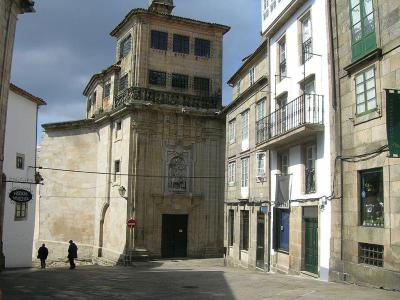
Over time the square became a hub for the sale of foodstuffs and goods, leading to its renaming as "Plaza del Campo" or "Main Market Square." The Church of San Bieito do Campo, situated nearby, shares this name. Though the church's neoclassical facade may deceive modern visitors, its foundation can be traced back to the 10th century, representing a long-standing religious presence within the square.
In the 19th century, the market was relocated to Plaza de Abastos, allowing the square to acquire its current name, Plaza de Cervantes. A bust of the renowned writer, Miguel de Cervantes, crowns the square's fountain, serving as a reminder of his association with Galicia through his surnames, Cervantes and Saavedra. Cervantes, famous for his masterpiece "Don Quijote," holds a significant place in Spanish literature, making the square a symbolic tribute to his legacy.
One of the prominent features of Cervantes Square is the baroque building that stands proudly at its corner. Erected in 1682, this building served as the old Town Hall for approximately two centuries, from 1583 until it was relocated to Palacio de Raxoi in 1787. Remarkably, it remains the only intact baroque municipal building in Galicia. A recent interior restoration has unveiled fascinating elements such as old writing desks, an oratory, the archive, and even the dungeons, giving visitors a glimpse into the historical significance of the space. Autos-da-fé, public acts of faith of the Inquisition, were known to take place in the square.
Over time the square became a hub for the sale of foodstuffs and goods, leading to its renaming as "Plaza del Campo" or "Main Market Square." The Church of San Bieito do Campo, situated nearby, shares this name. Though the church's neoclassical facade may deceive modern visitors, its foundation can be traced back to the 10th century, representing a long-standing religious presence within the square.
In the 19th century, the market was relocated to Plaza de Abastos, allowing the square to acquire its current name, Plaza de Cervantes. A bust of the renowned writer, Miguel de Cervantes, crowns the square's fountain, serving as a reminder of his association with Galicia through his surnames, Cervantes and Saavedra. Cervantes, famous for his masterpiece "Don Quijote," holds a significant place in Spanish literature, making the square a symbolic tribute to his legacy.
Want to visit this sight? Check out these Self-Guided Walking Tours in Santiago de Compostela. Alternatively, you can download the mobile app "GPSmyCity: Walks in 1K+ Cities" from Apple App Store or Google Play Store. The app turns your mobile device to a personal tour guide and it works offline, so no data plan is needed when traveling abroad.
Download The GPSmyCity App



Cervantes Square (Plaza de Cervantes) on Map
Sight Name: Cervantes Square (Plaza de Cervantes)
Sight Location: Santiago de Compostela, Spain (See walking tours in Santiago de Compostela)
Sight Type: Attraction/Landmark
Sight Location: Santiago de Compostela, Spain (See walking tours in Santiago de Compostela)
Sight Type: Attraction/Landmark
Nearby Sights

Walking Tours in Santiago de Compostela, Spain

Create Your Own Walk in Santiago de Compostela
Creating your own self-guided walk in Santiago de Compostela is easy and fun. Choose the city attractions that you want to see and a walk route map will be created just for you. You can even set your hotel as the start point of the walk.
Santiago de Compostela Introduction Walking Tour
Legend has it that after Saint James, one of the Twelve Apostles of Jesus, was martyred in Jerusalem in 44 AD, his followers carried his decapitated body by sea to Spain. Others claim that the saintly remains were miraculously taken up by angels and sailed to the coast of Galicia, where a massive rock closed around it and was later moved to its final resting place.
Either way, during the... view more
Tour Duration: 2 Hours
Travel Distance: 1.7 Km or 1.1 Miles
Either way, during the... view more
Tour Duration: 2 Hours
Travel Distance: 1.7 Km or 1.1 Miles