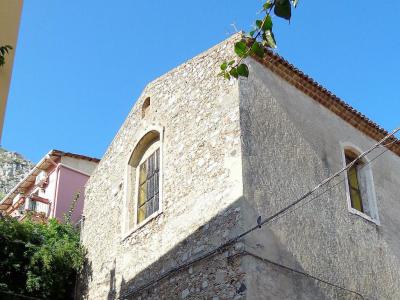


Chiesa della Visitazione (Church of the Visitation), Taormina
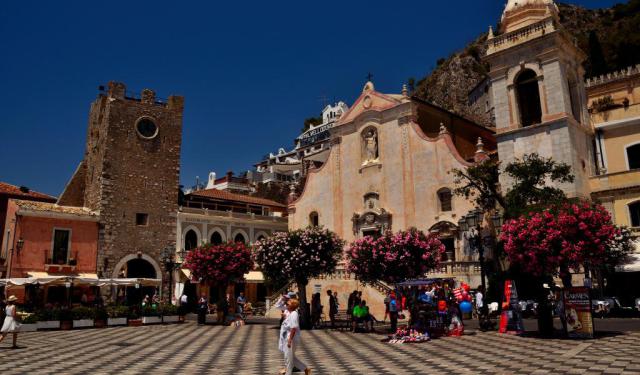
Just past the iconic Clock Tower, stands the Church of the Visitation-a small but richly storied church whose origins trace back centuries, possibly replacing a Romanesque predecessor. Inside, a hidden crypt hints at even earlier Christian roots, when clandestine worship found refuge beneath the streets of Taormina.
Externally, the church presents a sober medieval profile, with a portal crafted from rugged Taormina stone and accented by a window framed in Syracuse stone-an understated facade that contrasts with its surprisingly ornate interior. Rising modestly behind is the diminutive bell tower, elegantly integrated into the northeast corner of the structure, supported by twin arches-visual testimony to centuries of careful adaptation.
Stepping inside, visitors encounter a single nave lined with intricately decorated stucco altars. Each minor altar echoes the next, featuring twisted columns with finely sculpted reliefs, Corinthian capitals, split-arched tympanums adorned with cherubic finials, and richly patterned fabric antependia-collectively creating an interior screen-like effect of delicate artistry. The sense of refinement continues in the elevated presbytery, separated by a marble balustrade and dominated by a 1699 fresco titled “Triumph of the Cross” by Vincenzo Tuccari, surrounded by lush stucco work, cherubs, and volute motifs.
It is deeply embedded in Taormina’s religious traditions-especially during Holy Week, when the congregation of the Madonna Addolorata, gathers here to begin one of the town’s most evocative processions. Young women, in ceremonial black, carry the statue of the Madonna Addolorata, setting out in silence through torch‑lit streets.
Externally, the church presents a sober medieval profile, with a portal crafted from rugged Taormina stone and accented by a window framed in Syracuse stone-an understated facade that contrasts with its surprisingly ornate interior. Rising modestly behind is the diminutive bell tower, elegantly integrated into the northeast corner of the structure, supported by twin arches-visual testimony to centuries of careful adaptation.
Stepping inside, visitors encounter a single nave lined with intricately decorated stucco altars. Each minor altar echoes the next, featuring twisted columns with finely sculpted reliefs, Corinthian capitals, split-arched tympanums adorned with cherubic finials, and richly patterned fabric antependia-collectively creating an interior screen-like effect of delicate artistry. The sense of refinement continues in the elevated presbytery, separated by a marble balustrade and dominated by a 1699 fresco titled “Triumph of the Cross” by Vincenzo Tuccari, surrounded by lush stucco work, cherubs, and volute motifs.
It is deeply embedded in Taormina’s religious traditions-especially during Holy Week, when the congregation of the Madonna Addolorata, gathers here to begin one of the town’s most evocative processions. Young women, in ceremonial black, carry the statue of the Madonna Addolorata, setting out in silence through torch‑lit streets.
Want to visit this sight? Check out these Self-Guided Walking Tours in Taormina. Alternatively, you can download the mobile app "GPSmyCity: Walks in 1K+ Cities" from Apple App Store or Google Play Store. The app turns your mobile device to a personal tour guide and it works offline, so no data plan is needed when traveling abroad.
Download The GPSmyCity App



Chiesa della Visitazione (Church of the Visitation) on Map
Sight Name: Chiesa della Visitazione (Church of the Visitation)
Sight Location: Taormina, Italy (See walking tours in Taormina)
Sight Type: Religious
Sight Location: Taormina, Italy (See walking tours in Taormina)
Sight Type: Religious
Nearby Sights




Walking Tours in Taormina, Italy

Create Your Own Walk in Taormina
Creating your own self-guided walk in Taormina is easy and fun. Choose the city attractions that you want to see and a walk route map will be created just for you. You can even set your hotel as the start point of the walk.
Taormina Introduction Walking Tour
In 396 BC, the notorious tyrant Dionysius I of Syracuse instructed his commander Andromachus to establish a settlement at the foot of Mount Etna. This came after Dionysius had destroyed the ancient Greek city of Naxos, leaving its displaced inhabitants in need of a new home. The settlement's original name, Tauromenion, meaning “dwelling on the Taurus,” referred to the nearby mountain... view more
Tour Duration: 2 Hour(s)
Travel Distance: 2.0 Km or 1.2 Miles
Tour Duration: 2 Hour(s)
Travel Distance: 2.0 Km or 1.2 Miles