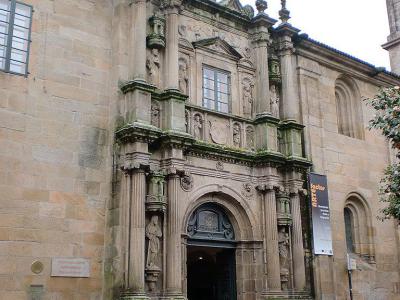


Colegio de Fonseca (Fonseca College), Santiago de Compostela
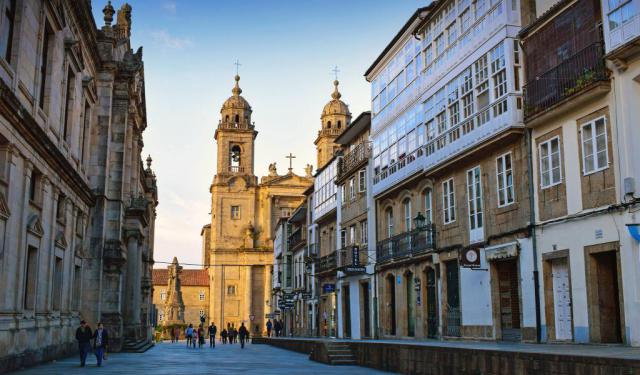
Fonseca College is a historic building associated with the University of Santiago de Compostela. The origins of Fonseca College date back to the 16th century when Archbishop Alonso III de Fonseca gathered the dispersed studia, creating a centralized educational institution. He utilized his family's old house as the initial nucleus for the college. The construction of the building took place between 1522 and 1544, with Juan de Álava designing the plans under the supervision of Alonso de Covarrubias. The construction was later carried out by Alonso de Guntín and Jácome García. The façade, completed in 1688 by Diego de Romay, is a later addition.
In 2015, when the Camino de Santiago in Spain was expanded and recognized by UNESCO as "Caminos de Santiago de Compostela: French Camino and Caminos del Norte de España," Fonseca College was included as an associated element in the retrospective inventory.
The Plateresque-style façade of Fonseca College consists of two sections. It features the Fonseca coat of arms and sculptures of the Doctors of the Church. Diego de Romay, the architect responsible for the completion of the façade, incorporated enigmatic dragon motifs that some authors associate with Mayan-inspired images.
Upon entering the building, visitors are greeted by a vestibule with a ribbed vault. To the left of the vestibule is the Mudejar coffered ceiling room, known as the Salón de Grados, which was once used as a refectory. Adjacent to it is the Gothic chapel, also designed by Diego de Romay, which now serves as an exhibition hall.
The central courtyard of Fonseca College is surrounded by a Plateresque-style cloister, designed by Gil de Hontañón. The intricate architectural details of the cloister contribute to the overall beauty of the college.
In 2015, when the Camino de Santiago in Spain was expanded and recognized by UNESCO as "Caminos de Santiago de Compostela: French Camino and Caminos del Norte de España," Fonseca College was included as an associated element in the retrospective inventory.
The Plateresque-style façade of Fonseca College consists of two sections. It features the Fonseca coat of arms and sculptures of the Doctors of the Church. Diego de Romay, the architect responsible for the completion of the façade, incorporated enigmatic dragon motifs that some authors associate with Mayan-inspired images.
Upon entering the building, visitors are greeted by a vestibule with a ribbed vault. To the left of the vestibule is the Mudejar coffered ceiling room, known as the Salón de Grados, which was once used as a refectory. Adjacent to it is the Gothic chapel, also designed by Diego de Romay, which now serves as an exhibition hall.
The central courtyard of Fonseca College is surrounded by a Plateresque-style cloister, designed by Gil de Hontañón. The intricate architectural details of the cloister contribute to the overall beauty of the college.
Want to visit this sight? Check out these Self-Guided Walking Tours in Santiago de Compostela. Alternatively, you can download the mobile app "GPSmyCity: Walks in 1K+ Cities" from Apple App Store or Google Play Store. The app turns your mobile device to a personal tour guide and it works offline, so no data plan is needed when traveling abroad.
Download The GPSmyCity App



Colegio de Fonseca (Fonseca College) on Map
Sight Name: Colegio de Fonseca (Fonseca College)
Sight Location: Santiago de Compostela, Spain (See walking tours in Santiago de Compostela)
Sight Type: Attraction/Landmark
Sight Location: Santiago de Compostela, Spain (See walking tours in Santiago de Compostela)
Sight Type: Attraction/Landmark
Nearby Sights

Walking Tours in Santiago de Compostela, Spain

Create Your Own Walk in Santiago de Compostela
Creating your own self-guided walk in Santiago de Compostela is easy and fun. Choose the city attractions that you want to see and a walk route map will be created just for you. You can even set your hotel as the start point of the walk.
Santiago de Compostela Introduction Walking Tour
Legend has it that after Saint James, one of the Twelve Apostles of Jesus, was martyred in Jerusalem in 44 AD, his followers carried his decapitated body by sea to Spain. Others claim that the saintly remains were miraculously taken up by angels and sailed to the coast of Galicia, where a massive rock closed around it and was later moved to its final resting place.
Either way, during the... view more
Tour Duration: 2 Hour(s)
Travel Distance: 1.7 Km or 1.1 Miles
Either way, during the... view more
Tour Duration: 2 Hour(s)
Travel Distance: 1.7 Km or 1.1 Miles