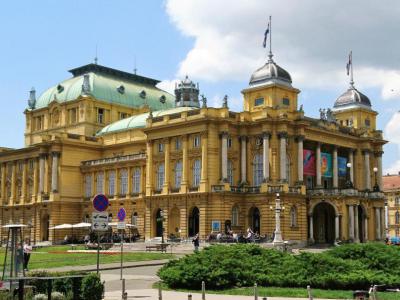


Croatian National Theater, Zagreb
The Croatian National Theater in Zagreb stands as one of the city’s principal cultural landmarks and a leading institution for drama, opera, and ballet. Its origins date back to 1834, when the first city theatre was established in what is now the Old City Hall. It officially became the Croatian National Theatre in 1860 and gained government support the following year, aligning it with other major European national theatres.
The current building, opened in 1895 during the era of the Austro-Hungarian Empire, was inaugurated in the presence of Franz Joseph I. It was designed by the Viennese architects Fellner & Helmer, known for their theatre designs across Central Europe. Over the decades, as Zagreb expanded, the structure itself became a crown jewel of the city’s Green Horseshoe parks.
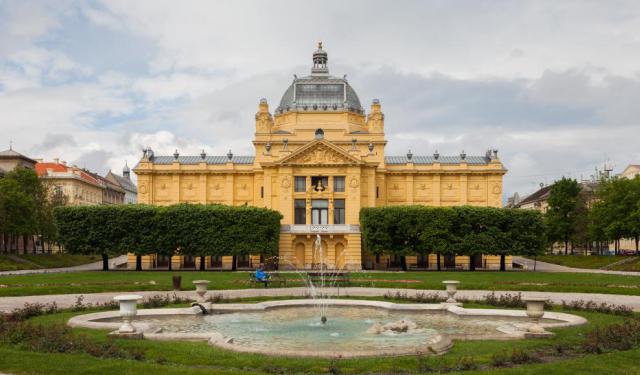
The structure is an example of Neo-Baroque architecture, defined by its symmetrical façade, decorative ornamentation, and prominent central entrance. Its bright yellow exterior makes it a focal point within the surrounding square. The first highlight, the fountain “The Well of Life,” is located directly in front of the theatre. To find it, stand at the base of the main entrance steps and look down into the circular bronze basin created in 1905 by Ivan Meštrović; look for the ten figures representing the different stages of life as they cling to the water’s edge.
Inside, the richly decorated auditorium, with its red and gold tones and painted ceiling, reflects late 19th-century design. The central focal point is the Ceremonial Curtain, located on the main stage. Once you find yourself inside the hall, look for Vlaho Bukovac’s masterpiece titled The Reformation of Croatian Literature and Art, which depicts famous 19th-century cultural figures. Directly opposite the stage, find the final highlight: the Emperor’s Box. Look for the most ornate, centrally positioned balcony in the first tier, which still features the plush gold and red velvet reserved for royalty since the building’s opening.
The theatre continues to host a wide program of performances. Visitors should note that access to the auditorium is usually restricted during rehearsals and performances, so checking guided tour times or performance schedules in advance is advisable.
The current building, opened in 1895 during the era of the Austro-Hungarian Empire, was inaugurated in the presence of Franz Joseph I. It was designed by the Viennese architects Fellner & Helmer, known for their theatre designs across Central Europe. Over the decades, as Zagreb expanded, the structure itself became a crown jewel of the city’s Green Horseshoe parks.
The structure is an example of Neo-Baroque architecture, defined by its symmetrical façade, decorative ornamentation, and prominent central entrance. Its bright yellow exterior makes it a focal point within the surrounding square. The first highlight, the fountain “The Well of Life,” is located directly in front of the theatre. To find it, stand at the base of the main entrance steps and look down into the circular bronze basin created in 1905 by Ivan Meštrović; look for the ten figures representing the different stages of life as they cling to the water’s edge.
Inside, the richly decorated auditorium, with its red and gold tones and painted ceiling, reflects late 19th-century design. The central focal point is the Ceremonial Curtain, located on the main stage. Once you find yourself inside the hall, look for Vlaho Bukovac’s masterpiece titled The Reformation of Croatian Literature and Art, which depicts famous 19th-century cultural figures. Directly opposite the stage, find the final highlight: the Emperor’s Box. Look for the most ornate, centrally positioned balcony in the first tier, which still features the plush gold and red velvet reserved for royalty since the building’s opening.
The theatre continues to host a wide program of performances. Visitors should note that access to the auditorium is usually restricted during rehearsals and performances, so checking guided tour times or performance schedules in advance is advisable.
Want to visit this sight? Check out these Self-Guided Walking Tours in Zagreb. Alternatively, you can download the mobile app "GPSmyCity: Walks in 1K+ Cities" from Apple App Store or Google Play Store. The app turns your mobile device to a personal tour guide and it works offline, so no data plan is needed when traveling abroad.
Download The GPSmyCity App



Croatian National Theater on Map
Sight Name: Croatian National Theater
Sight Location: Zagreb, Croatia (See walking tours in Zagreb)
Sight Type: Attraction/Landmark
Guide(s) Containing This Sight:
Sight Location: Zagreb, Croatia (See walking tours in Zagreb)
Sight Type: Attraction/Landmark
Guide(s) Containing This Sight:
Nearby Sights

Walking Tours in Zagreb, Croatia

Create Your Own Walk in Zagreb
Creating your own self-guided walk in Zagreb is easy and fun. Choose the city attractions that you want to see and a walk route map will be created just for you. You can even set your hotel as the start point of the walk.
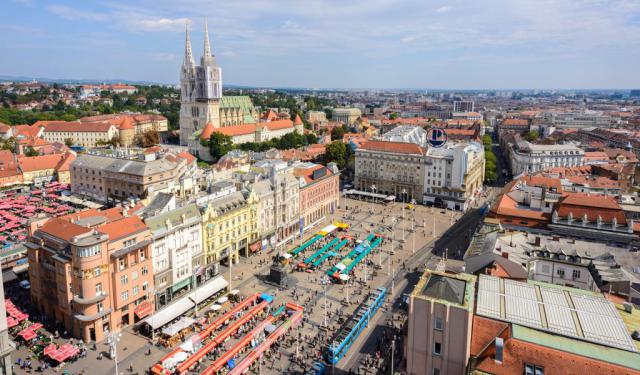
Zagreb Upper Town Walking Tour
Zagreb’s Upper Town forms the historic core of the city, rising on a hill above the modern lower districts. The name reflects its elevated position, distinguishing it from Lower Town, which developed later on the plains below. The wider area, however, has much older roots: nearby stood Andautonia, a Roman settlement that points to early habitation in the region. The name “Zagreb” itself... view more
Tour Duration: 1 Hour
Travel Distance: 1.8 Km or 1.1 Miles
Tour Duration: 1 Hour
Travel Distance: 1.8 Km or 1.1 Miles
Zagreb Lower Town Walking Tour
Zagreb’s Lower Town forms one of the two main districts in the historic heart of the Croatian capital, alongside the Upper Town. As its name suggests, it lies below the older hilltop settlements of Gradec and Kaptol. While those medieval centers developed organically on elevated ground, the Lower Town is the more modern of the two, shaped through deliberate urban planning during the late 19th... view more
Tour Duration: 2 Hours
Travel Distance: 2.5 Km or 1.6 Miles
Tour Duration: 2 Hours
Travel Distance: 2.5 Km or 1.6 Miles