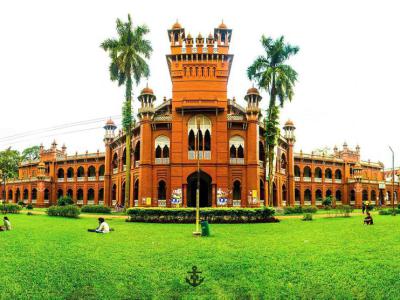
Curzon Hall, Dhaka
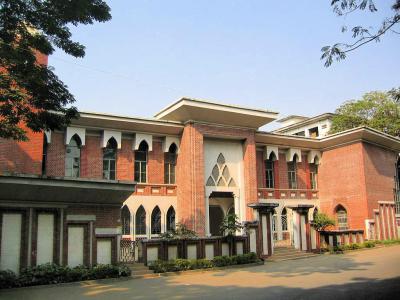
Curzon Hall, originally intended as a town hall, bears the name of Lord Curzon, the Viceroy of India, who laid its foundation in 1904. Its history intertwines with the shifts in governance and education in the region. Following Bengal's partition in 1905 and subsequent annulment in 1911, it found varied uses, eventually becoming part of Dhaka University's science section in 1921, where it remains today. Set within a well-maintained garden, this two-story brick structure features a spacious central hall, flanked by wings and verandas on all sides.
This architectural gem showcases a harmonious fusion of European and Mughal influences, evident in its northern facade adorned with horse-shoe and cusped arches. Its design, blending traditional art with modern functionality, reflects a transition in power dynamics post the 1857 Sepoy Revolt, as India came directly under British rule. The building's red hue, ornate brackets, deep eaves, and domed terrace pavilions evoke parallels with the architectural style of Fatehpur Sikri, Emperor Akbar's capital, symbolizing the British quest for legitimacy through association with the Mughals.
This architectural gem showcases a harmonious fusion of European and Mughal influences, evident in its northern facade adorned with horse-shoe and cusped arches. Its design, blending traditional art with modern functionality, reflects a transition in power dynamics post the 1857 Sepoy Revolt, as India came directly under British rule. The building's red hue, ornate brackets, deep eaves, and domed terrace pavilions evoke parallels with the architectural style of Fatehpur Sikri, Emperor Akbar's capital, symbolizing the British quest for legitimacy through association with the Mughals.
Curzon Hall on Map
Sight Name: Curzon Hall
Sight Location: Dhaka, Bangladesh (See walking tours in Dhaka)
Sight Type: Attraction/Landmark
Sight Location: Dhaka, Bangladesh (See walking tours in Dhaka)
Sight Type: Attraction/Landmark
Nearby Sights

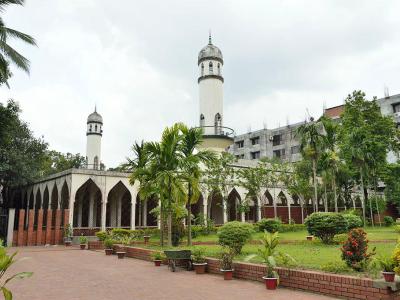
Dhaka University Mosque
Sight description based on Wikipedia.
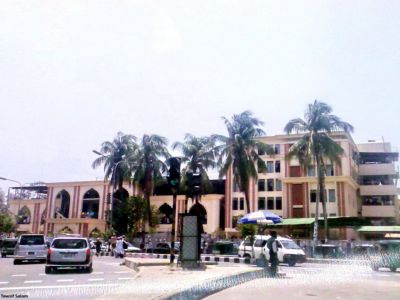
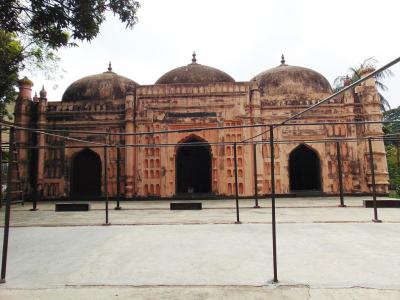
Kakrail Mosque
Sight description based on Wikipedia.
City Walks Overview
