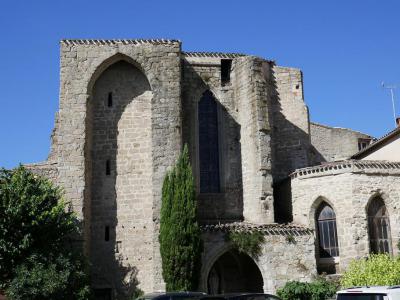


Eglise des Carmes (Carmelite Church), Carcassonne
The Carmelite Church (Eglise des Carmes) in Carcassonne is a historic Gothic landmark tucked away near the bustling streets of the Bastide area, close to the Canal du Midi. Dating back to the late 13th century, this ancient chapel, once part of a Carmelite convent, embodies the Mediterranean Gothic style, closely mirroring the layouts of the Cathedral of Saint Michael and Saint Vincent Church. Its single nave, measuring 12.8 meters wide and 17 meters long, is bordered by ten small chapels that exude a sense of intimacy and tranquility.
Though modest in overall design, the church is adorned with captivating details. Among its highlights are lovely stained-glass windows, delicately leaf-decorated capitals, and a series of statues, including depictions of Saint John of the Cross and Saint Teresa of Avila, illustrating the spiritual journey of the Carmelite order. The interior also features murals from the 19th century by Marius Engalhiere, a disciple of Viollet-le-Duc, with notable works such as a fresco of the Virgin Mary in tears.
The Carmelite convent endured upheaval during the French Revolution, its church was repurposed as a barn. Partial restoration in the 19th century saw some chapels demolished and converted into shops. Despite this, the church preserves 15th-century fresco remnants and tombs of prominent Carcassonne families, some now housed in Toulouse's Augustinian Museum.
The 14th-century wooden roof framework and painted woodwork remain intact, with plans to restore visibility. The Blessed Sacrament Chapel, formerly a Carmelite scapular chapel, preserves 15th-16th century fresco fragments. Despite partial dismantling, the cloister retains 17th-century arches and offers views of the fortified bell tower, damaged during the Revolution.
A vibrant stained-glass window by Gerard Million in the choir represents Elijah on his chariot of fire, a symbolic image central to Carmelite spirituality. The entrance hall features restored 17th-century wood paneling, a painting of Saint Vincent in his dungeon, and a large doorway bearing the Carmelite arms.
The Carmelite Church continues to be a hidden gem of Carcassonne, combining a rich historical legacy with understated beauty, and inviting visitors to uncover its layers of artistic and architectural significance.
Though modest in overall design, the church is adorned with captivating details. Among its highlights are lovely stained-glass windows, delicately leaf-decorated capitals, and a series of statues, including depictions of Saint John of the Cross and Saint Teresa of Avila, illustrating the spiritual journey of the Carmelite order. The interior also features murals from the 19th century by Marius Engalhiere, a disciple of Viollet-le-Duc, with notable works such as a fresco of the Virgin Mary in tears.
The Carmelite convent endured upheaval during the French Revolution, its church was repurposed as a barn. Partial restoration in the 19th century saw some chapels demolished and converted into shops. Despite this, the church preserves 15th-century fresco remnants and tombs of prominent Carcassonne families, some now housed in Toulouse's Augustinian Museum.
The 14th-century wooden roof framework and painted woodwork remain intact, with plans to restore visibility. The Blessed Sacrament Chapel, formerly a Carmelite scapular chapel, preserves 15th-16th century fresco fragments. Despite partial dismantling, the cloister retains 17th-century arches and offers views of the fortified bell tower, damaged during the Revolution.
A vibrant stained-glass window by Gerard Million in the choir represents Elijah on his chariot of fire, a symbolic image central to Carmelite spirituality. The entrance hall features restored 17th-century wood paneling, a painting of Saint Vincent in his dungeon, and a large doorway bearing the Carmelite arms.
The Carmelite Church continues to be a hidden gem of Carcassonne, combining a rich historical legacy with understated beauty, and inviting visitors to uncover its layers of artistic and architectural significance.
Want to visit this sight? Check out these Self-Guided Walking Tours in Carcassonne. Alternatively, you can download the mobile app "GPSmyCity: Walks in 1K+ Cities" from Apple App Store or Google Play Store. The app turns your mobile device to a personal tour guide and it works offline, so no data plan is needed when traveling abroad.
Download The GPSmyCity App



Eglise des Carmes (Carmelite Church) on Map
Sight Name: Eglise des Carmes (Carmelite Church)
Sight Location: Carcassonne, France (See walking tours in Carcassonne)
Sight Type: Religious
Sight Location: Carcassonne, France (See walking tours in Carcassonne)
Sight Type: Religious
Nearby Sights


Walking Tours in Carcassonne, France

Create Your Own Walk in Carcassonne
Creating your own self-guided walk in Carcassonne is easy and fun. Choose the city attractions that you want to see and a walk route map will be created just for you. You can even set your hotel as the start point of the walk.
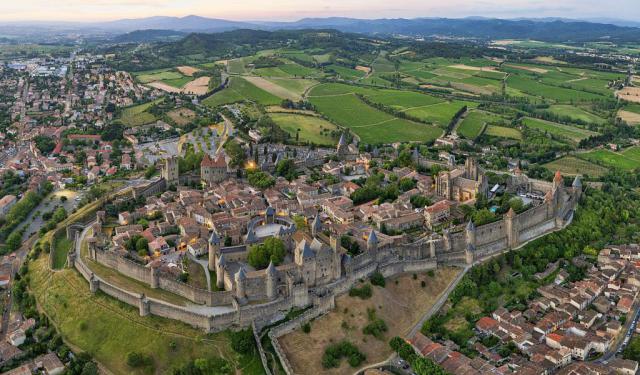
Discover Carcassonne City Center on Foot
Nestled in the picturesque region of Occitanie in southern France is the captivating city of Carcassonne.
The name "Carcassonne" is believed to have originated from the Gallic word "Carsac," referring to a fort settlement that was later fortified by the Romans who occupied the area in the 1st century BC.
A legend suggests another, more colorful version of the name,... view more
Tour Duration: 1 Hour(s)
Travel Distance: 1.9 Km or 1.2 Miles
The name "Carcassonne" is believed to have originated from the Gallic word "Carsac," referring to a fort settlement that was later fortified by the Romans who occupied the area in the 1st century BC.
A legend suggests another, more colorful version of the name,... view more
Tour Duration: 1 Hour(s)
Travel Distance: 1.9 Km or 1.2 Miles
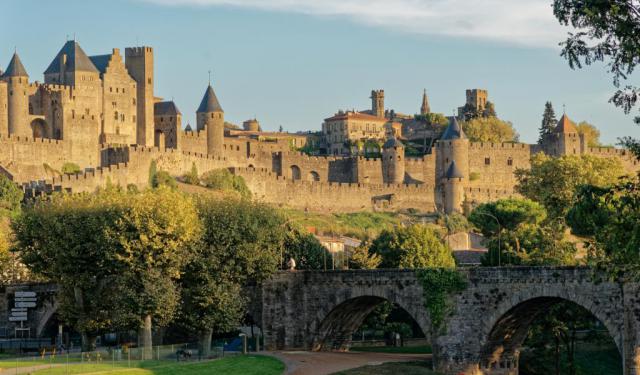
A Walk Through Carcassonne Medieval Hilltop Town
A pig full of wheat was thrown off the battlements. The lady commanding the fortress was a Muslim. The besieging Christians knew Muslims do not eat pig. What is more, the defenders must have plenty of food if they could feed wheat to a pig and throw it over the walls. The siege had lasted five years. The attackers were starving. They left.
Many stories are told about the fortified medieval... view more
Tour Duration: 1 Hour(s)
Travel Distance: 1.2 Km or 0.7 Miles
Many stories are told about the fortified medieval... view more
Tour Duration: 1 Hour(s)
Travel Distance: 1.2 Km or 0.7 Miles