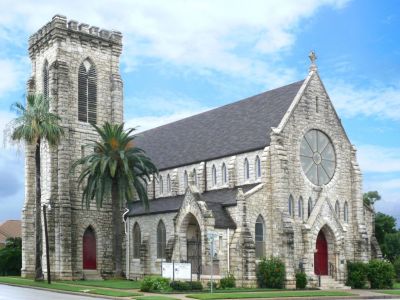


Grace Episcopal Church, Galveston
Grace Episcopal Church stands as a distinguished example of High Victorian Gothic architecture and carries a rich legacy dating back to the 19th century. Its roots trace to the 1840s when a mission Sunday School was established by the rector of Trinity Church to serve the growing suburban community. By 1876, the mission evolved into an independent parish-Grace Episcopal Church-and built its first sanctuary, a modest wooden structure at the corner of Avenue L and 36th Street.
The current stone church was made possible through a generous $30,000 donation from Galveston philanthropist Henry Rosenberg, whose contributions to the city are evident in numerous public institutions. The parish commissioned renowned architect Nicholas J. Clayton, who designed the new structure in the High Victorian Gothic style. Completed in 1895, the stone edifice replaced the original wooden chapel, which was relocated down the street. The new church, with its pointed arches, stained glass, and commanding architectural presence, became a spiritual and architectural landmark in the community.
Added to the National Register of Historic Places in 1975, Grace Episcopal Church remains an enduring symbol of faith, resilience, and artistic achievement. Its historical significance is deeply interwoven with Galveston’s development, and the church continues to serve as a place of worship and community gathering, honoring the legacy of those who built and supported it more than a century ago.
The current stone church was made possible through a generous $30,000 donation from Galveston philanthropist Henry Rosenberg, whose contributions to the city are evident in numerous public institutions. The parish commissioned renowned architect Nicholas J. Clayton, who designed the new structure in the High Victorian Gothic style. Completed in 1895, the stone edifice replaced the original wooden chapel, which was relocated down the street. The new church, with its pointed arches, stained glass, and commanding architectural presence, became a spiritual and architectural landmark in the community.
Added to the National Register of Historic Places in 1975, Grace Episcopal Church remains an enduring symbol of faith, resilience, and artistic achievement. Its historical significance is deeply interwoven with Galveston’s development, and the church continues to serve as a place of worship and community gathering, honoring the legacy of those who built and supported it more than a century ago.
Want to visit this sight? Check out these Self-Guided Walking Tours in Galveston. Alternatively, you can download the mobile app "GPSmyCity: Walks in 1K+ Cities" from Apple App Store or Google Play Store. The app turns your mobile device to a personal tour guide and it works offline, so no data plan is needed when traveling abroad.
Download The GPSmyCity App



Grace Episcopal Church on Map
Sight Name: Grace Episcopal Church
Sight Location: Galveston, USA (See walking tours in Galveston)
Sight Type: Religious
Sight Location: Galveston, USA (See walking tours in Galveston)
Sight Type: Religious
Nearby Sights




Walking Tours in Galveston, Texas

Create Your Own Walk in Galveston
Creating your own self-guided walk in Galveston is easy and fun. Choose the city attractions that you want to see and a walk route map will be created just for you. You can even set your hotel as the start point of the walk.
Historic Houses Walking Tour
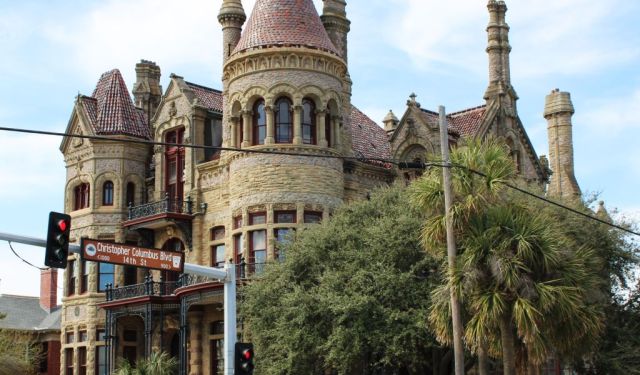
Galveston’s Broadway Avenue is a living corridor of architectural ambition, lined with grand homes that speak to the city’s Gilded Age past. Most of these stately mansions were built in the late 1800s and early 1900s, during a period when Galveston thrived as a key Gulf Coast port. Wealthy merchants, civic leaders, and industrialists commissioned elaborate residences here, hoping to place the... view more
Tour Duration: 2 Hours
Travel Distance: 2.5 Km or 1.6 Miles
Tour Duration: 2 Hours
Travel Distance: 2.5 Km or 1.6 Miles

Galveston Introduction Walking Tour
Galveston, perched on a barrier island along the Gulf Coast, holds a unique place in Texas history. Its modern chapter began in the early 1800s, when the infamous pirate Jean Lafitte set up a short-lived base here-driven out by the U.S. Navy in 1821. The city itself was officially founded in 1836, soon after Texas won independence from Mexico, and was named in honor of Spanish colonial governor... view more
Tour Duration: 2 Hours
Travel Distance: 3.5 Km or 2.2 Miles
Tour Duration: 2 Hours
Travel Distance: 3.5 Km or 2.2 Miles
City Walks Overview
