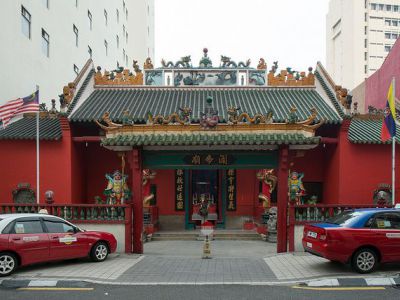


Guan Di Temple, Kuala Lumpur
Along Jalan Tun H.S.Lee, is a quiet temple built in honour of the Taoist God of War, Guan Di. Also known as Guan Yu, or General Kwan, Guan Di is widely worshipped by Chinese all over the world.
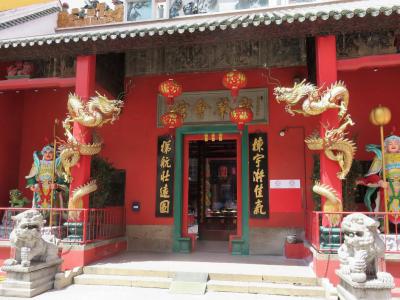
This Guan Di temple in Chinatown, Kuala Lumpur was built in 1888 and houses some idols made of wood, a rare occurrence in Chinese temples. After entering the small compound of the temple, you come across two fierce looking temple guards and formidable lions made of stone, to keep evil spirits at bay. Once you enter the temple, you are welcomed by the fragrance of the spiral incense sticks hanging from the ceiling. At the altar of Guan Di, you can find a gentle God of War sitting in a green robe. He holds his weapon, the vajra, in his right hand. Devotees pray to Guan Di for happiness and protection.
As per Chinese beliefs, touching a weapon such as a sword repeatedly brings good luck. Also, the bigger the weapon, the more is the luck it brings. Therefore, twice a year, devotees are allowed to touch Guan Di’s weapon. The 24th day of the 6th month of the Chinese calendar marks the feast of Guan Di, which is celebrated with great pomp every year at this temple. You can witness a variety of offerings and even a lion dance, if you visit the temple on this day.
This Guan Di temple in Chinatown, Kuala Lumpur was built in 1888 and houses some idols made of wood, a rare occurrence in Chinese temples. After entering the small compound of the temple, you come across two fierce looking temple guards and formidable lions made of stone, to keep evil spirits at bay. Once you enter the temple, you are welcomed by the fragrance of the spiral incense sticks hanging from the ceiling. At the altar of Guan Di, you can find a gentle God of War sitting in a green robe. He holds his weapon, the vajra, in his right hand. Devotees pray to Guan Di for happiness and protection.
As per Chinese beliefs, touching a weapon such as a sword repeatedly brings good luck. Also, the bigger the weapon, the more is the luck it brings. Therefore, twice a year, devotees are allowed to touch Guan Di’s weapon. The 24th day of the 6th month of the Chinese calendar marks the feast of Guan Di, which is celebrated with great pomp every year at this temple. You can witness a variety of offerings and even a lion dance, if you visit the temple on this day.
Want to visit this sight? Check out these Self-Guided Walking Tours in Kuala Lumpur. Alternatively, you can download the mobile app "GPSmyCity: Walks in 1K+ Cities" from Apple App Store or Google Play Store. The app turns your mobile device to a personal tour guide and it works offline, so no data plan is needed when traveling abroad.
Download The GPSmyCity App



Guan Di Temple on Map
Sight Name: Guan Di Temple
Sight Location: Kuala Lumpur, Malaysia (See walking tours in Kuala Lumpur)
Sight Type: Religious
Guide(s) Containing This Sight:
Sight Location: Kuala Lumpur, Malaysia (See walking tours in Kuala Lumpur)
Sight Type: Religious
Guide(s) Containing This Sight:
Nearby Sights

Walking Tours in Kuala Lumpur, Malaysia

Create Your Own Walk in Kuala Lumpur
Creating your own self-guided walk in Kuala Lumpur is easy and fun. Choose the city attractions that you want to see and a walk route map will be created just for you. You can even set your hotel as the start point of the walk.
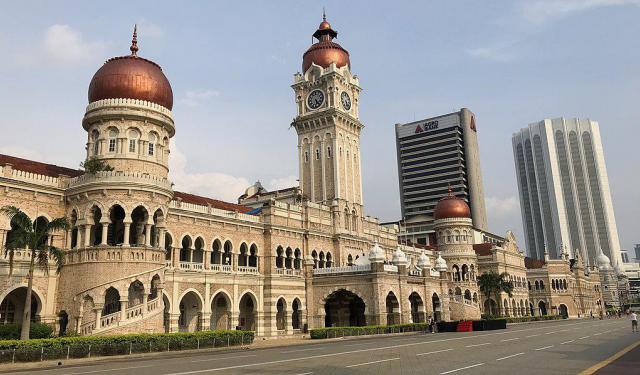
Historical Buildings Walking Tour
A city where even the buildings speak more than one language: look closely, and you’ll see it. Domes shaped by Islamic tradition, arches inspired by Mughal design, and symmetry rooted in European planning all stand side by side.
Kuala Lumpur’s historic buildings reflect the layered story of a city that grew from a rough tin-mining settlement into Malaysia’s capital. Founded in the... view more
Tour Duration: 2 Hour(s)
Travel Distance: 2.6 Km or 1.6 Miles
Kuala Lumpur’s historic buildings reflect the layered story of a city that grew from a rough tin-mining settlement into Malaysia’s capital. Founded in the... view more
Tour Duration: 2 Hour(s)
Travel Distance: 2.6 Km or 1.6 Miles
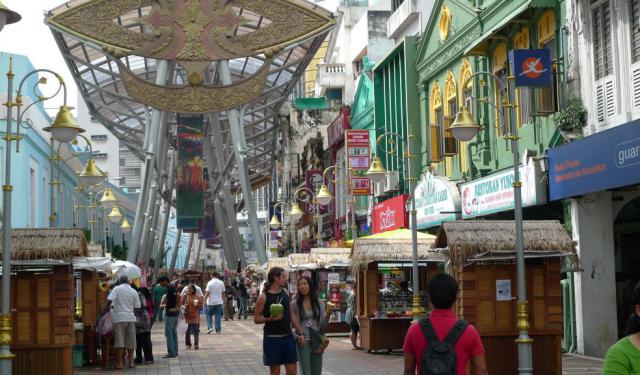
Kuala Lumpur Shopping Tour
Shopping is one of the top activities for those visiting Kuala Lumpur. In this vibrant city there’s something for every taste and budget, from high-end boutiques offering designer labels to the lively street markets drawing crowds with artsy finds and cheap reproductions, where cheap doesn’t necessarily mean a less enjoyable experience.
With a shopping scene as comprehensive as that of... view more
Tour Duration: 2 Hour(s)
Travel Distance: 3.6 Km or 2.2 Miles
With a shopping scene as comprehensive as that of... view more
Tour Duration: 2 Hour(s)
Travel Distance: 3.6 Km or 2.2 Miles
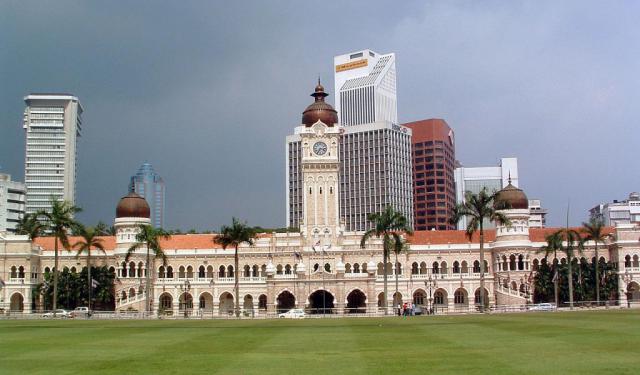
Kuala Lumpur Old Town Walking Tour
Kuala Lumpur, the capital of Malaysia, began as a modest frontier settlement shaped by geography and opportunity. Its name comes from the Malay words kuala and lumpur, together translating as “muddy confluence,” a reference to its location at the meeting point of the Klang and Gombak rivers.
The city’s origins date to the 1850s, when Chinese miners arrived in the area to exploit rich tin... view more
Tour Duration: 1 Hour(s)
Travel Distance: 1.4 Km or 0.9 Miles
The city’s origins date to the 1850s, when Chinese miners arrived in the area to exploit rich tin... view more
Tour Duration: 1 Hour(s)
Travel Distance: 1.4 Km or 0.9 Miles
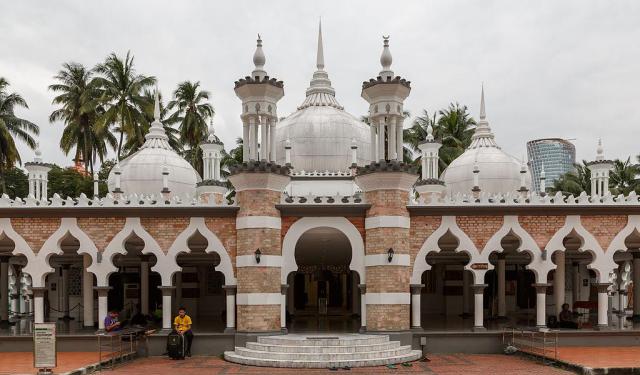
Historical Religious Buildings
Just as the whole of Malaysia, Kuala Lumpur is a culturally diverse and tolerant city where all of the world’s major religions coexist in perfect harmony. Back in the 1800s-early 1900s, along with the large influx of laborers and merchants of different backgrounds, brought in by the British colonization, came the unique sets of faiths and religious systems: Buddhism, Taoism, Hinduism,... view more
Tour Duration: 1 Hour(s)
Travel Distance: 2.0 Km or 1.2 Miles
Tour Duration: 1 Hour(s)
Travel Distance: 2.0 Km or 1.2 Miles
Useful Travel Guides for Planning Your Trip
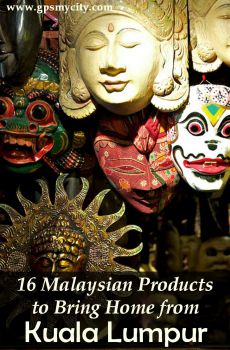
16 Malaysian Things to Buy as Souvenirs in Kuala Lumpur
"Malaysia, Truly Asia" is what you hear en route to Malaysia. Indeed, there's practically every bit of Asia to be found here, as the country's population is made up primarily of three groups: Malay, Chinese and Indians. Quite expectedly, the diversity of Malaysian handcrafts is...