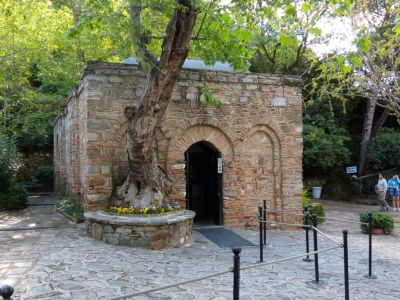


House of the Virgin Mary, Ephesus (must see)
Nestled on the slopes of Mount Nightingale, near the ancient ruins of Ephesus, the House of the Virgin Mary-known locally as Meryem Ana Evi-is a serene stone shrine that holds deep religious and historical significance. This modest, single-story dwelling is widely believed to have been the final earthly home of Mary, the mother of Jesus, where she spent her last years under the care of Saint John the Apostle. It is also thought by many to be the site of her Assumption into heaven. Unlike the grand structures of ancient Ephesus, such as the vast Temple of Artemis, the house is humble in size, yet immense in spiritual meaning.
The house is surrounded by the peaceful landscape of the Turkish countryside, hidden among olive, tangerine, and pomegranate trees. Visitors reach it by driving up a scenic road that winds through the hills above Selçuk and the ruins of Ephesus. As pilgrims and tourists walk the final path to the shrine, they leave behind the noise of the world and enter a place of tranquility and reverence. Just outside the house, a sacred fountain and a “wishing wall” allow visitors to collect holy water and leave written prayers or wishes-continuing a tradition rooted in local customs long before Islam or Christianity arrived in the region.
The site gained international recognition in 1896 when Pope Leo XIII declared it an official Catholic pilgrimage site. His successor, Pope Pius X, further affirmed its sacred status by granting a plenary indulgence to pilgrims who visit. Since then, several popes-including Paul VI, John Paul II, and Benedict XVI-have visited the site, offering masses and gifts to honor the Virgin Mary. Pope Paul VI’s 1967 visit, for instance, included the gift of a bronze lamp, and John Paul II celebrated mass there in 1979 before thousands of faithful. These papal visits have significantly raised the shrine’s profile in the Catholic world.
Beyond religious devotion, the House of the Virgin Mary draws visitors of all backgrounds who are curious about its mysterious origins and its place in the tapestry of Anatolian history. While the precise historical evidence of Mary’s residence here is debated, the connection to early Christian traditions and the region’s rich cultural backdrop make it a compelling destination.
The house is surrounded by the peaceful landscape of the Turkish countryside, hidden among olive, tangerine, and pomegranate trees. Visitors reach it by driving up a scenic road that winds through the hills above Selçuk and the ruins of Ephesus. As pilgrims and tourists walk the final path to the shrine, they leave behind the noise of the world and enter a place of tranquility and reverence. Just outside the house, a sacred fountain and a “wishing wall” allow visitors to collect holy water and leave written prayers or wishes-continuing a tradition rooted in local customs long before Islam or Christianity arrived in the region.
The site gained international recognition in 1896 when Pope Leo XIII declared it an official Catholic pilgrimage site. His successor, Pope Pius X, further affirmed its sacred status by granting a plenary indulgence to pilgrims who visit. Since then, several popes-including Paul VI, John Paul II, and Benedict XVI-have visited the site, offering masses and gifts to honor the Virgin Mary. Pope Paul VI’s 1967 visit, for instance, included the gift of a bronze lamp, and John Paul II celebrated mass there in 1979 before thousands of faithful. These papal visits have significantly raised the shrine’s profile in the Catholic world.
Beyond religious devotion, the House of the Virgin Mary draws visitors of all backgrounds who are curious about its mysterious origins and its place in the tapestry of Anatolian history. While the precise historical evidence of Mary’s residence here is debated, the connection to early Christian traditions and the region’s rich cultural backdrop make it a compelling destination.
Want to visit this sight? Check out these Self-Guided Walking Tours in Ephesus. Alternatively, you can download the mobile app "GPSmyCity: Walks in 1K+ Cities" from Apple App Store or Google Play Store. The app turns your mobile device to a personal tour guide and it works offline, so no data plan is needed when traveling abroad.
Download The GPSmyCity App



House of the Virgin Mary on Map
Sight Name: House of the Virgin Mary
Sight Location: Ephesus, Turkey (See walking tours in Ephesus)
Sight Type: Attraction/Landmark
Sight Location: Ephesus, Turkey (See walking tours in Ephesus)
Sight Type: Attraction/Landmark
Nearby Sights
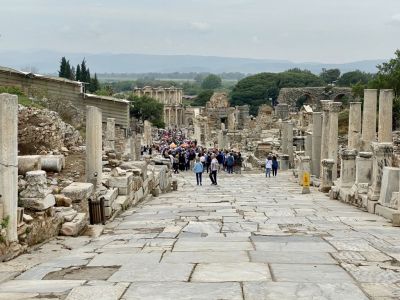
Walking Tours in Ephesus, Turkey

Create Your Own Walk in Ephesus
Creating your own self-guided walk in Ephesus is easy and fun. Choose the city attractions that you want to see and a walk route map will be created just for you. You can even set your hotel as the start point of the walk.
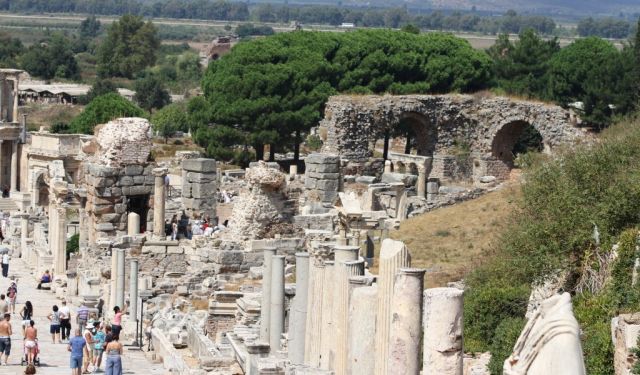
Ephesus Introduction Walking Tour
Ancient Greek poet Antipater of Sidon exclaimed that Babylon and the tomb of Mausolus paled in comparison with the Temple of Artemis. The temple is undoubtedly a highlight, as it is one of the Seven Wonders of the Ancient World. However, Ephesus has much more to offer. The city was one of the great urban centers of the ancient Mediterranean, with a history stretching back to the second millennium... view more
Tour Duration: 2 Hour(s)
Travel Distance: 1.0 Km or 0.6 Miles
Tour Duration: 2 Hour(s)
Travel Distance: 1.0 Km or 0.6 Miles
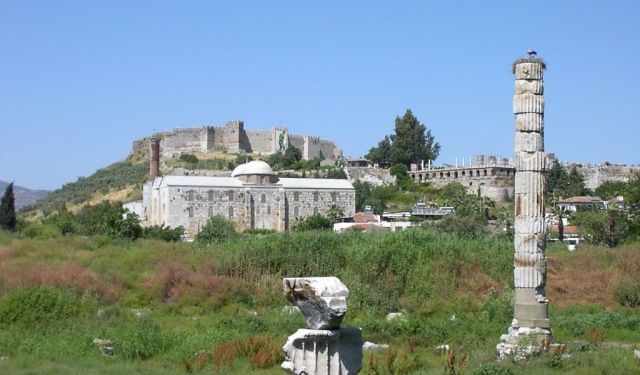
Selcuk Introduction Walking Tour
The name Selçuk comes from the Seljuk Turks, who settled in the area in the 12th century AD after centuries of shifting empires in western Anatolia. But the story of this small town stretches back much further, into the heart of the ancient world. Long before the Seljuks left their mark, the land around it was dominated by Ephesus, one of the great cities of antiquity and a vital hub of the Greek... view more
Tour Duration: 2 Hour(s)
Travel Distance: 3.3 Km or 2.1 Miles
Tour Duration: 2 Hour(s)
Travel Distance: 3.3 Km or 2.1 Miles