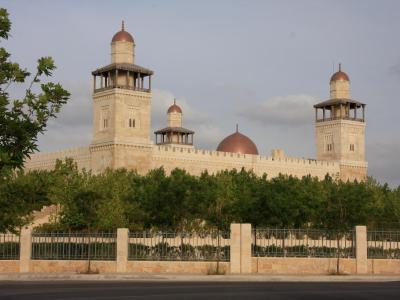


King Hussein Mosque, Amman
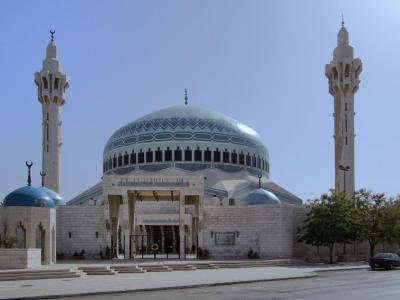
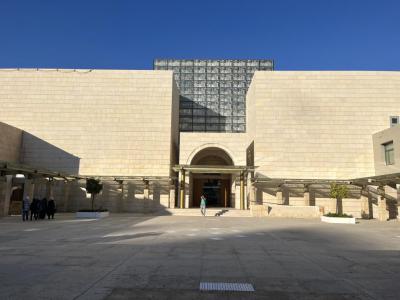
The King Hussein Bin Talal Mosque, commonly known as the King Hussein Mosque, is the largest mosque in Jordan, covering 60,000 square meters. It should not be confused with the older Grand Al-Husseini Mosque, built in 1924 in Downtown Amman. This mosque blends modernity with traditional Islamic design, featuring prominent inscriptions on its walls, arches, and floors that reflect the Hashemite commitment to architecture and art.
Constructed in 2005 under the reign of King Abdullah II, the mosque is situated in West Amman’s Dabouq area. Its elevated position offers views of Amman and the Wadi Al-Seer Mountains, making it a visible landmark from various parts of the city.
The mosque has a square shape with four minarets and marble floors. King Abdullah II initiated its construction in late 2005 to honor the late King Hussein, providing space for about 5,500 worshipers. The mosque's total building area is around 8,000 square meters, with parking facilities for 450 vehicles and additional internal roads, pathways, sidewalks, stairways, and landscaped green spaces.
Spanning three levels-the ground floor, the first floor, and a mezzanine-the mosque features an entrance with grand stone arches reaching up to ten meters high. Its stone facades are adorned with Islamic patterns and inscriptions. The main dome, standing 31 meters tall, is surrounded by arches and smaller domes. The external prayer hall is covered with multiple domes made from reinforced concrete, complemented by appropriate ablution and water facilities.
The mezzanine floor, situated between the inner and outer prayer halls, includes two dedicated prayer rooms for women, each with its own ablution area. The mosque’s mihrab is a notable Islamic artwork crafted from pure walnut and oak wood using a traditional “interlock” technique that avoids adhesives or metal fasteners-a method not used for over 200 years.
Constructed in 2005 under the reign of King Abdullah II, the mosque is situated in West Amman’s Dabouq area. Its elevated position offers views of Amman and the Wadi Al-Seer Mountains, making it a visible landmark from various parts of the city.
The mosque has a square shape with four minarets and marble floors. King Abdullah II initiated its construction in late 2005 to honor the late King Hussein, providing space for about 5,500 worshipers. The mosque's total building area is around 8,000 square meters, with parking facilities for 450 vehicles and additional internal roads, pathways, sidewalks, stairways, and landscaped green spaces.
Spanning three levels-the ground floor, the first floor, and a mezzanine-the mosque features an entrance with grand stone arches reaching up to ten meters high. Its stone facades are adorned with Islamic patterns and inscriptions. The main dome, standing 31 meters tall, is surrounded by arches and smaller domes. The external prayer hall is covered with multiple domes made from reinforced concrete, complemented by appropriate ablution and water facilities.
The mezzanine floor, situated between the inner and outer prayer halls, includes two dedicated prayer rooms for women, each with its own ablution area. The mosque’s mihrab is a notable Islamic artwork crafted from pure walnut and oak wood using a traditional “interlock” technique that avoids adhesives or metal fasteners-a method not used for over 200 years.
Want to visit this sight? Check out these Self-Guided Walking Tours in Amman. Alternatively, you can download the mobile app "GPSmyCity: Walks in 1K+ Cities" from Apple App Store or Google Play Store. The app turns your mobile device to a personal tour guide and it works offline, so no data plan is needed when traveling abroad.
Download The GPSmyCity App



King Hussein Mosque on Map
Sight Name: King Hussein Mosque
Sight Location: Amman, Jordan (See walking tours in Amman)
Sight Type: Religious
Sight Location: Amman, Jordan (See walking tours in Amman)
Sight Type: Religious
Nearby Sights



Walking Tours in Amman, Jordan

Create Your Own Walk in Amman
Creating your own self-guided walk in Amman is easy and fun. Choose the city attractions that you want to see and a walk route map will be created just for you. You can even set your hotel as the start point of the walk.
Amman Introduction Walking Tour
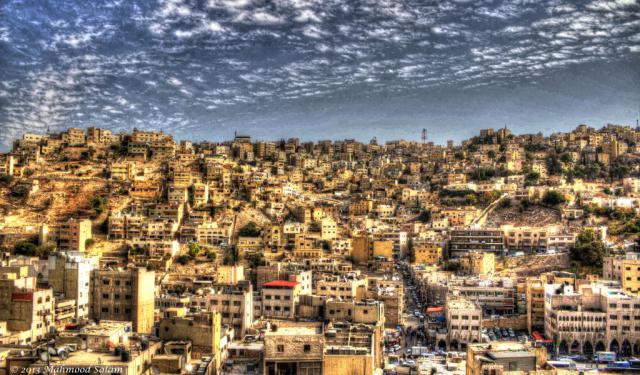
The capital of Jordan, Amman, is a city that successfully marries rich history with the bustling vibrancy of a modern metropolis. A place where ancient tales and contemporary life intersect.
The earliest evidence of human settlement in the area dates back to the 8th millennium BC. Initially, in the second millennium BC, the city was known as Rabat Aman and served as the capital of the Ammonite... view more
Tour Duration: 2 Hours
Travel Distance: 4.3 Km or 2.7 Miles
The earliest evidence of human settlement in the area dates back to the 8th millennium BC. Initially, in the second millennium BC, the city was known as Rabat Aman and served as the capital of the Ammonite... view more
Tour Duration: 2 Hours
Travel Distance: 4.3 Km or 2.7 Miles
Roman Ruins Walking Tour
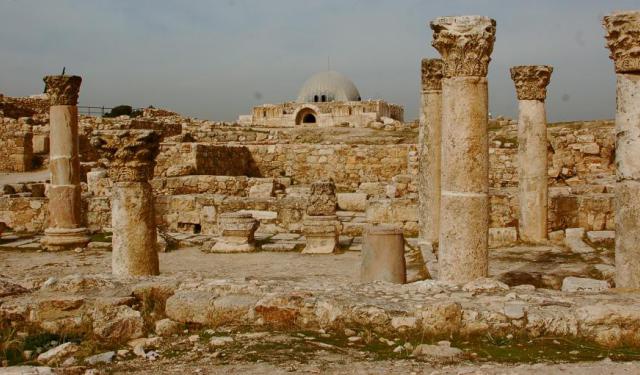
Once dominated by the Romans, the modern-day Jordanian capital, Amman, still boasts that legacy. The area known as the Citadel, sitting on the highest hill in Amman, Jebel Al Qala’a, some 850 meters above sea level, offers plenty to see.
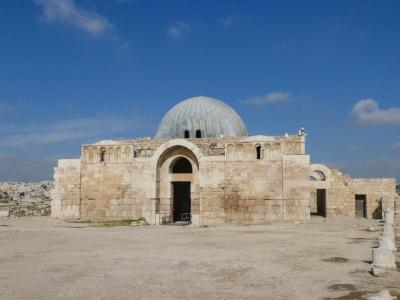
Perched atop the Citadel, the Umayyad Palace is a captivating sight. Dating back to the 8th century, it showcases intricate Islamic architecture and affords... view more
Tour Duration: 2 Hours
Travel Distance: 3 Km or 1.9 Miles
Perched atop the Citadel, the Umayyad Palace is a captivating sight. Dating back to the 8th century, it showcases intricate Islamic architecture and affords... view more
Tour Duration: 2 Hours
Travel Distance: 3 Km or 1.9 Miles
City Walks Overview
