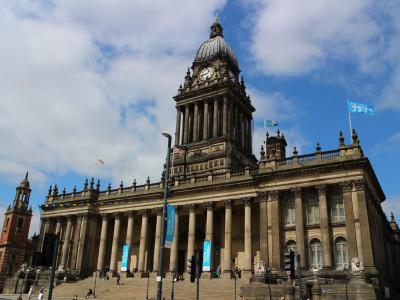


Leeds Town Hall, Leeds
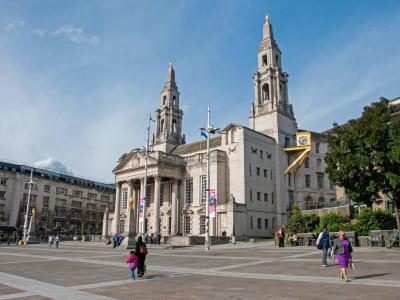
Standing in front of Leeds Town Hall, take a moment to appreciate the scale of this Victorian landmark. Completed in 1858, it was designed by Cuthbert Brodrick, who won a competition to create what local reformer John D. Heaton had envisioned as a grand municipal palace. Queen Victoria and Prince Albert attended its official opening in September that year.
Start with the broad flight of stone steps leading to the main entrance. On either side, you'll see four large stone lions resting on raised platforms. Carved by William Day Keyworth and added in 1867, they symbolize civic strength and dignity.
Now, raise your eyes to the ten enormous Corinthian columns, recognizable by their decorative capitals carved with leaves. Behind them, set deep into the building, is the main entrance with three elaborate wrought-iron doorways. Above, notice the sculptural group representing Progress, Art, and Commerce, reflecting the ambitions of industrial Leeds.
Higher still stands the 225-foot clock tower, crowned by a distinctive dome. Interestingly, the tower wasn't part of Brodrick's original design. It was added to give Leeds a landmark that would rival the grand civic buildings of neighboring towns, particularly Bradford.
Before heading inside, walk along either side of the building. Here, columns and decorative pillars frame two levels of round-arched windows. Classical architectural details continue around the exterior, giving the entire structure a monumental appearance.
Inside, if public access is available, the entrance vestibule introduces yet another side of Victorian grandeur. Notice the patterned Minton floor tiles and the domed ceiling overhead. Here, you'll also find marble statues of Queen Victoria and Prince Albert, standing opposite each other.
Beyond the vestibule lies Victoria Hall, the building's principal ceremonial and concert space. Once inside, direct your attention upwards to the richly decorated ceiling, rising more than 90 feet above the floor. Around the hall are ornate columns, gilded details, and elaborate plasterwork. One writer compared this interior to a wedding cake. At one end, the great pipe organ dominates the space, recalling the hall's long association with musical performances.
Leeds Town Hall was designed to impress, and indeed, its architecture remains a powerful expression of the civic pride and industrial wealth of Victorian Leeds.
Want to visit this sight? Check out these Self-Guided Walking Tours in Leeds. Alternatively, you can download the mobile app "GPSmyCity: Walks in 1K+ Cities" from Apple App Store or Google Play Store. The app turns your mobile device to a personal tour guide and it works offline, so no data plan is needed when traveling abroad.
Download The GPSmyCity App



Leeds Town Hall on Map
Sight Name: Leeds Town Hall
Sight Location: Leeds, England (See walking tours in Leeds)
Sight Type: Attraction/Landmark
Guide(s) Containing This Sight:
Sight Location: Leeds, England (See walking tours in Leeds)
Sight Type: Attraction/Landmark
Guide(s) Containing This Sight:
Nearby Sights
Walking Tours in Leeds, England
Create Your Own Walk in Leeds
Creating your own self-guided walk in Leeds is easy and fun. Choose the city attractions that you want to see and a walk route map will be created just for you. You can even set your hotel as the start point of the walk.
A Walking Guide To Leeds City Center
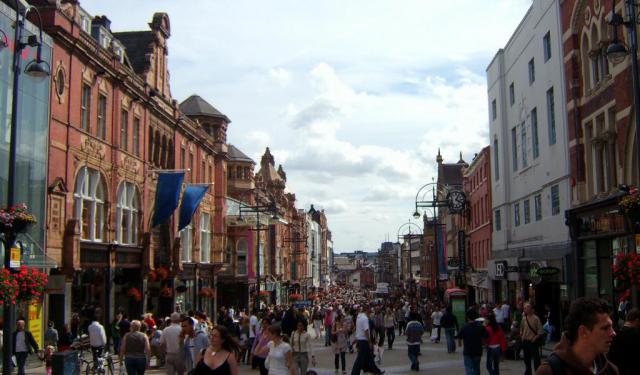
Leeds has come a long way from its beginnings as a small settlement beside the River Aire. Its name is possibly rooted in the ancient Brythonic word "Ladenses," which means "folks of the rapid river." In the 5th century, the area formed part of the kingdom of Elmet, and the 8th-century scholar, the Venerable Bede, referred to it as “Loidis.” Over time, the name evolved into... view more
Tour Duration: 2 Hours
Travel Distance: 2.7 Km or 1.7 Miles
Tour Duration: 2 Hours
Travel Distance: 2.7 Km or 1.7 Miles
Explore Leeds' Historical Shopping Venues on Foot
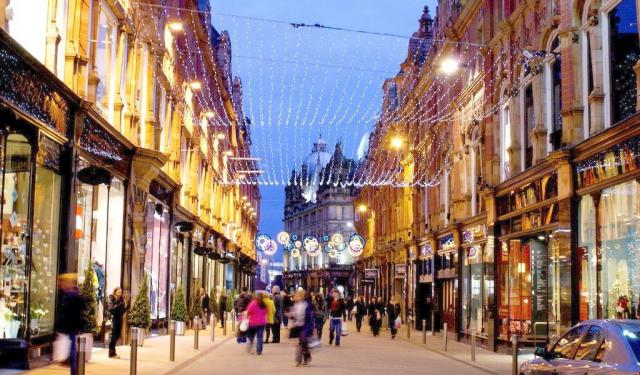
Leeds is a shopaholic’s paradise and a true world of retail scaled down to the size of a downtown area. Compactly located within walking distance from each other, the city's best boutiques are never far away from an eager shopper.
Here, the biggest brands and small independents are housed in some of the city’s most iconic buildings. Among them is the historic Kirkgate Market, the... view more
Tour Duration: 1 Hour
Travel Distance: 1.2 Km or 0.7 Miles
Here, the biggest brands and small independents are housed in some of the city’s most iconic buildings. Among them is the historic Kirkgate Market, the... view more
Tour Duration: 1 Hour
Travel Distance: 1.2 Km or 0.7 Miles
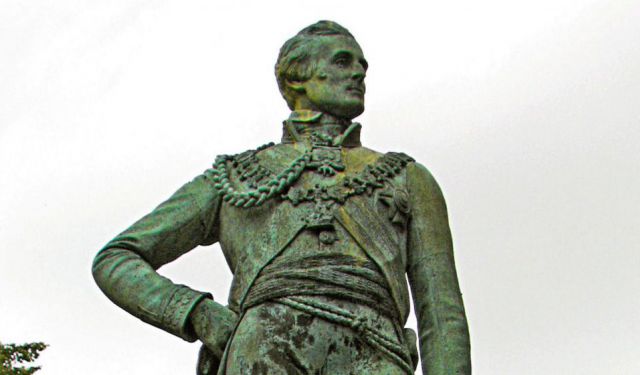
Discover Leeds' Historical Sculptures on Foot
In Leeds, statues adorn various corners, reflecting historical figures and cultural symbols. Some of them are hundreds of years old but still in remarkable condition.
One notable sculpture is that of Robert Peel, commemorating the 19th-century Prime Minister and founder of Britain's modern police force.
On the opposite side of the nearby Woodhouse Moor Park stands the regal Statue of... view more
Tour Duration: 2 Hours
Travel Distance: 3.2 Km or 2 Miles
One notable sculpture is that of Robert Peel, commemorating the 19th-century Prime Minister and founder of Britain's modern police force.
On the opposite side of the nearby Woodhouse Moor Park stands the regal Statue of... view more
Tour Duration: 2 Hours
Travel Distance: 3.2 Km or 2 Miles
City Walks Overview
