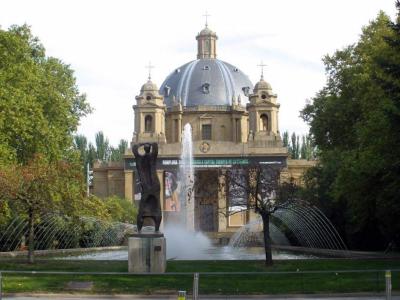


Monumento a los Caidos (Monument to the Fallen), Pamplona
The Monument to the Fallen stands as a solemn reminder of the tragic toll of the Spanish Civil War in Pamplona. This structure serves as a commemorative tribute to the 4,500 Navarrese individuals who lost their lives fighting on the rebel side during the conflict. Designed by architects José Yárnoz and Víctor Eusa, the monument was constructed in 1942, shortly after the conclusion of the Civil War.
The architectural composition of the Monument to the Fallen is characterized by austere classicism, reflecting a return to traditional forms and motifs. The building features a central floor in the shape of a Greek cross, covered by a large dome that serves as its defining element. Lanterns adorn the sides of the dome, while a hexastyle porch with smooth square shafts and a mixtilinear pediment adds to its dignified presence. Despite the exterior's sense of heaviness and proportion, the interior exudes lightness and spaciousness, creating a profound contrast.
In addition to its architectural significance, the Monument to the Fallen houses a crypt where several soldiers were interred between July 17, 1961, and November 2016. Notably, among those buried here are Emilio Mola and José Sanjurjo, prominent figures involved in the coup d'état against the Republic that precipitated the Civil War. The walls of the monument's interior bear the names of the Navarrese individuals who perished in combat on the nationalist side, serving as a poignant reminder of the human cost of war. Despite its somber origins, the monument has undergone a transformation in recent years, now hosting small municipal exhibitions and serving as a venue for cultural events, symbolizing a shift towards remembrance and reconciliation.
The architectural composition of the Monument to the Fallen is characterized by austere classicism, reflecting a return to traditional forms and motifs. The building features a central floor in the shape of a Greek cross, covered by a large dome that serves as its defining element. Lanterns adorn the sides of the dome, while a hexastyle porch with smooth square shafts and a mixtilinear pediment adds to its dignified presence. Despite the exterior's sense of heaviness and proportion, the interior exudes lightness and spaciousness, creating a profound contrast.
In addition to its architectural significance, the Monument to the Fallen houses a crypt where several soldiers were interred between July 17, 1961, and November 2016. Notably, among those buried here are Emilio Mola and José Sanjurjo, prominent figures involved in the coup d'état against the Republic that precipitated the Civil War. The walls of the monument's interior bear the names of the Navarrese individuals who perished in combat on the nationalist side, serving as a poignant reminder of the human cost of war. Despite its somber origins, the monument has undergone a transformation in recent years, now hosting small municipal exhibitions and serving as a venue for cultural events, symbolizing a shift towards remembrance and reconciliation.
Want to visit this sight? Check out these Self-Guided Walking Tours in Pamplona. Alternatively, you can download the mobile app "GPSmyCity: Walks in 1K+ Cities" from Apple App Store or Google Play Store. The app turns your mobile device to a personal tour guide and it works offline, so no data plan is needed when traveling abroad.
Download The GPSmyCity App



Monumento a los Caidos (Monument to the Fallen) on Map
Sight Name: Monumento a los Caidos (Monument to the Fallen)
Sight Location: Pamplona, Spain (See walking tours in Pamplona)
Sight Type: Attraction/Landmark
Sight Location: Pamplona, Spain (See walking tours in Pamplona)
Sight Type: Attraction/Landmark
Nearby Sights
Walking Tours in Pamplona, Spain

Create Your Own Walk in Pamplona
Creating your own self-guided walk in Pamplona is easy and fun. Choose the city attractions that you want to see and a walk route map will be created just for you. You can even set your hotel as the start point of the walk.
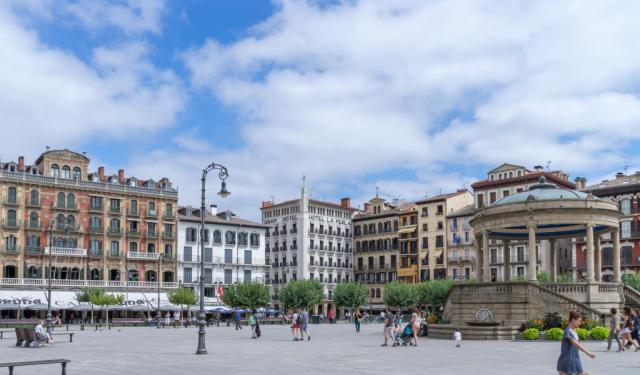
Pamplona Introduction Walking Tour
Pamplona, the capital of the autonomous region of Navarre in northern Spain, is one of the oldest cities in the country. Its history spans millennia. Originally a small Vascones settlement known as Iruña, it was transformed into a Roman city named Pompelo by the Roman commander Gnaeus Pompey in 74 BC. Over the centuries, Pamplona witnessed the rise and fall of various powers, from the Visigoths... view more
Tour Duration: 2 Hours
Travel Distance: 2.8 Km or 1.7 Miles
Tour Duration: 2 Hours
Travel Distance: 2.8 Km or 1.7 Miles
City Walks Overview
