


Monumento al Marinaio di Taranto (Monument to the Sailor of Taranto), Taranto
The Monument to the Sailor of Taranto is one of the monuments of the Borgo Nuovo of the city. Dedicated to the sailors of the Italian Navy, it was created in bronze on the Corso Due Mari by the sculptor Vittorio Di Cobertaldo in 1974, at the request of Admiral Angelo Iachino, commander of the fleet stationed in Taranto during the Second World War, who wanted to donate the opera to the city which was the scene of the famous " Night of Taranto ". The sculpture, which is about seven meters high and rests on a pedestal, depicts two sailors in the act of greeting the boats that are about to cross the navigable canal that connects the Mar Grande with the Mar Piccolo, raising their typical right-handed cap. The work integrates with the ancient railing of Corso Due Mari on which a five-pointed star and the coat of arms of the Savoy Navy are imprinted, and aims to express the link between the city and the sailors of the Navy. The sculptor who created the enlargement from the artist Di Cobertaldo's sketch for the bronze casting was Paolo Bosio, the work was then cast in the Catani Foundry in Rome, before being transported to the port of Taranto.
Created by Vittorio Di Cobertaldo in 1974, the Monument to the Sailor of Taranto is one of the most iconic places in the City of the Two Seas. The metal work, seven meters high (without the pedestal), depicts a couple of sailors, with the typical hat raised in the act of symbolically greeting the arrival or departure of ships transiting the Navigable Canal. The work, commissioned by Admiral Angelo Iachino (one of the most illustrious and controversial Italian military personalities of the Second World War), is aimed at the Mar Grande roadstead, scene of the tragic battle of the "Night of Taranto" (11-12 November 1940 ), during which the Italian Navy suffered very serious losses in ships and men due to a powerful attack by the British Royal Navy, led by Admiral Andrew Cunningham. The powerful and well-organized war operation ended with a clear victory by the British fleet which dealt an important blow to the Italian team and above all to the military reputation of the fascist regime. The torpedoing began at approximately 11pm, when warships, heavy and light cruisers and several destroyers were gathered in the port of Taranto and lasted approximately ninety minutes during which several attacks were launched. Perhaps the hardest blow, especially from a symbolic point of view, was the gash in the left side of the "Cavour" ship which, the following day, was found lying on its side by the citizens, who, having left their shelters, looked out onto the seafront to see what had happened and gather information on the conditions of the soldiers. According to some historiography, the success of the British attack was supported by an act of betrayal on the part of the high ranks of the Royal Navy ready to join the Allied ranks, but at the moment there is no concrete evidence to support this thesis. This sad episode which saw Taranto as protagonist is perhaps not among the best known of the Second World War, yet it marked a historical turning point in the way of waging war at sea, demonstrating the supremacy of aviation. Since then, in fact, aircraft carriers have become decisive in shaping the outcome of a military clash. The monument harmonizes well with the beautiful railing installed at the beginning of the 1900s along the bank of the Navigable Canal. Never replaced over the years, it bears a star and the coat of arms of the Savoy Navy in the center of each segment.
There are two figures that overlook the Mar Grande from the eastern bank of the navigable canal, that of Corso Due Mari and the Vittorio Emanuele II seafront, right in front of the Aragonese castle. They wave their hats and wave their arms in greeting, as the people of Taranto do when a ship leaves the Maritime Military Arsenal leaving the Mar Piccolo, or returns there after a mission. These two figures represent the two bronze characters that make up the monument to the Sailor of Taranto. 7 meters high not counting the pedestal that supports them, they have stood there since 1974 to remember the 58 fallen of the "night of Taranto" battle, which decimated the Italian military fleet between 11 and 12 November 1940: a tragic event, still imprinted in the memory of the city. The monument appears spectacular at sunset, when the horizon is tinged with red and the backlight enhances the stylized and dynamic lines of the work, which was designed by the artist Vittorio di Colbertaldo (1902-1979) on behalf of Admiral Angelo Iachino and made in bronze by Paolo Bosio. ***PH***
Created by Vittorio Di Cobertaldo in 1974, the Monument to the Sailor of Taranto is one of the most iconic places in the City of the Two Seas. The metal work, seven meters high (without the pedestal), depicts a couple of sailors, with the typical hat raised in the act of symbolically greeting the arrival or departure of ships transiting the Navigable Canal. The work, commissioned by Admiral Angelo Iachino (one of the most illustrious and controversial Italian military personalities of the Second World War), is aimed at the Mar Grande roadstead, scene of the tragic battle of the "Night of Taranto" (11-12 November 1940 ), during which the Italian Navy suffered very serious losses in ships and men due to a powerful attack by the British Royal Navy, led by Admiral Andrew Cunningham. The powerful and well-organized war operation ended with a clear victory by the British fleet which dealt an important blow to the Italian team and above all to the military reputation of the fascist regime. The torpedoing began at approximately 11pm, when warships, heavy and light cruisers and several destroyers were gathered in the port of Taranto and lasted approximately ninety minutes during which several attacks were launched. Perhaps the hardest blow, especially from a symbolic point of view, was the gash in the left side of the "Cavour" ship which, the following day, was found lying on its side by the citizens, who, having left their shelters, looked out onto the seafront to see what had happened and gather information on the conditions of the soldiers. According to some historiography, the success of the British attack was supported by an act of betrayal on the part of the high ranks of the Royal Navy ready to join the Allied ranks, but at the moment there is no concrete evidence to support this thesis. This sad episode which saw Taranto as protagonist is perhaps not among the best known of the Second World War, yet it marked a historical turning point in the way of waging war at sea, demonstrating the supremacy of aviation. Since then, in fact, aircraft carriers have become decisive in shaping the outcome of a military clash. The monument harmonizes well with the beautiful railing installed at the beginning of the 1900s along the bank of the Navigable Canal. Never replaced over the years, it bears a star and the coat of arms of the Savoy Navy in the center of each segment.
There are two figures that overlook the Mar Grande from the eastern bank of the navigable canal, that of Corso Due Mari and the Vittorio Emanuele II seafront, right in front of the Aragonese castle. They wave their hats and wave their arms in greeting, as the people of Taranto do when a ship leaves the Maritime Military Arsenal leaving the Mar Piccolo, or returns there after a mission. These two figures represent the two bronze characters that make up the monument to the Sailor of Taranto. 7 meters high not counting the pedestal that supports them, they have stood there since 1974 to remember the 58 fallen of the "night of Taranto" battle, which decimated the Italian military fleet between 11 and 12 November 1940: a tragic event, still imprinted in the memory of the city. The monument appears spectacular at sunset, when the horizon is tinged with red and the backlight enhances the stylized and dynamic lines of the work, which was designed by the artist Vittorio di Colbertaldo (1902-1979) on behalf of Admiral Angelo Iachino and made in bronze by Paolo Bosio. ***PH***
Want to visit this sight? Check out these Self-Guided Walking Tours in Taranto. Alternatively, you can download the mobile app "GPSmyCity: Walks in 1K+ Cities" from Apple App Store or Google Play Store. The app turns your mobile device to a personal tour guide and it works offline, so no data plan is needed when traveling abroad.
Download The GPSmyCity App



Monumento al Marinaio di Taranto (Monument to the Sailor of Taranto) on Map
Sight Name: Monumento al Marinaio di Taranto (Monument to the Sailor of Taranto)
Sight Location: Taranto, Italy (See walking tours in Taranto)
Sight Type: Statue/Public Art
Sight Location: Taranto, Italy (See walking tours in Taranto)
Sight Type: Statue/Public Art
Nearby Sights




Walking Tours in Taranto, Italy

Create Your Own Walk in Taranto
Creating your own self-guided walk in Taranto is easy and fun. Choose the city attractions that you want to see and a walk route map will be created just for you. You can even set your hotel as the start point of the walk.
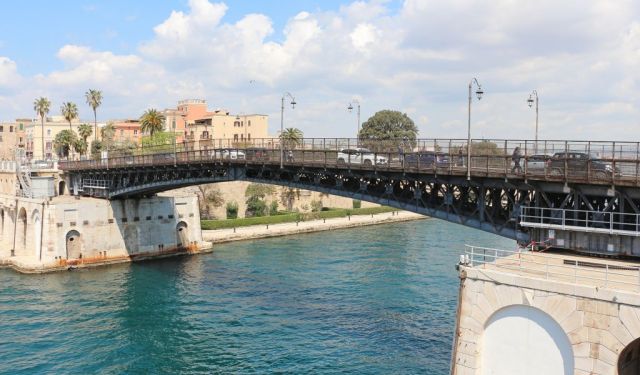
Taranto Introduction Walking Tour
Taranto, the famed “city of the two seas,” sparkles on the Ionian coast of Puglia, framed by the glistening bays of Mar Grande and Mar Piccolo. This isn’t just a pretty port town-it’s a place where history, culture, and postcard-perfect views meet head-on. With its prime Mediterranean location, Taranto has been a hot spot for everyone from ancient Greeks to Roman generals, Byzantine... view more
Tour Duration: 2 Hours
Travel Distance: 2.9 Km or 1.8 Miles
Tour Duration: 2 Hours
Travel Distance: 2.9 Km or 1.8 Miles
City Walks Overview
