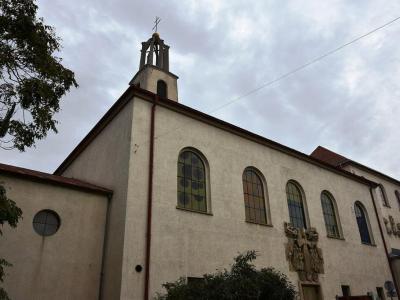


Münzgrabenkirche, Graz
The Münzgraben church (Münzgrabenkirche), also known as the Fatima Church of the Immaculate Heart of Mary or the Graz-Münzgraben parish church, is a significant Catholic building situated in Graz. Named after the revered pilgrimage site of Fátima in Portugal, it was built between 1952 and 1960 under the architectural direction of Georg Lippert, blending historical influences with modern design.
The site of the Münzgraben church has a long religious history, previously housing an Augustinian Barefoot Monastery and Saint Anna Church since the 17th century. Over time, it transitioned between religious orders and served various community purposes, including as a hospital. After Saint Anna's Church was destroyed in a bomb attack in 1944, the construction of the new Fatima Church and adjacent convent began to the south of the original location.
Designed by Lippert, the church features a main nave, a distinct choir, and a side bell tower, with the order's office integrated into the side wings. Noteworthy is Saint Anne's chapel, dedicated to the church lost during World War II. The church's inauguration in 1960 marked the completion of a significant building phase, blending historicist elements with the functional spirit of post-war architecture.
Artistically, the church features notable works such as a statue of Saint Michael by Josef Troyer and interior frescoes depicting the Holy Trinity and significant Dominican saints. Renovation of the glass windows in 1997 by artists Gunter Damisch and Fritz Panzer added a modern touch. Adjacent to the church, the rosarium, and the Fatima Chapel provide spaces for reflection, enriching the spiritual atmosphere of the Münzgraben church.
The site of the Münzgraben church has a long religious history, previously housing an Augustinian Barefoot Monastery and Saint Anna Church since the 17th century. Over time, it transitioned between religious orders and served various community purposes, including as a hospital. After Saint Anna's Church was destroyed in a bomb attack in 1944, the construction of the new Fatima Church and adjacent convent began to the south of the original location.
Designed by Lippert, the church features a main nave, a distinct choir, and a side bell tower, with the order's office integrated into the side wings. Noteworthy is Saint Anne's chapel, dedicated to the church lost during World War II. The church's inauguration in 1960 marked the completion of a significant building phase, blending historicist elements with the functional spirit of post-war architecture.
Artistically, the church features notable works such as a statue of Saint Michael by Josef Troyer and interior frescoes depicting the Holy Trinity and significant Dominican saints. Renovation of the glass windows in 1997 by artists Gunter Damisch and Fritz Panzer added a modern touch. Adjacent to the church, the rosarium, and the Fatima Chapel provide spaces for reflection, enriching the spiritual atmosphere of the Münzgraben church.
Want to visit this sight? Check out these Self-Guided Walking Tours in Graz. Alternatively, you can download the mobile app "GPSmyCity: Walks in 1K+ Cities" from Apple App Store or Google Play Store. The app turns your mobile device to a personal tour guide and it works offline, so no data plan is needed when traveling abroad.
Download The GPSmyCity App



Münzgrabenkirche on Map
Sight Name: Münzgrabenkirche
Sight Location: Graz, Austria (See walking tours in Graz)
Sight Type: Religious
Sight Location: Graz, Austria (See walking tours in Graz)
Sight Type: Religious
Nearby Sights



Walking Tours in Graz, Austria

Create Your Own Walk in Graz
Creating your own self-guided walk in Graz is easy and fun. Choose the city attractions that you want to see and a walk route map will be created just for you. You can even set your hotel as the start point of the walk.
Graz Old Town Walking Tour
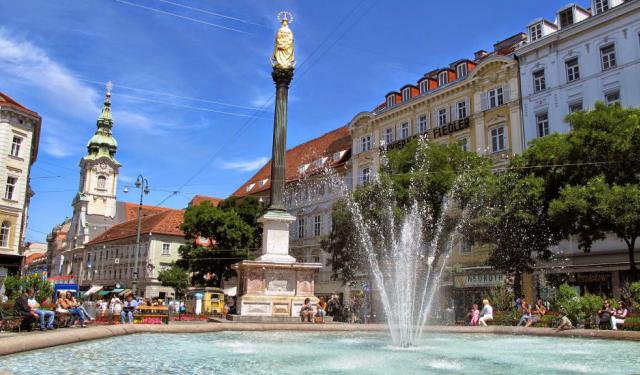
Before humanity understood how planets move, the renowned astronomer Johannes Kepler was studying the skies from Graz between 1594 and 1600. During his time here, he developed ideas that would eventually lead to his revolutionary laws of planetary motion.
Graz, the capital of the Austrian state of Styria, has a history stretching back more than a thousand years. Its name derives from the Slavic... view more
Tour Duration: 2 Hour(s)
Travel Distance: 3.0 Km or 1.9 Miles
Graz, the capital of the Austrian state of Styria, has a history stretching back more than a thousand years. Its name derives from the Slavic... view more
Tour Duration: 2 Hour(s)
Travel Distance: 3.0 Km or 1.9 Miles