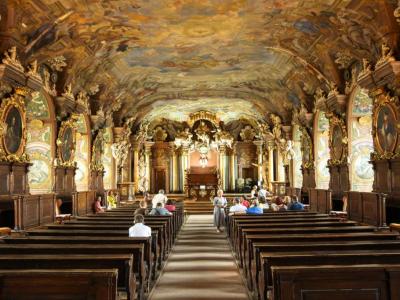


Museum of the University of Wroclaw, Wroclaw
The Museum of the University of Wrocław is located in the main university building, which is a Baroque structure designed by Krzysztof Tausch. This building is known for its significant architectural and artistic value. It is one of the most important Baroque monuments in Poland and Central and Eastern Europe.
The museum has been around since 1992 and showcases the history of the University of Wrocław from 1702 to today. The museum collects and displays items connected to the university’s history, such as furniture, historical equipment, scientific instruments, and archives related to the university and its people. Noteworthy exhibits include the rector's scepters from 1702, items from the faculties of philosophy and theology, and the rector’s attire from the late 19th century. It also houses a remarkable collection of astronomical instruments, including a 14th-century astrolabe, a celestial globe from 1699, an 18th-century equatorial sundial, and Galileo's compass from 1665.
The museum includes several historic rooms. The Aula Leopoldina is the largest and most notable hall in the building. It is a well-preserved secular Baroque interior in Poland, featuring illusionistic wall paintings by Krzysztof Handke and decorations by Franz Mangoldt and Ignatius Provisore. Another room, the Oratorium Marianum, was originally a monastic chapel built between 1728-1741. After the Jesuit Order was secularized and the University was established in 1811, it became a concert Music Hall.
The museum also features the Mathematical Tower, which has a viewing terrace at 42 meters high. This tower was once an Astronomical Observatory, established in 1791 by Professor LA Jungnitz. It contains a meridian line on the floor, the only instrument of its kind in Poland. Additionally, the museum has three exhibition halls: the Roman Longchamps Hall, the Stefan Banach Hall, and the Hall Under the Filar.
The museum has been around since 1992 and showcases the history of the University of Wrocław from 1702 to today. The museum collects and displays items connected to the university’s history, such as furniture, historical equipment, scientific instruments, and archives related to the university and its people. Noteworthy exhibits include the rector's scepters from 1702, items from the faculties of philosophy and theology, and the rector’s attire from the late 19th century. It also houses a remarkable collection of astronomical instruments, including a 14th-century astrolabe, a celestial globe from 1699, an 18th-century equatorial sundial, and Galileo's compass from 1665.
The museum includes several historic rooms. The Aula Leopoldina is the largest and most notable hall in the building. It is a well-preserved secular Baroque interior in Poland, featuring illusionistic wall paintings by Krzysztof Handke and decorations by Franz Mangoldt and Ignatius Provisore. Another room, the Oratorium Marianum, was originally a monastic chapel built between 1728-1741. After the Jesuit Order was secularized and the University was established in 1811, it became a concert Music Hall.
The museum also features the Mathematical Tower, which has a viewing terrace at 42 meters high. This tower was once an Astronomical Observatory, established in 1791 by Professor LA Jungnitz. It contains a meridian line on the floor, the only instrument of its kind in Poland. Additionally, the museum has three exhibition halls: the Roman Longchamps Hall, the Stefan Banach Hall, and the Hall Under the Filar.
Want to visit this sight? Check out these Self-Guided Walking Tours in Wroclaw. Alternatively, you can download the mobile app "GPSmyCity: Walks in 1K+ Cities" from Apple App Store or Google Play Store. The app turns your mobile device to a personal tour guide and it works offline, so no data plan is needed when traveling abroad.
Download The GPSmyCity App



Museum of the University of Wroclaw on Map
Sight Name: Museum of the University of Wroclaw
Sight Location: Wroclaw, Poland (See walking tours in Wroclaw)
Sight Type: Museum/Gallery
Sight Location: Wroclaw, Poland (See walking tours in Wroclaw)
Sight Type: Museum/Gallery
Nearby Sights
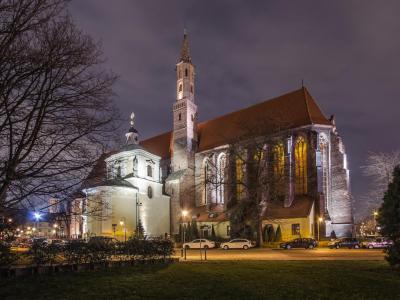
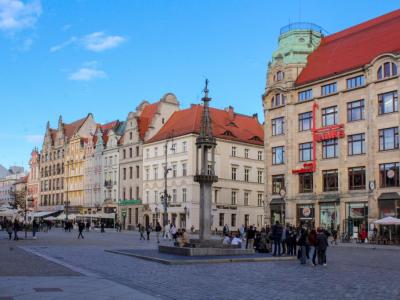
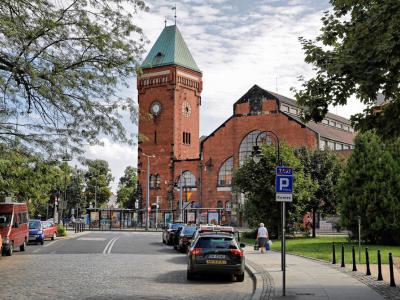
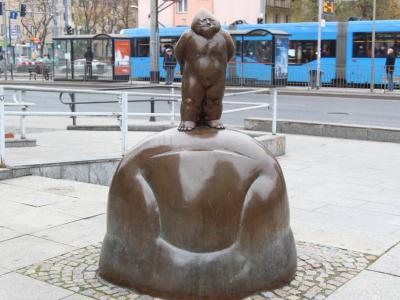
Walking Tours in Wroclaw, Poland

Create Your Own Walk in Wroclaw
Creating your own self-guided walk in Wroclaw is easy and fun. Choose the city attractions that you want to see and a walk route map will be created just for you. You can even set your hotel as the start point of the walk.
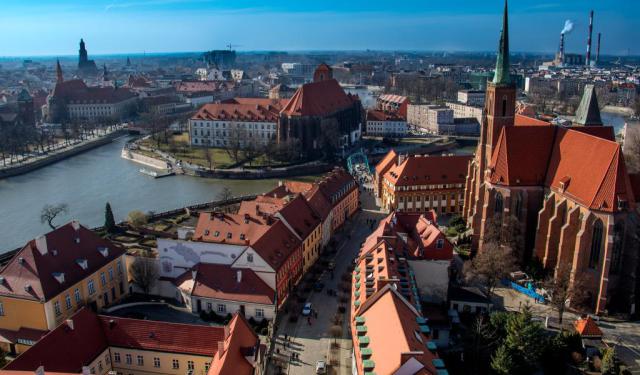
Wroclaw Introduction Walking Tour
Wroclaw, the capital of Poland’s Lower Silesia province, is a travel gem for wandering hearts. Steeped in over 1,000 years of history and a vibrant blend of Polish, German, and other cultural influences, it could easily compete for the title of the most beautiful city in Europe.
The area around Wroclaw was inhabited as early as the 9th century by Slavic tribes. The town was originally part of... view more
Tour Duration: 2 Hour(s)
Travel Distance: 3.7 Km or 2.3 Miles
The area around Wroclaw was inhabited as early as the 9th century by Slavic tribes. The town was originally part of... view more
Tour Duration: 2 Hour(s)
Travel Distance: 3.7 Km or 2.3 Miles
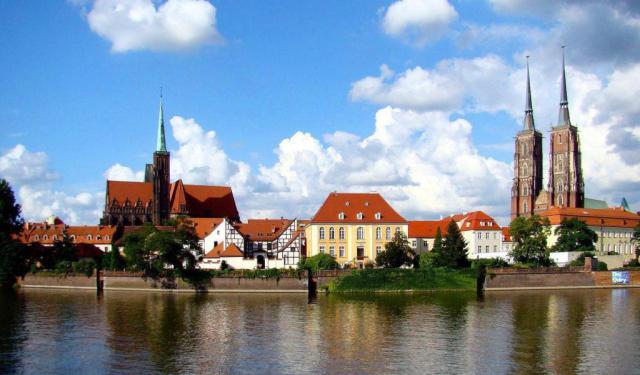
Cathedral Island Walking Tour
Cathedral Island, known as "Ostrów Tumski" in Polish, is a historic and enchanting district in the heart of Wroclaw. This picturesque island, nestled amid the Oder River, is a treasure trove of architectural and cultural wonders that date back centuries.
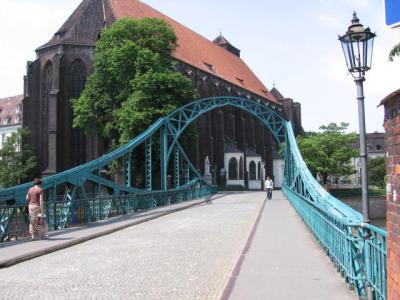
Begin your journey by crossing the iconic Tumski Bridge. It's not just a pathway but a symbol of love, as couples often attach... view more
Tour Duration: 1 Hour(s)
Travel Distance: 0.7 Km or 0.4 Miles
Begin your journey by crossing the iconic Tumski Bridge. It's not just a pathway but a symbol of love, as couples often attach... view more
Tour Duration: 1 Hour(s)
Travel Distance: 0.7 Km or 0.4 Miles